Caminantes
Where the beds are on the Camino de Santiago
By August Frederik Kramer · Last updated 27 September 2026
The worry everybody arrives with is that there will be no bed. Measured, that is not the problem. Along the Camino Francés there are 584 places to sleep within 300 m of the waymarks, 12,824 beds among the ones that publish a count, and on the last hundred kilometres that works out at 2.35 beds for every pilgrim arriving at the busiest rate of the year. The shortage is not of beds. It is of beds in the place you will want one.
How many there actually are
Every place below sits within 300 m of the route’s own GPS track: 584 of them on the Camino Francés, which is 0.8 per kilometre. 68% of them publish a bed count, and those add up to 12,824 beds, or 16.7 per kilometre of walking.
The last hundred kilometres, the stretch everyone is told is impossible in summer, holds 140 of those places and 2,808 beds. In August, the busiest month the office has counted this year, about 2,735 pilgrims a day reached Santiago on all routes together, of whom roughly 1,193 came up the Camino Francés. Against 2,808 beds that is 2.35 each. The arithmetic says there is room.
Thinnest Day 18, Población de Arroyo, 3 placesThickest Day 33, Palas de Rei, 40 places
The thinnest day and the thickest
Day 33 into Palas de Rei has 40 places and 847 beds. Day 18 into Población de Arroyo has 3 places and 158 beds, over 22.4 km. That is the same route, two weeks apart.
This is what the total hides. A route can hold thousands of beds and still hand you an evening where the choice is three doors or another 22.4 km, and no average tells you which evening that is. The chart above does, which is the whole reason it is a chart.
The longest stretch with nothing
The biggest gap between two mapped places on the Camino Francés is 16.8 km, and it falls on day 1.
Day 1 is Saint-Jean-Pied-de-Port to Orreaga / Roncesvalles, which we measured separately as the single biggest climbing day anywhere on the ten routes: 1,351 m of ascent. The hardest day on the network is also the one with the fewest places to stop, and those two facts are almost never printed on the same page.
584 doors, but only 149 places to stop
Spread evenly, 584 places would put a door every 1,316 m. They are not spread evenly. Albergues huddle together, so what a tired walker actually meets is a village with beds, then a stretch without. Count each village or town with beds once and the Francés has 149 places to stop: enough to sleep somewhere different every night for 4 Caminos in a row.
Half the gaps between one stop and the next are 3.9 km or less: 47 min of walking at 5 km an hour. On the last hundred kilometres the doors bunch up to one every 714 m, about 7 football pitches apart.
Where would you sleep tonight?
Every row below is a day of the Francés and every square a kilometre of it. Stop on any square and the colour tells you how far it is to the next door on the map.
- 1Roncesvalles
- 2Zubiri
- 3Pamplona
- 4Puente la Reina
- 5Estella-Lizarra
- 6Los Arcos
- 7Logroño
- 8Nájera
- 9Santo Domingo de la Calzada
- 10Fresneña
- 11Villafranca Montes de Oca
- 12Atapuerca
- 13Burgos
- 14Hornillos del Camino
- 15Villaquirán de la Puebla
- 16Boadilla del Camino
- 17Carrión de los Condes
- 18Población de Arroyo
- 19Sahagún
- 20El Burgo Ranero
- 21Mansilla de las Mulas
- 22León
- 23Villadangos del Páramo
- 24Astorga
- 25Santa Marina de Somoza
- 26Molinaseca
- 27Camponaraya
- 28Trabadelo
- 29La Laguna de Castilla
- 30Triacastela
- 31Sarria
- 32Portomarín
- 33Palas de Rei
- 34Arzúa
- 35O Pedrouzo
- 36Santiago de Compostela
Day 1 → 36 · caminantes.co
Download the “where would you sleep tonight” poster (PNG)Free to pin, print or share. A link back to this page is all we ask.
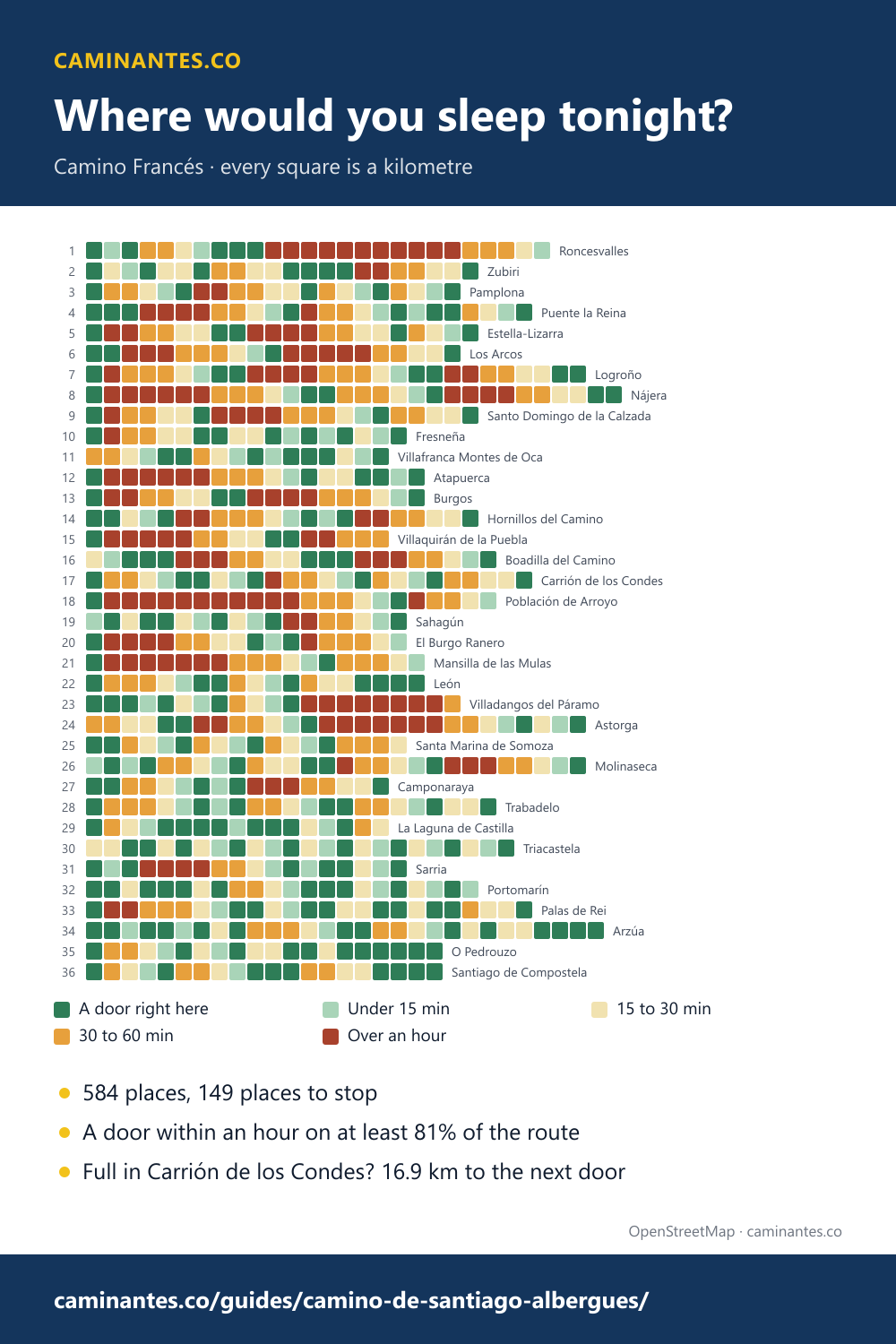
You will hear that on the Francés there is always a bed within an hour. Measured on the map, it is true on at least 81% of the route, and on 59% the next door is under half an hour away.
The other 19% is where the colour goes dark, and it comes in long runs rather than scattered squares: day one over the Pyrenees, and the open stretches of the meseta. Those are the days to decide where you will sleep before you set off. A few small villages are missing from the map, so read a dark square as “plan here”, not “nothing here”.
Know these words before your Camino. Spanish is preparation, the same as boots and stages. Try the free topic
If the albergue is full
Everyone plans a stage to a town. The useful question is what happens if every bed in that town is taken, so here it is for every stage end on our plan: the distance to the next mapped door beyond it.
- Carrión de los Condes Day 1716.9 km · 3 h 23 min
- El Burgo Ranero Day 2012.9 km · 2 h 35 min
- Villafranca Montes de Oca Day 1111.9 km · 2 h 23 min
- Logroño Day 711.8 km · 2 h 22 min
- Hornillos del Camino Day 1410.4 km · 2 h 05 min
- Estella-Lizarra Day 59.6 km · 1 h 55 min
- Sahagún Day 199.3 km · 1 h 52 min
- Portomarín Day 327.7 km · 1 h 32 min
OpenStreetMap · caminantes.co
Carrión de los Condes, the end of day 17, is the worst place to find a full house: 6 places in town, then 16.9 km with nothing, 3 h 23 min more on tired legs. The kindest is Triacastela, where the next door is 1.8 km on, 22 min.
How big is an albergue?
Smaller than most people picture. Of the 395 places on the Francés that publish a bed count, the middle one sleeps 26, and 40% sleep 20 or fewer. The biggest, in Santo Domingo de la Calzada, publishes 213. An albergue is usually a dormitory in a village house, not a hostel block, which is why a town with a dozen of them can still fill up.
- 1 to 10 beds47
- 11 to 20 beds112
- 21 to 40 beds140
- 41 to 80 beds72
- 81 or more beds24
Places that publish a bed count, from OpenStreetMap · caminantes.co
All 10 routes
Across the 10 routes there are 1,657 places mapped and 20,031 beds among those that publish a count. Bed totals are only shown where most places on that route carry one; where they do not, the place count is the honest figure and the bed column is left out rather than understated.
| Route | km | Places | Beds | Places per km | With a bed count |
|---|---|---|---|---|---|
| Camino Francés | 768.6 | 584 | 12,824 | 0.8 | 68% |
| Camino Portugués | 620.2 | 287 | – | 0.5 | 17% |
| Camino Primitivo | 306.6 | 156 | 2,656 | 0.5 | 52% |
| Camino Finisterre | 85.0 | 45 | – | 0.5 | 49% |
| Camino del Norte | 831.6 | 304 | – | 0.4 | 15% |
| Camino Inglés | 110.5 | 33 | – | 0.3 | 21% |
| Camino Mozárabe | 419.0 | 68 | – | 0.2 | 0% |
| Camino Lebaniego | 66.5 | 15 | – | 0.2 | 13% |
| Vía de la Plata | 994.6 | 131 | – | 0.1 | 7% |
| Camino Invierno | 263.1 | 34 | – | 0.1 | 26% |
A dash means too few places publish a count for a total to mean anything.
What this is, and what it is not
This is OpenStreetMap, read on September 27, 2026 and snapped to each route’s track. It is not a bed inventory and it is not a booking service. The data is volunteered, so coverage follows how busy a route is: 68% of places on the Camino Francés publish a bed count against far fewer on the quietest routes, and the table says which is which rather than averaging them together.
Hotels are left out on purpose. They are mapped unevenly along the routes, well in the towns and barely in the villages, so adding them would inflate exactly the places that already have plenty and change nothing where it matters. What is counted is albergues, guest houses and mountain refuges: the places a pilgrim actually walks into without a reservation.
OpenStreetMap contributors, ODbL
Common questions
Are there enough albergues on the Camino de Santiago?
On the Camino Francés, yes, by the arithmetic: 584 places and 12,824 mapped beds, and on the last hundred kilometres 2.35 beds for every pilgrim arriving at August’s rate. The difficulty is distribution rather than supply. One stage has 3 places on it and another has 40.
Which stage has the fewest places to sleep?
Day 18, into Población de Arroyo: 3 places and 158 beds across 22.4 km. The most is day 33 into Palas de Rei, with 40 places and 847 beds.
What is the longest stretch without an albergue?
16.8 km, on day 1, between Saint-Jean-Pied-de-Port and Orreaga / Roncesvalles. That is also the biggest climbing day on any of the ten routes at 1,351 m of ascent, so it is the stretch where having nowhere to stop costs the most.
Do I need to book an albergue in advance?
This page cannot tell you that, and anybody who answers it from a total is guessing. What it can tell you is which evenings have three options and which have forty, which is the part you can actually plan around. Municipal albergues traditionally do not take bookings at all.
Where do these numbers come from?
OpenStreetMap, read on September 27, 2026, filtered to lodging within 300 m of each route’s GPS track and snapped to our own stage plan. It is volunteered data: complete enough to compare stages against each other, not complete enough to be called an inventory, and the table shows the coverage for every route so you can see which is which.
How far apart are the albergues on the Camino Francés?
The 584 mapped places sit in 149 villages and towns with beds. Half the gaps between one stop and the next are 3.9 km or less, about 47 min of walking, and the next mapped door is within an hour on at least 81% of the route. The longest walk on from a stage town is 16.9 km, from Carrión de los Condes.
Keep reading
Which Camino is hardest? The ten ranked by climb per km
The steepest route is also the shortest, and the longest is only eighth steepest. All ten measured on both axes, from their own GPS tracks.
What does Buen Camino mean, and how do you reply?
Word for word it is "good path". What it actually does, how to answer it, who says it, and the fifteen other words you will hear every day.
The Variante Espiritual: 74.8 km on foot, or 41.7 km and a boat
The direct line from Pontevedra to Pontecesures is 34.7 km; walking the whole variant is 74.8 km, more than double. Take the Traslatio and it is 7.0 km more than not going at all.
Take it with you
Caminantes is free, works offline, and plans your stages around your own legs rather than a guidebook's.