Caminantes
Camino training plan: a week-by-week plan for your route
By August Frederik Kramer · Last updated 7 September 2026
Your training plan
Which Camino?
When do you leave?
How far can you walk today?
The plan has three walks a week.
How this plan works
The long walk grows by 1.5 km a week, every fourth week is lighter, and the last week is easy so you arrive rested. It builds towards a typical day on your route. See a doctor first if you have a heart, lung or joint condition, are pregnant, or have not been active for a long time.
Every Camino training plan on the internet says roughly the same thing. Walk a few times a week. Add a kilometre. Load the pack. Break the boots in. Taper before you fly. It is reasonable advice and it is missing the only part that varies: what you are training for.
A Camino is not one walk. The hardest single day on the Camino Francés climbs 1,351 m. The hardest day on the Vía de la Plata climbs 538 m. Preparing for those with the same twelve-week schedule makes no sense, and no page that sells the schedule tells you which one you are about to walk.
So here is the other half. Below is the hardest day on each of the ten routes, measured off the tracks, and the thing that matters at least as much: which day of the walk it is.
The hardest day on every route
Ordered by the most climbing in a single day. "Day one" is the first stage out of the starting town, and the opening week is the first seven stages, or the whole route where it is shorter than that.
| Route | Hardest day | Which day | Distance and climb | Longest day | Opening week |
|---|---|---|---|---|---|
| Camino Francés | Saint-Jean-Pied-de-Port to Orreaga / Roncesvalles | 1 of 36 | 25.9 km, 1,351 m | 29.3 km | 161.1 km, 3,217 m |
| Camino Lebaniego | Puente El Arrudo to Lebeña | 2 of 3 | 23.3 km, 963 m | 26.7 km | 66.4 km, 2,133 m |
| Camino del Norte | Gernika-Lumo to Bilbao | 6 of 39 | 31.9 km, 836 m | 31.9 km | 165.5 km, 4,320 m |
| Camino Invierno | As Lamas to Chantada | 8 of 13 | 26.6 km, 704 m | 26.6 km | 131.6 km, 2,368 m |
| Camino Primitivo | Borres to Montefurado | 5 of 15 | 16.6 km, 698 m | 31.8 km | 129.9 km, 3,523 m |
| Camino Mozárabe | Pinos Puente to La Alhondiguilla | 2 of 19 | 23.7 km, 685 m | 34.9 km | 147.9 km, 1,924 m |
| Camino Inglés | Fene to Betanzos | 2 of 6 | 29.2 km, 623 m | 29.2 km | 110.5 km, 1,800 m |
| Vía de la Plata | Puebla de Sanabria to Lubián | 35 of 47 | 29.6 km, 538 m | 31.4 km | 145.6 km, 1,754 m |
| Camino Finisterre | Santiago de Compostela to Negreira | 1 of 5 | 21.1 km, 429 m | 21.1 km | 85.1 km, 1,432 m |
| Camino Portugués | Infesta to Santiago de Compostela | 31 of 31 | 28.3 km, 417 m | 29.9 km | 135.3 km, 374 m |
Two columns in that table are worth reading against each other. The hardest day and the longest day are almost never the same day. A plan that builds distance and ignores climb prepares you for one column.
When the hardest day comes, drawn
Each row is one route, one bar per walking day, each bar as tall as that day’s climb. The gold bar is the hardest day. On 2 of the 10 routes it is the very first bar: the hardest day arrives before the walk has trained you for anything.
Download this chart as a poster (PNG)Free to share in your group or on your blog. A link back to this page is all we ask.
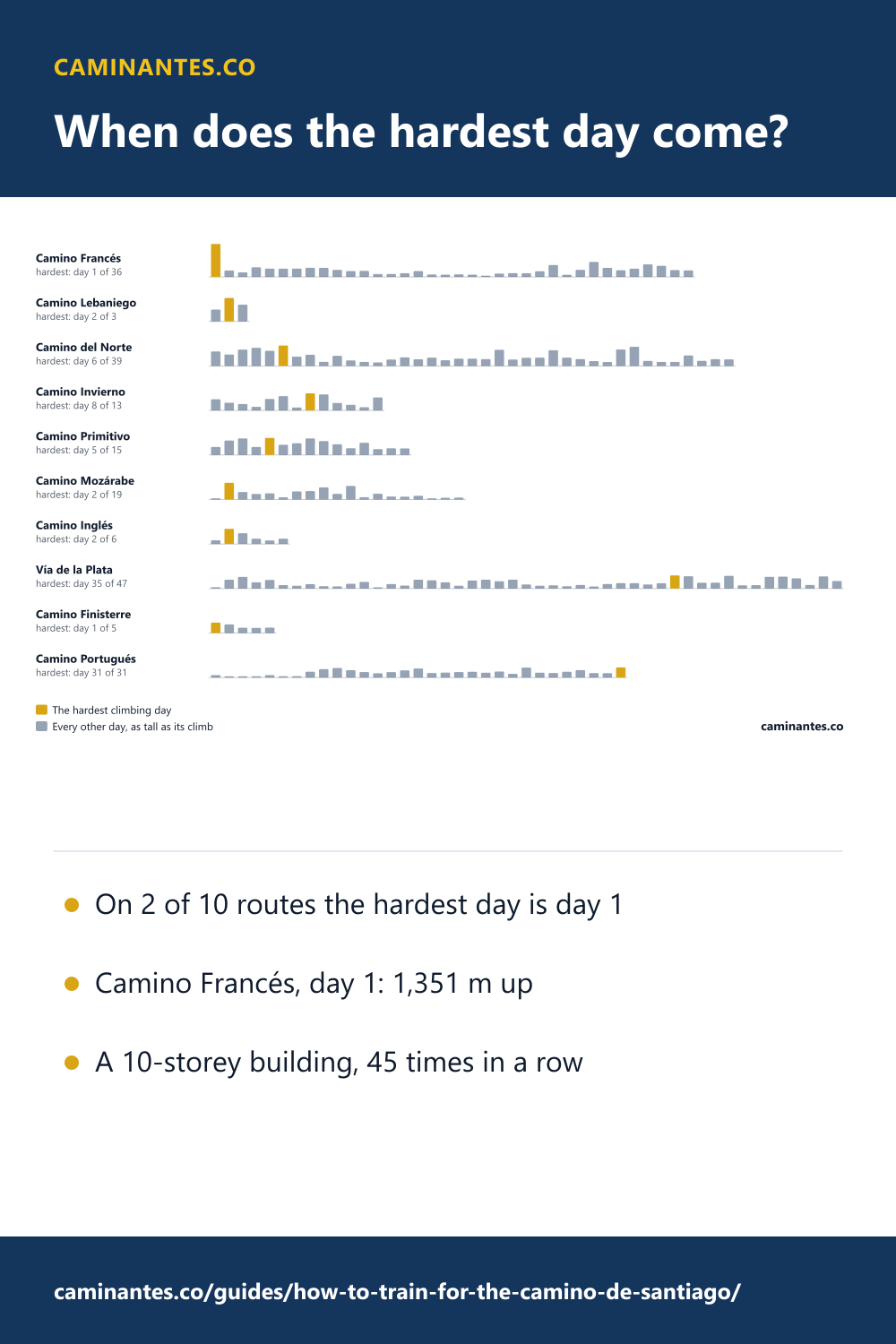
Put the Camino Francés’s first day in terms you can practise: 1,351 m of climbing is a 10-storey building, walked up 45 times in a row.
Know these words before your Camino. Spanish is preparation, the same as boots and stages. Try the free topic
The hardest day comes first on 2 routes
This is the finding that should change a training plan, and it is the one nobody publishes.
On the Camino Francés, the hardest of all 36 days is day 1: Saint-Jean-Pied-de-Port to Orreaga / Roncesvalles, 25.9 km climbing 1,351 m over the Pyrenees. The second-hardest day on the entire route climbs 616 m. The opening day is not merely the hardest, it is more than twice the next one, and it arrives before a single kilometre of the walk has done anything for your legs.
Every gradual training plan is built on the assumption that you get fitter as you go and the route gets harder as you go. On the most walked Camino in the world those two curves run in opposite directions. The route front-loads its worst day and you meet it on the morning of day one, jet-lagged, with a pack you have not carried for more than a weekend.
The same is true of Camino Finisterre, where day one is also the hardest climbing day of the walk.
There is a well-known way to take the sting out of the Francés version, which is to split that first day and sleep partway up. What it costs and what it buys is measured in our guide to Saint-Jean-Pied-de-Port to Roncesvalles.
The routes that give you their worst week first
A single hard day is survivable. What actually ends walks is consecutive hard days, because the second one starts on legs that have not recovered from the first. So the more useful measure is the heaviest three days in a row, and where they fall.
On 3 of the 7 routes that run longer than a week, and so could put it anywhere, that block lands in the first seven days:
- Camino Francés, days 1 to 3: Saint-Jean-Pied-de-Port to Pamplona / Iruña, 67.4 km and 1,801 m of climbing.
- Camino del Norte, days 4 to 6: Deba to Bilbao, 80.1 km and 2,202 m of climbing.
- Camino Primitivo, days 7 to 9: El Vilar de Buspol to O Cádavo, 61.9 km and 1,728 m of climbing.
The Camino Primitivo and the Camino del Norte are the two worth singling out, because both are commonly recommended to people who have already walked the Francés and want something quieter. The Camino Primitivo climbs 3,523 m in its opening week and the Camino del Norte climbs 4,320 m, against 3,217 m for the Francés. Quieter does not mean gentler.
The routes you can partly train on
The counterweight, and the honest answer for anyone who cannot put in months of preparation. Some routes open softly enough that the first few days do real conditioning work for you.
- Camino Mozárabe opens with 19.1 km and 34 m of climbing, ranked 18 of 19 on that route for climbing.
- Camino Inglés opens with 17.7 km and 153 m of climbing, ranked 5 of 6 on that route for climbing.
- Vía de la Plata opens with 17.7 km and 53 m of climbing, ranked 46 of 47 on that route for climbing.
- Camino Portugués opens with 23.9 km and 101 m of climbing, ranked 25 of 31 on that route for climbing.
The Vía de la Plata is the clearest case. Its first day is 17.7 km with 53 m of climbing, near the bottom of its own 47 stages, and the route's hardest climbing does not arrive until day 35. That is more than a month of walking in which to become the person who can do it. It is also the longest route on the list, so the trade is real rather than free.
What the numbers actually tell you to do
Three things fall out of the table, and none of them is a schedule.
Train for a shape, not a distance. Your route's hardest day has two numbers, and the climb is the one people leave out. A flat 25 km prepares you for the distance column and not the other one.
Find out when your hard day arrives. If it comes in week three, the walk itself will have done some of the work by then. If it comes on the morning of day one, nothing will have.
Look at consecutive days, not the worst one. The block of three is a better description of what a Camino asks of you than any single stage, because a Camino is the only walk most people ever do where they cannot take tomorrow off.
A 12-week Camino training plan, as an example
Twelve weeks for the Camino Francés, starting from walks of 5 to 10 km, three days a week. The planner above makes the same kind of plan for your route, your date and where you start from.
- Week 1 · Long walk 8 km · + 2 short walksAbout 2 h of walking. Hill walk with 200 m of climbing.
- Week 2 · Long walk 9.5 km · + 2 short walksAbout 2 h 25 min of walking. Hill walk with 300 m of climbing.
- Week 3 · Long walk 11 km · + 2 short walksAbout 2 h 45 min of walking. Hill walk with 400 m of climbing.
- Week 4 · Long walk 8.5 km · + 2 short walkslighterpack onAbout 2 h 10 min of walking. Hill walk with 320 m of climbing.
- Week 5 · Long walk 12.5 km · + 2 short walksAbout 3 h 10 min of walking. Hill walk with 500 m of climbing.
- Week 6 · Long walk 14 km · + 2 short walksAbout 3 h 30 min of walking. Hill walk with 600 m of climbing.
- Week 7 · Long walk 15.5 km · + 2 short walksAbout 3 h 55 min of walking. Hill walk with 700 m of climbing.
- Week 8 · Long walk 12 km · + 2 short walkslighterAbout 3 h of walking. Hill walk with 560 m of climbing.
- Week 9 · Long walk 17 km · + 2 short walksAbout 4 h 15 min of walking. Hill walk with 800 m of climbing.
- Week 10 · Long walk 18.5 km · + 2 short walksAbout 4 h 40 min of walking. Hill walk with 900 m of climbing. Next day 14.5 km.
- Week 11 · Long walk 20 km · + 2 short walksAbout 5 h of walking. Hill walk with 1,000 m of climbing. Next day 16 km.
- Week 12 · Long walk 12 km · + 2 short walksrest upAbout 3 h of walking.
What the plan is, and what it is not
It follows three rules that are common to walking plans: add no more than about 1.5 km to your long walk from one week to the next; make every fourth week a lighter one, so your legs catch up; and walk much less in the last week, so you arrive rested. The goal it builds towards is not a guess: it is your route’s typical day and its hardest climb, measured off the track.
It is a progression, not a prescription. It cannot know your body, your knees or how much time you really have, and it does not try to. If a week feels too much, repeat it.
See a doctor before you start if you have a heart, lung or joint condition, are pregnant, or have not been active for a long time.
How these figures were measured
Distances and stage boundaries come from the same stage data the route pages use. Climb is accumulated from elevation sampled along the track, banking a run of ascent only once it clears a noise floor, so that small wobbles in the elevation data do not add up into imaginary climbing.
Ascent figures are method-dependent, and anyone who tells you otherwise is selling a guidebook. Sampling interval and smoothing both move them. What makes the table above worth reading is that all ten routes were measured the same way, so the differences between them are real even where you could argue with any individual number.
Common questions
How should I train for the Camino de Santiago?
Start from the route rather than from a generic schedule. The hardest single day on the Camino Francés is 25.9 km with 1,351 m of climbing; on the Camino Primitivo it is 16.6 km with 698 m. Those are different walks and they need different preparation. Whatever plan you follow, the thing worth building towards is a day that looks like your route's hardest one in both distance and climb, not just distance.
What is the hardest day on the Camino Francés?
Day 1 of 36: Saint-Jean-Pied-de-Port to Orreaga / Roncesvalles, 25.9 km climbing 1,351 m over the Pyrenees. It is the first day of the walk. The second-hardest day on the whole route climbs 616 m, so the opening day is in a category of its own.
Can you walk the Camino without training?
People do it every year and most of them finish. Whether it is a good idea depends almost entirely on which route you pick and where you start, because the routes are not equally forgiving at the beginning. Camino Mozárabe opens with 19.1 km and 34 m of climbing, which is a day you can absorb untrained. The Camino Francés opens with 1,351 m, which is not.
How many kilometres a day will I actually walk?
On our stage plans the typical day is around 20 km, but the average is the least useful number in planning: what hurts is the long days and the steep ones. The Camino del Norte has 10 stages of 25 km or more. Our guide to how many kilometres a day gives the per-route averages properly.
Which route is easiest to start on if I am not fit?
The routes that open gently are Camino Mozárabe, Camino Inglés, Vía de la Plata, Camino Portugués. Each begins with a day in the easier half of its own stages and under 300 m of climbing, so the first few days can do some of the conditioning for you. That is a genuinely different proposition from starting over a mountain pass.
Is training for climbing different from training for distance?
On these routes they come apart, which is the practical reason this page exists. The day with the most kilometres and the day with the most climbing are usually not the same day, and on several routes they are nowhere near each other. A plan built only on distance leaves you ready for one of them.
How accurate are these figures?
They are measured along our own tracks and sampled against elevation data the same way the rest of the site is, rather than copied from a guidebook. Ascent in particular is method-dependent: sampling interval and smoothing both move it, so treat these as figures measured one consistent way, which makes the comparisons between routes meaningful even where a single number is arguable.
Keep reading
The Camino has ten starting points, and two of them are not in Spain
Three of the routes never reach Santiago, and one starts at the cathedral and walks away from it. Every start measured, with what the first day out of that town will cost you.
How long is the Camino? Ten routes, one honest answer each
Every route measured in kilometres and miles, plus how far is left from Roncesvalles, Burgos, León, Astorga and Sarria. And why the figures elsewhere disagree, which comes down to three things, and none of them is carelessness.
Which Camino should you walk? Three numbers decide it, and one is never published
All ten routes side by side on days, climb per kilometre, and the longest single stage. That last one usually settles the choice, and almost nobody prints it.
Take it with you
Caminantes is free, works offline, and plans your stages around your own legs rather than a guidebook's.