Caminantes
Which Camino de Santiago route should you walk? All ten compared
By August Frederik Kramer · Last updated 2 September 2026
Almost everyone answers this question with an adjective. The Francés is "easy", the Primitivo is "hard", the Norte is "beautiful". Here are three numbers instead, for all ten routes: how many days it takes, how steep it is per kilometre, and how long the hardest single day is. That last number usually decides more than the other two.
All ten routes, shortest first
Sorted by days, because that is the filter almost everyone applies first. The m per km column is steepness independent of length: a long route collects a lot of climb without being steep. Longest day is the hardest single stage in our split.
| Route | Days | Length | Climb | m per km | Longest day |
|---|---|---|---|---|---|
| Camino Lebaniego | 3 | 66.5 km | 2,134 m | 32.1 | 26.7 km |
| Camino Finisterre | 5 | 85.0 km | 1,431 m | 16.8 | 21.1 km |
| Camino Inglés | 6 | 110.5 km | 1,802 m | 16.3 | 29.2 km |
| Camino de Invierno | 13 | 263.1 km | 4,941 m | 18.8 | 26.6 km |
| Camino Primitivo | 15 | 306.6 km | 6,777 m | 22.1 | 31.8 km |
| Camino Mozárabe | 19 | 419.0 km | 4,452 m | 10.6 | 34.9 km |
| Camino Portugués | 31 | 620.2 km | 6,519 m | 10.5 | 29.9 km |
| Camino Francés | 36 | 768.6 km | 10,446 m | 13.6 | 29.3 km |
| Camino del Norte | 39 | 831.6 km | 14,663 m | 17.6 | 31.9 km |
| Vía de la Plata | 47 | 994.6 km | 11,724 m | 11.8 | 31.4 km |
Read it like a signpost
Find your question, follow the arrow. Each arm is one measured fact from the table above, and the reasoning for every one of them is further down the page.
Download the signpost as a poster (PNG)Free to share in your group or on your blog. A link back to this page is all we ask.
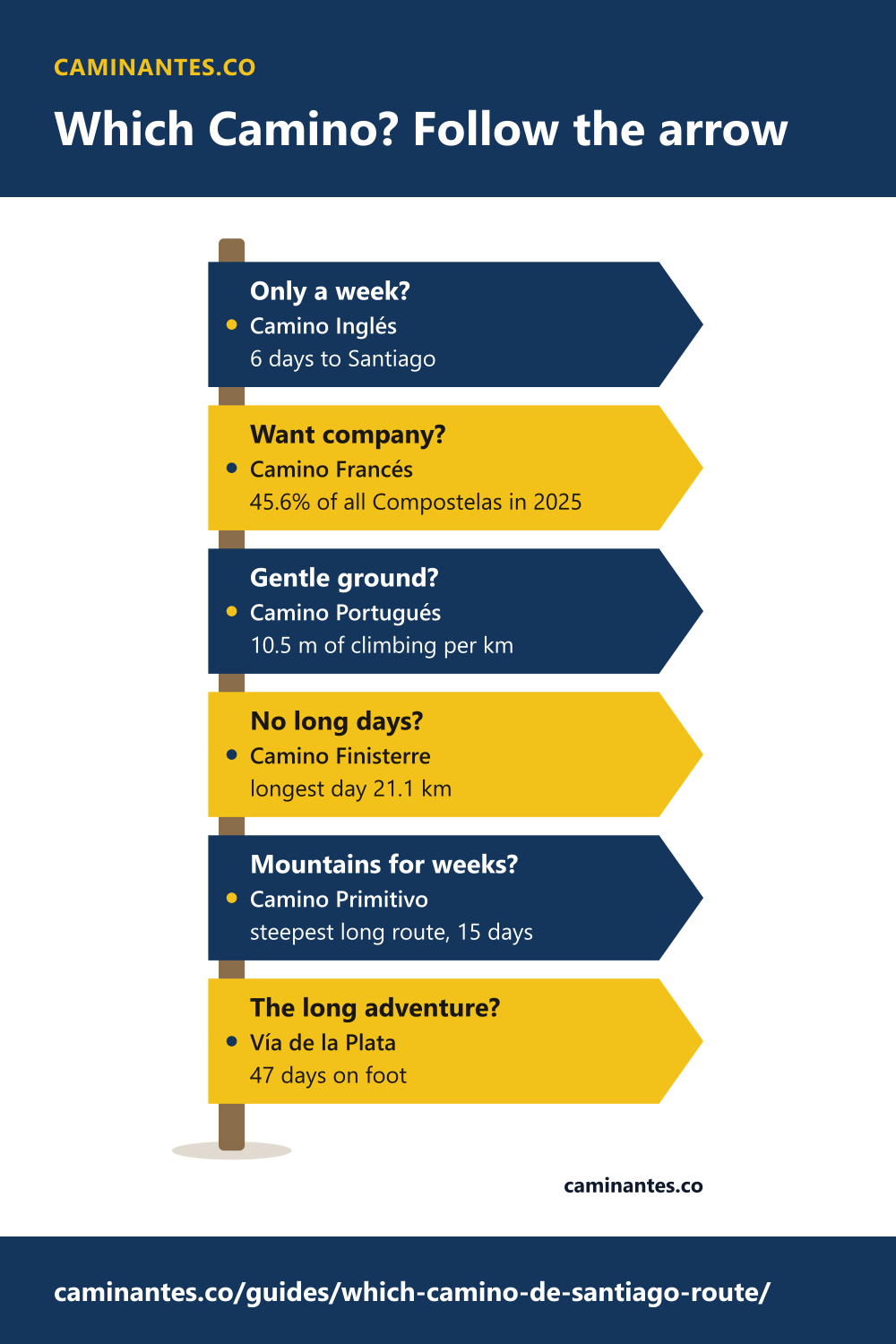
To feel the difference: on the Camino Portugués every kilometre climbs about 3.5 storeys of stairs. On the Camino Primitivo it is about 7.4, every kilometre, for 15 days.
To see all ten side by side on the ground, and where they meet before Santiago, open the Camino de Santiago map.
How much time do you have?
In practice the calendar picks the route, not the other way round. Under a week there are 3: Camino Lebaniego (3 days), Camino Finisterre (5 days), Camino Inglés (6 days). At the other end is the Vía de la Plata, 47 days over 994.6 km.
Note what "days" means here: it is the number of stages in our split, so days of walking, with no travel days at either end. A guidebook that cuts the same route into fewer stages is asking you to walk further each day.
Know these words before your Camino. Spanish is preparation, the same as boots and stages. Try the free topic
Which is the easiest?
Per kilometre it is the Camino Portugués, at 10.5 metres of ascent per kilometre. But "easy" and "flat" are not the same thing. For most people the easiest Camino is the one they actually finish, and then two other things weigh more: how many days it takes, and how long the worst day is.
On that second point the Camino Finisterre comes out best: its longest stage is 21.1 km, shorter than on any other route. If you do not want thirty-kilometre days, that is the number to choose on.
Which is the hardest?
Three answers, all three defensible, and they point at three different routes.
Steepest per kilometre: the Camino Lebaniego, 32.1 m/km. At 66.5 km it is the shortest in the table, and that is exactly why it tops it: on every single kilometre you climb more than on any other route.
Most climb in total: the Camino del Norte, 14,663 metres. That is the number that impresses, and it comes largely from the route being 831.6 km long.
Hardest to sustain: the Camino Primitivo, 22.1 m/km across 15 days. This is the steepest of the routes that run ten days or longer, and it is the answer that matters on the ground: one hard day is fine, three weeks of hard days is a different question.
For a first Camino
The figures above measure the walking. They do not measure the waymarking, the number of albergues or how many people you meet, and on a first walk those three decide a great deal of how hard it feels. So rather than one recommendation, here is what each route is most suited to.
| Route | Days | Best suited to |
|---|---|---|
| Camino Lebaniego | 3 | A long weekend, or a detour from the Norte with real history at the end. |
| Camino Finisterre | 5 | Anyone not ready to stop walking when they reach Santiago. |
| Camino Inglés | 6 | A first Camino in a week, or a Compostela on limited leave. |
| Camino de Invierno | 13 | Winter walkers, and Francés veterans wanting a different Galicia. |
| Camino Primitivo | 15 | Fit walkers, hill lovers, and second-time pilgrims. |
| Camino Mozárabe | 19 | Experienced, self-sufficient walkers who want Andalusia. |
| Camino Portugués | 31 | Walkers who want a gentler profile, and anyone with only two weeks. |
| Camino Francés | 36 | First-time pilgrims, and anyone who wants company and easy logistics. |
| Camino del Norte | 39 | Experienced walkers who want the coast, the food, and fewer people. |
| Vía de la Plata | 47 | Solitude, Roman history, and pilgrims with six weeks. |
Walking it later in life
This is the question that comes back most often on the forums, and it is almost always asked as a question about age when it is not one. What counts is not your age but the hardest day, and that is a number you can look up before you go.
So do not read the average, read the longest day column. A route with a low average and one thirty-five-kilometre stage is harder than a route with a higher average that never passes twenty. The Camino Finisterre has the shortest hardest day of all ten, at 21.1 km.
And you are free to walk a route in more days than we split it into. Every stage table on this site is a proposal, not a prescription: walking the Camino Francés in more than 36 days is still walking all of it.
What these numbers do not answer
Which Camino is the most beautiful. It is the third thing everyone asks and there is no measurement for it, so there is no ranking here. Anyone who puts a number on it invented the number. What we can do is say what kind of landscape each route crosses, and that is on the route page.
How these numbers were measured
Distance and climb come from the same measurement as the rest of this site: the GPS tracks of the routes, sampled every hundred metres against an elevation model. All ten routes were treated identically, and that is the point. The absolute figure stays an estimate, but the comparison between routes holds, and that comparison is exactly what disappears when you line up figures from ten different sources.
More on that measurement, and on why elevation figures on the internet contradict each other, is in Camino elevation gain. The full profile of each route, where you can read the climb between any two points, is under Elevation profile.
Common questions
Which Camino route is the easiest?
Per kilometre the Camino Portugués, at 10.5 metres of ascent per kilometre. For a first Camino that is not the whole answer though: the Camino Inglés is 6 days over 110.5 km, and being shorter it is the one most people actually finish. Climb is only one of the three numbers that matter; time and the longest stage matter just as much.
Which Camino route is best for beginners?
It depends how much time you have. Under a week: the Camino Lebaniego (3 days), the Camino Finisterre (5 days), the Camino Inglés (6 days). With five weeks the Camino Francés is the usual first choice, not because it is flat (13.6 m/km) but because the waymarking and the albergues along it take most of the work off you.
Which Camino route is the hardest?
There are three defensible answers. Steepest per kilometre: the Camino Lebaniego, 32.1 m/km. Most climb in total: the Camino del Norte, 14,663 metres. Hardest to sustain for weeks: the Camino Primitivo, 22.1 m/km across 15 days.
Which Camino route is the flattest?
The Camino Portugués, at 10.5 metres of ascent per kilometre across 620.2 km. Flattest is not the same as easiest: it runs to 31 days, and its longest single stage is 29.9 km.
Which Camino can you walk in a week?
The Camino Lebaniego in 3 days (66.5 km). The Camino Finisterre in 5 days (85.0 km). The Camino Inglés in 6 days (110.5 km). Those are our stages, not a guidebook’s: a split with 6 stages is 6 days of walking, travel not included.
Am I too old to walk the Camino de Santiago?
That is not a question about age but about the hardest day. The number that counts is the longest stage, not the average: the Camino Finisterre has the shortest longest day of all ten, at 21.1 km. For comparison the Camino Lebaniego covers 66.5 km in 3 days, at 32.1 m/km the steepest of them all.
Keep reading
The last 100 km: one town misses the line by two hundred metres
Where a Compostela-qualifying walk starts on all seven routes into Santiago, measured from the tracks. One route sits exactly on the line, and three cannot answer the question at all.
You will be fine without Spanish on the Camino. Until you are not
The specific moments where English runs out: the pharmacy counter, the phone call, the doctor, and the last hundred kilometres, where the signs stop being in Spanish at all.
Day one over the Pyrenees is the hardest stage on the Francés. Split it at Orisson
What the stage measures, why the descent and not the climb is the problem, and what stopping at Orisson costs.
Take it with you
Caminantes is free, works offline, and plans your stages around your own legs rather than a guidebook's.