Caminantes
Do you need Spanish on the Camino de Santiago?
By August Frederik Kramer · Last updated 29 August 2026
Search the question and you will get one answer. No, you do not need Spanish. You will be fine. Everyone speaks a bit of English, the arrows do the navigating, and the Camino has been absorbing people who cannot ask for a glass of water for eleven hundred years.
That answer is true. It is worth noticing who is giving it: the pages saying it loudest belong to companies that sell Camino holidays, and a company selling you a walking holiday has no reason at all to lengthen your list of things to prepare. It is also worth noticing that the pilgrim forums, where nobody is selling anything, disagree with it fairly consistently.
Both can be right, because the honest version of the answer has a shape to it. You will not need Spanish for about ninety five percent of your Camino. The other five percent is not scattered evenly through the day. It collects, with some precision, around the hours when something has gone slightly wrong, and those are the hours you would most like to have gone smoothly.
So rather than a percentage, here are the actual moments.
The pharmacy, at eight in the evening
This is the one, and it is the reason this page exists. Blisters, a stomach, a tendon, a rash from a bedbug, a headache that is really dehydration. You walk into a farmacia in a village with three streets, and the person behind the counter is a qualified pharmacist who is going to ask you what is wrong and what you have already taken. They may well speak no English, because almost nobody who comes into that shop needs any.
Pointing works for a blister. It does not work for "this started two days ago", "only when I go downhill", "I already took ibuprofen this morning", or "I am allergic to penicillin". Those are the sentences that change what you are handed, and they are the reason we built a whole course around the farmacia counter rather than filing six words under a general health heading.
The phone call for a bed
Face to face, you can get a long way on goodwill, gestures and a translation app held up between you. On the telephone every one of those disappears at once. There is no face, no pointing, no screen to show, and the line is often bad.
You will make this call. It happens the first afternoon a village is full, or when a stage runs long and you want to know whether it is worth walking the last seven kilometres, or in the weeks before you leave when the one place you want is not on any booking site and has only a phone number. Asking whether there is a bed, for how many, for tonight, and what it costs is four sentences and about twenty words: a bed for the night is that call and the arrival that follows it.
The number you have to understand coming back
Asking is the easy half. Anyone can learn to say cuánto cuesta. The half that catches people is that the answer arrives as fast spoken Spanish, and prices, times and distances are exactly the words that get said quickest, because to the person saying them they are routine.
Not understanding the answer is where people quietly overpay, miss a bus, or walk an extra hour because they heard a village name and not the number of kilometres attached to it. Numbers, prices and the time are a small, closed set of words and unusually worth the effort, which is why they are their own course.
Know these words before your Camino. Spanish is preparation, the same as boots and stages. Try the free topic
When it is not a blister any more
Most Camino injuries are boring. A few are not, and the small number of people who end a Camino in a consulting room in Ponferrada or Sarria all have the same problem: they need to describe a pain, in a body part, that started at a particular time, and answer questions about it.
This is also the paperwork moment, and the two arrive together more often than you would think. A doctor's note, an insurance form, a lost credencial, an explanation at the Pilgrim's Office about why there is a gap in your stamps. Those conversations have their own vocabulary, and it is the same small set every time: the Compostela and what to say when things go wrong.
The bar where the menu is a man telling you what there is
Outside the tourist stretches, a great many places have no written menu. There is a person, and there is what they have today, and they will tell you. In that moment the pilgrim menu is a safety net: you can say menú del peregrino, get fed, and never find out what else was available.
That works, and it is also how people walk eight hundred kilometres through one of the best eating countries in Europe and come home having eaten the same plate thirty times. Being able to follow what is being offered is the difference, which is the point of eating beyond the pilgrim menu.
The last hundred kilometres are not signposted in Spanish
This is the part almost nothing else mentions, and it is genuinely surprising the first time.
Galicia has its own language. Galego is not an accent and not a dialect of Spanish: it is a co-official language, it is what a great many people in the villages speak to one another, and it is what a large share of the road signs, the place names and the notices in the albergue are written in. Everyone will also speak Spanish to you, so this is not a barrier. It is just not what you were promised, and it lands in the final week, on the stretch that about half of all pilgrims walk.
The Basque Country does the same thing at the other end of the Camino Francés, more sharply, because Euskara is not related to Spanish at all. And the Camino Portugués simply starts in a different language. Spanish is understood across all of it, which is exactly why Spanish is the one to have.
How to say the names you will be reading, Galician x and Basque tx included, is in how to pronounce Camino de Santiago and every town on the way, where you can tap each stage town and hear it.
What you do not need
All of the above is an argument for a small, specific vocabulary. It is not an argument for a language course, and it is worth being clear about that because the honest answer to "do I need Spanish" is not "yes, lots".
You do not need the subjunctive. You do not need to conjugate anything in the past tense. You do not need six months of a daily streak, and you certainly do not need to be able to hold a conversation about politics. A pilgrim's Spanish is a strange, narrow dialect: a few dozen nouns, a handful of verbs used almost entirely in the present tense, the numbers, and the confidence to produce them badly. Our phrasebook guide lists the words themselves, including a section on what is not worth learning before you go.
The part that is not about emergencies at all
Everything above is insurance, and insurance is a poor reason to learn anything. The better reason is duller and it is what people actually report afterwards.
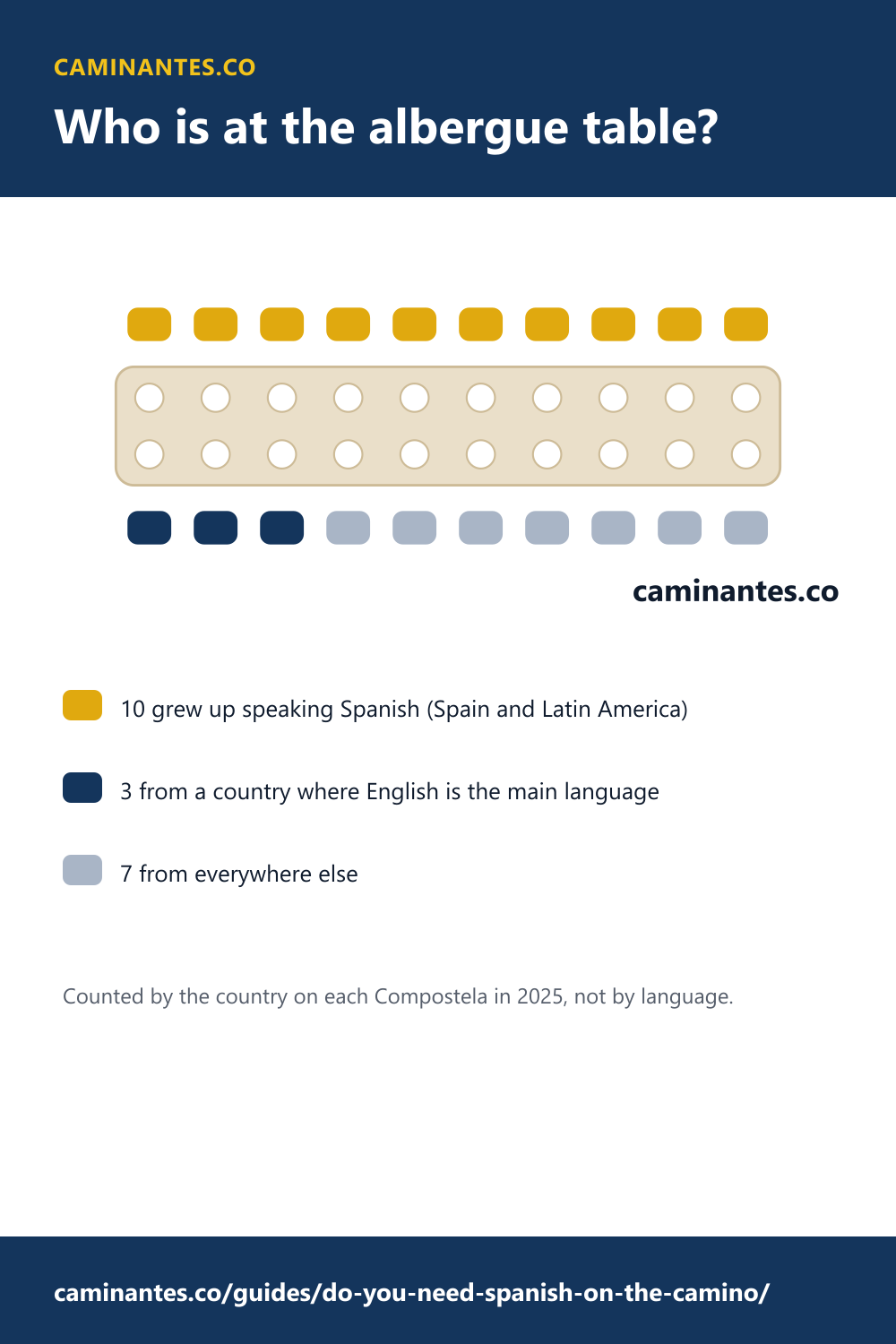
The Camino puts you in a kitchen every evening with people you did not choose, about half of whom grew up speaking Spanish. It puts you in a bar at eleven in the morning with a hospitalero who has met forty thousand pilgrims and has opinions about all of them. With no Spanish, you get the version of those evenings that happens in English, with the other foreigners. That is a good version. It is just not the one that was on offer. Pilgrim small talk is a much shorter list than people assume, because the same six questions come round every single night.
- 10 grew up speaking Spanish (Spain and Latin America)
- 3 from a country where English is the main language
- 7 from everywhere else
Seat twenty of the pilgrims who reached Santiago in 2025 at one table, and about 10 grew up speaking Spanish. Only 3 come from a country where English is the main language. For the other 7, English is a second language too.
Counted by the country on each Compostela in 2025, not by language.
Download this table as a poster (PNG)Free to share in your group or on your blog. A link back to this page is all we ask.
So, honestly
No, you do not need Spanish to walk the Camino de Santiago, and anyone telling you that you cannot go without it is wrong. What is also true is that the moments where it matters are predictable, they are few, and they are precisely the moments you would not choose to be helpless in. Thirty or forty words, learned in the odd ten minutes over the weeks before you leave, covers almost all of them.
That is a small enough amount of preparation that it belongs on the same list as breaking in your boots and getting your pack under ten percent of your body weight. It is not a course you have to finish. It is one more thing you do before you go.
Common questions
Do you need to speak Spanish to walk the Camino de Santiago?
No, in the sense that thousands of people finish every year without a word of it, and the waymarking, the albergues and the pilgrim infrastructure are all built to work without a shared language. Yes, in the narrower sense that matters: there are ordinary situations on any Camino where nobody within reach speaks English, and they cluster around the moments when something has gone wrong. Thirty or forty words covers almost all of them.
What language do they speak on the Camino de Santiago?
Spanish everywhere, but not only Spanish. Galicia has its own language, Galego, and it is not a dialect of Spanish: it is co-official, it is what a great many people in the villages actually speak to each other, and it is on a large share of the road signs and place names over the final stretch into Santiago. The Basque Country has Euskara, which is unrelated to Spanish entirely. On the Camino Portugués you start in Portuguese. Spanish is understood in all of it, so Spanish is the language to have.
Is English widely spoken on the Camino?
In the albergues on the busy routes, often. In a pharmacy in a village of two hundred people at eight in the evening, frequently not. English coverage on the Camino tracks tourism, so it is best exactly where you need it least and thinnest where you need it most. That distribution, rather than the overall percentage, is the thing worth planning around.
How much Spanish is actually enough?
Far less than a language course assumes and rather more than a phrase card holds. You need to be able to ask for a bed, ask what something costs, understand the answer when it comes back as a number, say where it hurts, and read a sign that is telling you the path is closed. That is a few dozen words and about four constructions, and it can be learned in the weeks before you go without any grammar at all.
Will I offend anyone by not speaking Spanish?
No. Nobody on the Camino expects a foreign pilgrim to speak Spanish, and the welcome does not depend on it. That is not really the argument for learning some. The argument is that the conversations you can have are different from the conversations you can have through gestures, and that the difference shows up in the evening in the albergue kitchen rather than at the counter.
Keep reading
Day one over the Pyrenees is the hardest stage on the Francés. Split it at Orisson
What the stage measures, why the descent and not the climb is the problem, and what stopping at Orisson costs.
The eighty Spanish words a Camino actually runs on
Asking for a bed, the credencial stamp, the pilgrim menu, and saying where it hurts. The words that matter on the trail, and none of the ones that do not.
The steepest Camino is not the one with the most climbing
Elevation gain for all ten routes, measured from the tracks and ranked by climb per kilometre rather than by total, which changes the order more than you would think.
Take it with you
Caminantes is free, works offline, and plans your stages around your own legs rather than a guidebook's.