Caminantes
How to pronounce Camino de Santiago, and every town on the way
By August Frederik Kramer · Last updated 4 October 2026
Camino de Santiago is said kah-MEE-noh deh sahn-TYAH-goh: the capitals are where your voice leans. The towns are harder. Of the 184 stage towns in Spain on our ten routes, 110 (60%) have at least one letter that does not sound the way an English reader would guess: an ñ, an ll, a v that is really a b. Tap any of them below to hear it, then take the six rules that cover nearly all of them.
Camino
kah-MEE-noh
Pick a route
Tap a name to hear it. The highlighted syllable is the one to lean on.
Spanish stress follows three rules, and a written accent beats them all. A town appears in syllables: tap the one you would lean on.
The names you will say most
The capitals are the stressed syllable; "eh" is the e in bed, "oh" the o in more, said short. Every vowel is said, including the last e of a word, which English tends to swallow.
| Name | Say it |
|---|---|
| Camino | kah-MEE-noh |
| Camino de Santiago | kah-MEE-noh deh sahn-TYAH-goh |
| Santiago de Compostela | sahn-TYAH-goh deh kohm-pohs-TEH-lah |
| Santiago | sahn-TYAH-goh |
| Compostela | kohm-pohs-TEH-lah |
| Buen Camino | BWEHN kah-MEE-noh |
| Galicia | gah-LEE-thyah |
| Camino Francés | kah-MEE-noh frahn-THEHS |
| Camino Portugués | kah-MEE-noh pohr-too-GEHS |
| Camino del Norte | kah-MEE-noh dehl NOHR-teh |
| Camino Primitivo | kah-MEE-noh pree-mee-TEE-boh |
| Vía de la Plata | BEE-ah deh lah PLAH-tah |
| Camino Inglés | kah-MEE-noh een-GLEHS |
| Camino Finisterre | kah-MEE-noh fee-nees-TEH-rreh |
| Camino Invierno | kah-MEE-noh een-BYEHR-noh |
| Camino Mozárabe | kah-MEE-noh moh-THAH-rah-beh |
| Camino Lebaniego | kah-MEE-noh leh-bah-NYEH-goh |
What Buen Camino means, and what to say back, is in what Buen Camino means.
Six rules, taught by towns you will walk through
Spanish is spelled the way it is said, so a handful of rules get you through almost every sign. Each one below comes with the first town on the Camino Francés that needs it, and with how many of the 184 stage towns on our plan in Spain have it.
ñ is "ny"
The ñ is the ny in canyon: Logroño is loh-GROH-nyoh. 8 stage towns have one.
ll is "y"
Across most of Spain ll sounds like the y in yes, so Roncesvalles is rrohn-thehs-BAH-yehs. 23 stage towns have one.
j, and g before e or i, is a breathy h
Say it from the back of the throat, like the ch in Scottish loch: Nájera is NAH-heh-rah. 11 stage towns have one or the other.
z, and c before e or i, is "th"
Zubiri is thoo-BEE-ree. This is not a lisp: in central and northern Spain the z and the soft c are their own sound, the th in think, and s stays s, which is why Santiago keeps its s. In Andalusia, where the Vía de la Plata and the Mozárabe set off, and across Latin America, people say s instead, and Basque speakers say the z of a Basque name as s too. 30 stage towns have it.
v is a soft b, and h is silent
Spanish has no separate v sound: Villafranca Montes de Oca is bee-yah-FRAHN-kah MOHN-tehs deh OH-kah. And the h is never said, so Hornillos del Camino is ohr-NEE-yohs dehl kah-MEE-noh. 27 stage towns have a v, and 6 an h.
rr, and an r at the start, is rolled
A single r in the middle of a word is one quick tap of the tongue. A double rr, or an r that starts a word, is a roll: Puente la Reina is PWEHN-teh lah RRAY-nah, and the respellings write it rr. 34 stage towns have one, the most common trap on the whole list.
Where the stress goes
Stress is the syllable your voice leans on, and Spanish puts it in the same place every time. Of the 110 one-word stage town names in our quiz, 85 follow the first rule, 20 carry a written accent that overrides it, and 5 follow the second.
- Ends in a vowel, n or s? Lean on the second to last syllable: Roncesvalles (rrohn-thehs-BAH-yehs).
- Ends in any other consonant? Lean on the last: Santander (sahn-tahn-DEHR).
- A written accent (á é í ó ú) wins over both: Nájera (NAH-heh-rah).
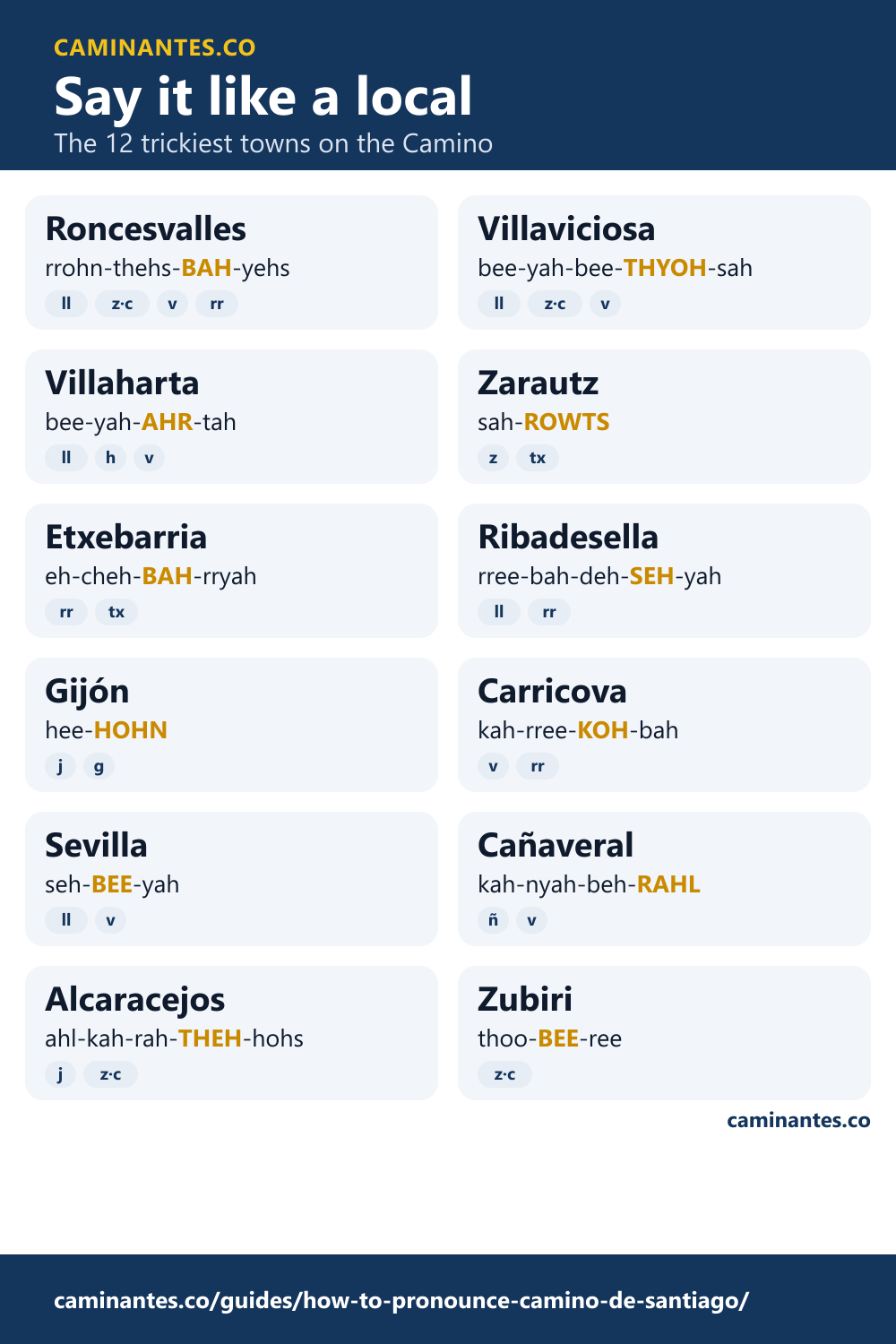
Download the poster (PNG)Free to print and share. Please keep caminantes.co on it.
Galicia: 56 towns, and the x
The last part of every route to Santiago is in Galicia, and 56 of the stage towns are Galician. Galician is read almost like Spanish, with one letter to watch: x is "sh", so Seixas is SAY-shahs. The O and A in front of a name, as in O Pedrouzo, are said oh and ah. Galicia itself is gah-LEE-thyah.
French and Basque names
The Camino Francés starts in France: Saint-Jean-Pied-de-Port is French, san zhahn pyay duh POR, with the t of Saint and Port left silent. In the Basque Country and Navarre many towns have two names, and pilgrims usually say the Spanish one: Pamplona rather than Iruña, Roncesvalles rather than Orreaga. Where only the Basque name is used, tx is "ch" and tz is "ts", so Etxebarria is eh-cheh-BAH-rryah.
Know these words before your Camino. Spanish is preparation, the same as boots and stages. Try the free topic
Your first 16 words
The town names get you to the right place; these get you a bed. They are the 16 words our Spanish course gives away free, with the same respellings.
| Spanish | Say it | Meaning |
|---|---|---|
| el peregrino | ehl peh-reh-GREE-noh | the pilgrim |
| la credencial | lah kreh-dehn-THYAHL | the pilgrim passport |
| el sello | ehl SEH-yoh | the stamp |
| ¡Buen Camino! | BWEHN kah-MEE-noh | have a good Camino |
| la flecha amarilla | lah FLEH-chah ah-mah-REE-yah | the yellow arrow |
| el camino | ehl kah-MEE-noh | the way, the path |
| la etapa | lah eh-TAH-pah | the stage, the day's walk |
| la mochila | lah moh-CHEE-lah | the backpack |
| la bota | lah BOH-tah | the boot |
| la ampolla | lah ahm-POH-yah | the blister |
| la farmacia | lah fahr-MAH-thyah | the pharmacy |
| el albergue | ehl ahl-BEHR-geh | the pilgrim hostel |
| el hospitalero | ehl ohs-pee-tah-LEH-roh | the albergue host |
| la litera | lah lee-TEH-rah | the bunk bed |
| ¿hay camas libres? | EYE KAH-mahs LEE-brehs | are there free beds? |
| completo | kohm-PLEH-toh | full, no vacancies |
Every one of them, with example sentences, is the free topic of Camino Basics, and the rest of Spanish for the Camino starts there.
Every town, route by route
Every stage town on our plan in Spain, in walking order. Towns in Portugal, 26 of them at the start of the Camino Portugués, are left out: Portuguese is not read by Spanish rules.
Camino Francés: 37
| Town | Say it | Watch for |
|---|---|---|
| Saint-Jean-Pied-de-Port | san zhahn pyay duh POR | French: the stress falls at the end of the whole name, and the t of Saint and Port is silent. |
| Orreaga / Roncesvalles | rrohn-thehs-BAH-yehs | say Roncesvalles; ll = y; z, c = th; v = b; rolled r |
| Zubiri | thoo-BEE-ree | z, c = th |
| Pamplona / Iruña | pahm-PLOH-nah | say Pamplona |
| Puente la Reina / Gares | PWEHN-teh lah RRAY-nah | say Puente la Reina; rolled r |
| Estella-Lizarra | ehs-TEH-yah | say Estella; ll = y |
| Los Arcos | lohs AHR-kohs | |
| Logroño | loh-GROH-nyoh | ñ = ny |
| Nájera | NAH-heh-rah | j = h |
| Santo Domingo de la Calzada | SAHN-toh doh-MEEN-goh deh lah kahl-THAH-dah | z, c = th |
| Fresneña | frehs-NEH-nyah | ñ = ny |
| Villafranca Montes de Oca | bee-yah-FRAHN-kah MOHN-tehs deh OH-kah | ll = y; v = b |
| Atapuerca | ah-tah-PWEHR-kah | |
| Burgos | BOOR-gohs | |
| Hornillos del Camino | ohr-NEE-yohs dehl kah-MEE-noh | ll = y; h silent |
| Villaquirán de la Puebla | bee-yah-kee-RAHN deh lah PWEH-blah | ll = y; v = b; qu = k |
| Boadilla del Camino | boh-ah-DEE-yah dehl kah-MEE-noh | ll = y |
| Carrión de los Condes | kah-RRYOHN deh lohs KOHN-dehs | rolled r |
| Población de Arroyo | poh-blah-THYOHN deh ah-RROH-yoh | z, c = th; rolled r |
| Sahagún | sah-ah-GOON | h silent |
| El Burgo Ranero | ehl BOOR-goh rrah-NEH-roh | rolled r |
| Mansilla de las Mulas | mahn-SEE-yah deh lahs MOO-lahs | ll = y |
| León | leh-OHN | |
| Villadangos del Páramo | bee-yah-DAHN-gohs dehl PAH-rah-moh | ll = y; v = b |
| Astorga | ahs-TOHR-gah | |
| Santa Marina de Somoza | SAHN-tah mah-REE-nah deh soh-MOH-thah | z, c = th |
| Molinaseca | moh-lee-nah-SEH-kah | |
| Camponaraya | kahm-poh-nah-RAH-yah | |
| Trabadelo | trah-bah-DEH-loh | |
| La Laguna de Castilla | lah lah-GOO-nah deh kahs-TEE-yah | ll = y |
| Triacastela | tryah-kahs-TEH-lah | |
| Sarria | SAH-rryah | rolled r |
| Portomarín | pohr-toh-mah-REEN | |
| Palas de Rei | PAH-lahs deh RRAY | rolled r |
| Arzúa | ahr-THOO-ah | z, c = th |
| O Pedrouzo | oh peh-DROH-thoh | z, c = th |
| Santiago de Compostela | sahn-TYAH-goh deh kohm-pohs-TEH-lah |
Camino Portugués: 6
| Town | Say it | Watch for |
|---|---|---|
| O Porriño | oh poh-RREE-nyoh | ñ = ny; rolled r |
| Redondela | rreh-dohn-DEH-lah | rolled r |
| Pontevedra | pohn-teh-BEH-drah | v = b |
| Caldas de Reis | KAHL-dahs deh RRAYS | rolled r |
| Infesta | een-FEHS-tah | |
| Santiago de Compostela | sahn-TYAH-goh deh kohm-pohs-TEH-lah |
Camino del Norte: 40
| Town | Say it | Watch for |
|---|---|---|
| Irún | ee-ROON | |
| Donostia / San Sebastián | SAHN seh-bahs-TYAHN | say San Sebastián |
| Zarautz | sah-ROWTS | z = s; tx = ch |
| Deba | DEH-bah | |
| Etxebarria | eh-cheh-BAH-rryah | rolled r; tx = ch |
| Gernika-Lumo | gehr-NEE-kah | say Gernika |
| Bilbao | beel-BAH-oh | |
| Sestao | sehs-TAH-oh | |
| Sámano | SAH-mah-noh | |
| El Puente | ehl PWEHN-teh | |
| Santoña | sahn-TOH-nyah | ñ = ny |
| Ajo | AH-hoh | j = h |
| Santander | sahn-tahn-DEHR | |
| Arce | AHR-theh | z, c = th |
| Santillana del Mar | sahn-tee-YAH-nah dehl MAHR | ll = y |
| La Iglesia | lah ee-GLEH-syah | |
| San Vicente de la Barquera | SAHN bee-THEHN-teh deh lah bahr-KEH-rah | z, c = th; v = b; qu = k |
| Colombres | koh-LOHM-brehs | |
| Llanes | YAH-nehs | ll = y |
| Ribadesella / Ribeseya | rree-bah-deh-SEH-yah | say Ribadesella; ll = y; rolled r |
| Colunga | koh-LOON-gah | |
| Villaviciosa | bee-yah-bee-THYOH-sah | ll = y; z, c = th; v = b |
| Gijón / Xixón | hee-HOHN | say Gijón; j = h; g = h |
| Avilés | ah-bee-LEHS | v = b |
| L'Arena | lah-REH-nah | |
| La Magdalena | lah mahg-dah-LEH-nah | |
| Aucinera | ow-thee-NEH-rah | z, c = th |
| Luarca / Ḷḷuarca | LWAHR-kah | say Luarca |
| Navia | NAH-byah | v = b |
| Porcía | pohr-THEE-ah | z, c = th |
| Ribadeo | rree-bah-DEH-oh | rolled r |
| Vilanova | bee-lah-NOH-bah | v = b |
| Abadín | ah-bah-DEEN | |
| Vilalba | bee-LAHL-bah | v = b |
| A Silvosa | ah seel-BOH-sah | v = b |
| A Bouzaboa | ah boh-thah-BOH-ah | z, c = th |
| Sobrado | soh-BRAH-doh | |
| Arzúa | ahr-THOO-ah | z, c = th |
| O Pedrouzo | oh peh-DROH-thoh | z, c = th |
| Santiago de Compostela | sahn-TYAH-goh deh kohm-pohs-TEH-lah |
Camino Primitivo: 16
| Town | Say it | Watch for |
|---|---|---|
| Oviedo | oh-BYEH-doh | v = b |
| Grau / Grado | GRAH-doh | say Grado |
| Salas | SAH-lahs | |
| Tinéu | tee-NEH-oh | say Tineo |
| Borres | BOH-rrehs | rolled r |
| Montefurado | mohn-teh-foo-RAH-doh | |
| El Vilar de Buspol | ehl bee-LAHR deh boos-POHL | v = b |
| Valdedo | bahl-DEH-doh | v = b |
| A Fonsagrada | ah fohn-sah-GRAH-dah | |
| O Cádavo | oh KAH-dah-boh | v = b |
| Lugo | LOO-goh | |
| Carricova | kah-rree-KOH-bah | v = b; rolled r |
| Melide | meh-LEE-deh | |
| Seixas | SAY-shahs | x = sh; no Spanish voice for x |
| O Pedrouzo | oh peh-DROH-thoh | z, c = th |
| Santiago de Compostela | sahn-TYAH-goh deh kohm-pohs-TEH-lah |
Vía de la Plata: 48
| Town | Say it | Watch for |
|---|---|---|
| Seville | seh-BEE-yah | say Sevilla; ll = y; v = b |
| Torre de la Reina | TOH-rreh deh lah RRAY-nah | rolled r |
| Castilblanco de los Arroyos | kahs-teel-BLAHN-koh deh lohs ah-RROH-yohs | rolled r |
| Almadén de la Plata | ahl-mah-DEHN deh lah PLAH-tah | |
| El Real de la Jara | ehl rreh-AHL deh lah HAH-rah | j = h; rolled r |
| Monesterio | moh-nehs-TEH-ryoh | |
| Fuente de Cantos | FWEHN-teh deh KAHN-tohs | |
| Zafra | THAH-frah | z, c = th |
| Villafranca de los Barros | bee-yah-FRAHN-kah deh lohs BAH-rrohs | ll = y; v = b; rolled r |
| Almendralejo | ahl-mehn-drah-LEH-hoh | j = h |
| Mérida | MEH-ree-dah | |
| El Carrascalejo | ehl kah-rrahs-kah-LEH-hoh | j = h; rolled r |
| Alcuéscar | ahl-KWEHS-kahr | |
| Aldea del Cano | ahl-DEH-ah dehl KAH-noh | |
| Cáceres | KAH-theh-rehs | z, c = th |
| Casar de Cáceres | kah-SAHR deh KAH-theh-rehs | z, c = th |
| Cañaveral | kah-nyah-beh-RAHL | ñ = ny; v = b |
| Galisteo | gah-lees-TEH-oh | |
| Oliva de Plasencia | oh-LEE-bah deh plah-SEHN-thyah | z, c = th; v = b |
| La Granja | lah GRAHN-hah | j = h |
| Baños de Montemayor | BAH-nyohs deh mohn-teh-mah-YOHR | ñ = ny |
| Peromingo | peh-roh-MEEN-goh | |
| Casafranca | kah-sah-FRAHN-kah | |
| San Pedro de Rozados | SAHN PEH-droh deh rroh-THAH-dohs | z, c = th; rolled r |
| Salamanca | sah-lah-MAHN-kah | |
| Calzada de Valdunciel | kahl-THAH-dah deh bahl-doon-THYEHL | z, c = th; v = b |
| El Cubo de Tierra del Vino | ehl KOO-boh deh TYEH-rrah dehl BEE-noh | v = b; rolled r |
| Zamora | thah-MOH-rah | z, c = th |
| Montamarta | mohn-tah-MAHR-tah | |
| Granja de Moreruela | GRAHN-hah deh moh-reh-RWEH-lah | j = h |
| Tábara | TAH-bah-rah | |
| Calzadilla de Tera | kahl-thah-DEE-yah deh TEH-rah | ll = y; z, c = th |
| Mombuey | mohm-BWAY | |
| Asturianos | ahs-too-RYAH-nohs | |
| Puebla de Sanabria | PWEH-blah deh sah-NAH-bryah | |
| Lubián | loo-BYAHN | |
| A Gudiña | ah goo-DEE-nyah | ñ = ny |
| Veiga de Nostre | BAY-gah deh NOHS-treh | v = b |
| Laza | LAH-thah | z, c = th |
| Vilar de Barrio | bee-LAHR deh BAH-rryoh | v = b; rolled r |
| Xunqueira de Ambía | shoon-KAY-rah deh ahm-BEE-ah | qu = k; x = sh; no Spanish voice for x |
| Ourense | oh-REHN-seh | |
| Cea | THEH-ah | z, c = th |
| A Hedreira | ah eh-DRAY-rah | h silent |
| Silleda | see-YEH-dah | ll = y |
| O Curro | oh KOO-rroh | rolled r |
| Cacheiras | kah-CHAY-rahs | |
| Santiago de Compostela | sahn-TYAH-goh deh kohm-pohs-TEH-lah |
Camino Inglés: 7
| Town | Say it | Watch for |
|---|---|---|
| Ferrol | feh-RROHL | rolled r |
| Fene | FEH-neh | |
| Betanzos | beh-TAHN-thohs | z, c = th |
| A Salgueira | ah sahl-GAY-rah | u silent |
| Os Ramos | ohs RRAH-mohs | rolled r |
| Vilacide de Arriba | bee-lah-THEE-deh deh ah-RREE-bah | z, c = th; v = b; rolled r |
| Santiago de Compostela | sahn-TYAH-goh deh kohm-pohs-TEH-lah |
Camino Finisterre: 6
| Town | Say it | Watch for |
|---|---|---|
| Santiago de Compostela | sahn-TYAH-goh deh kohm-pohs-TEH-lah | |
| Negreira | neh-GRAY-rah | |
| A Corna | ah KOHR-nah | |
| Mollón | moh-YOHN | ll = y |
| Cee | THEH-eh | z, c = th |
| Finisterre | fee-nees-TEH-rreh | rolled r |
Camino Invierno: 14
| Town | Say it | Watch for |
|---|---|---|
| Ponferrada | pohn-feh-RRAH-dah | rolled r |
| Borrenes | boh-RREH-nehs | rolled r |
| Puente de Domingo Flórez | PWEHN-teh deh doh-MEEN-goh FLOH-rehth | z, c = th |
| O Barco | oh BAHR-koh | |
| Petín | peh-TEEN | |
| Quiroga | kee-ROH-gah | qu = k |
| A Pobra do Brollón | ah POH-brah doh broh-YOHN | ll = y |
| As Lamas | ahs LAH-mahs | |
| Chantada | chahn-TAH-dah | |
| Rodeiro | rroh-DAY-roh | rolled r |
| Lalín | lah-LEEN | |
| Silleda | see-YEH-dah | ll = y |
| Pardellas | pahr-DEH-yahs | ll = y |
| Santiago de Compostela | sahn-TYAH-goh deh kohm-pohs-TEH-lah |
Camino Mozárabe: 20
| Town | Say it | Watch for |
|---|---|---|
| Granada | grah-NAH-dah | |
| Pinos Puente | PEE-nohs PWEHN-teh | |
| La Alhondiguilla | lah ahl-ohn-dee-GEE-yah | ll = y; h silent; u silent |
| Puertollano | pwehr-toh-YAH-noh | ll = y |
| Alcaudete | ahl-kow-DEH-teh | |
| Baena | bah-EH-nah | |
| Castro del Río | KAHS-troh dehl RREE-oh | rolled r |
| Santa Cruz | SAHN-tah KROOTH | z, c = th |
| Córdoba | KOHR-doh-bah | |
| Estación de Obejo | ehs-tah-THYOHN deh oh-BEH-hoh | j = h; z, c = th |
| Villaharta | bee-yah-AHR-tah | ll = y; h silent; v = b |
| Alcaracejos | ahl-kah-rah-THEH-hohs | j = h; z, c = th |
| Hinojosa del Duque | ee-noh-HOH-sah dehl DOO-keh | j = h; h silent; qu = k |
| Monterrubio de la Serena | mohn-teh-RROO-byoh deh lah seh-REH-nah | rolled r |
| Castuera | kahs-TWEH-rah | |
| Campanario | kahm-pah-NAH-ryoh | |
| Don Benito | DOHN beh-NEE-toh | |
| Santa Amalia | SAHN-tah ah-MAH-lyah | |
| San Pedro de Mérida | SAHN PEH-droh deh MEH-ree-dah | |
| Mérida | MEH-ree-dah |
Camino Lebaniego: 4
| Town | Say it | Watch for |
|---|---|---|
| San Vicente de la Barquera | SAHN bee-THEHN-teh deh lah bahr-KEH-rah | z, c = th; v = b; qu = k |
| Puente El Arrudo | PWEHN-teh ehl ah-RROO-doh | rolled r |
| Lebeña | leh-BEH-nyah | ñ = ny |
| Santo Toribio de Liébana | SAHN-toh toh-REE-byoh deh LYEH-bah-nah |
How these are made: the stage towns are the ones on our stage plan. The respellings are computed from the spelling with the Real Academia Española’s stress rules, which is possible because Spanish is written as it is said; the Galician x, the Basque tx and tz and the French start are handled by hand. The sound comes from your own device’s speech voice, so it varies by phone and browser.
Common questions
How do you pronounce Camino de Santiago?
kah-MEE-noh deh sahn-TYAH-goh. Lean on MEE and TYAH. Santiago is three syllables, not four: the i and a run together into "tyah".
How do you pronounce Santiago de Compostela?
sahn-TYAH-goh deh kohm-pohs-TEH-lah. Every vowel is said, including the final a.
How do you pronounce Galicia?
gah-LEE-thyah in Spain, with the soft c as th. In Latin America and parts of Galicia itself you will hear gah-LEE-syah.
Do Spaniards lisp?
No. In most of Spain the z and the soft c are a separate sound, the th in think, while s stays s. That is why Arzúa has a th and Santiago does not.
How do you pronounce Buen Camino?
BWEHN kah-MEE-noh. The ue is one sound, "weh", so Buen is a single syllable.
Why will the audio not say Xunqueira?
The x is Galician and says sh. A Spanish speech voice reads it as ks, so where your device has no Galician voice the page shows the respelling instead of playing a wrong sound.
Keep reading
Camino de Santiago meaning: Santiago, Compostela, word by word
Santiago is Saint James fused into one word, and Compostela is most likely a burial ground, not a field of stars. Of the 211 towns our 10 routes stop in, 12 carry a saint’s title; only the last carries James.
Porto to Santiago: 13 days, 246.4 km, two countries
The Camino Portugués from Porto, measured: 7 days in Portugal and 6 in Spain, 3,176 m of climbing, 199 places to sleep, and a path that fills up from about 191 people a day to 975.
Camino de Santiago map: ten routes, and the 38.7 km most pilgrims share
Ten routes drawn from their own tracks on one map of Spain and Portugal. Seven end in Santiago, and from Arzúa three are one path: in 2025, 291,346 pilgrims, 55%, walked its last 38.7 km.
Take it with you
Caminantes is free, works offline, and plans your stages around your own legs rather than a guidebook's.