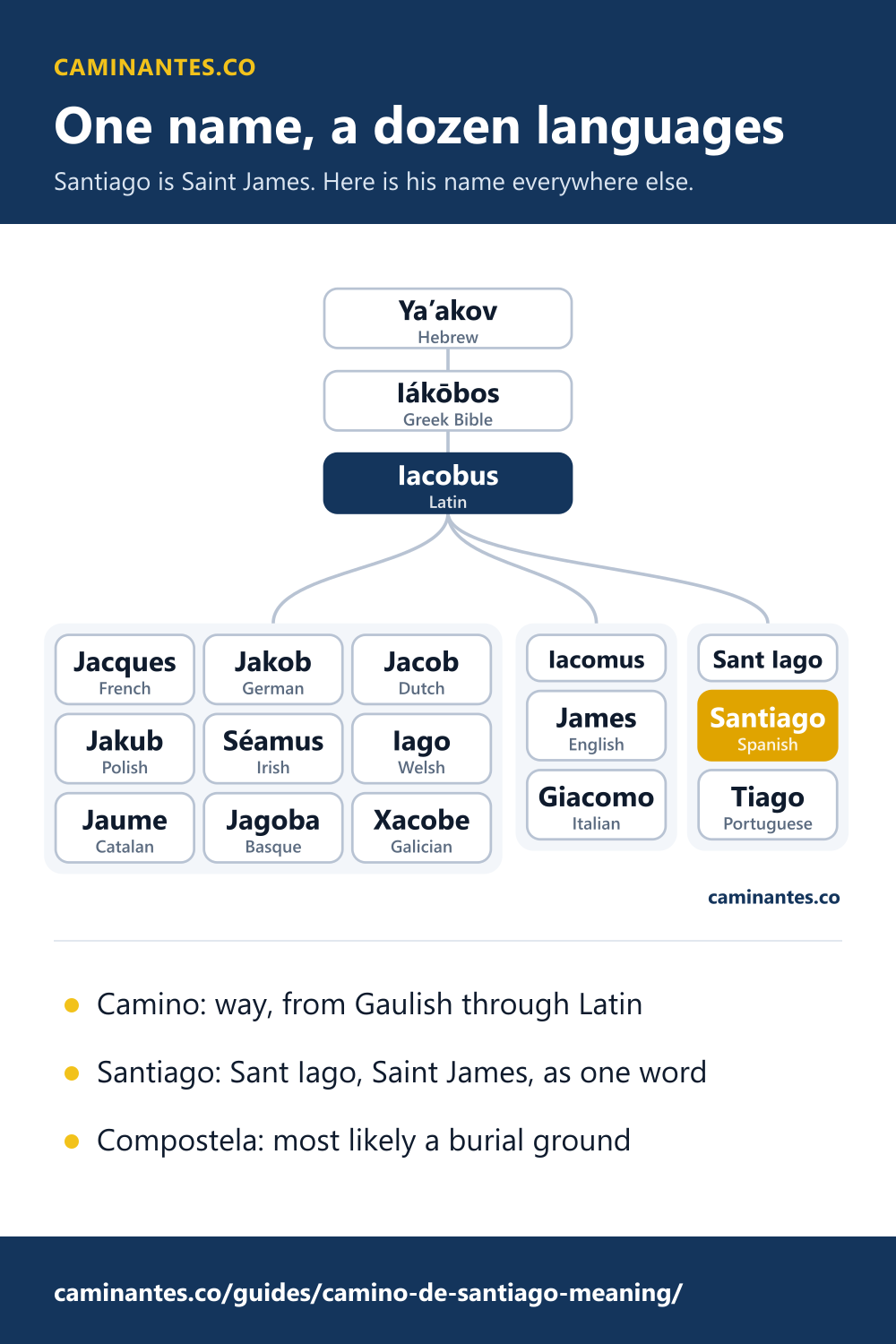
Spanish puts a saint in front of a name all the time. Of the 211 towns where the stages of our 10 routes start or end, 12 carry a saint’s title in front of a name, from San Vicente de la Barquera to Santo Domingo de la Calzada. Only one carries James, and there the title has fused into the name so completely that it no longer looks like a title at all: the last town, Santiago.
Camino: a Celtic word on a Latin road
Camino means way, road or path, and it is older than Spanish. It comes from the Latin cammīnus, which Latin took from Gaulish, the Celtic language spoken in Roman France. Its cousins are the Portuguese caminho, the Italian cammino and the French chemin.
It is also the first word most pilgrims learn. It is one of the sixteen in the free Spanish topic, and the second half of the greeting you will hear all the way: what Buen Camino means.
Santiago: a saint and his name, fused
Santiago is James, the apostle the Camino leads to. The name has walked further than any pilgrim: from Hebrew through Greek and Latin, where the church put “Saint” in front of it, and into Spanish, where the two words wore down into one. Step through it, and watch the letters move.
From Ya’akov to Santiago, one step at a time
HebrewYa’akovThe name of the patriarch Jacob. Genesis explains it from the word for heel: he was born holding his twin brother’s.
Greek BibleIákōbosThe Greek translation of the Bible writes it as Iákōbos.
LatinIacobusLatin makes it Iacobus. James the apostle and Jacob the patriarch are the same name.
Church LatinSanctus Iacobus“Saint James” in the language of the medieval church.
Old SpanishSant IagoSpoken Spanish wears it down: Sant Iaco, Sant Iague, then Sant Iago.
One wordSantiagoOne word, not two: as the battle cry of the Reconquista it was shouted in one breath, which is said to be how it became a name in its own right.
You can still see the title in today’s Spanish. A saint is san before most men’s names, which is why our stages stop in Donostia / San Sebastián, San Pedro de Mérida, San Pedro de Rozados, and San Vicente de la Barquera. But it stays santo before Domingo, Tomás, Tomé and Toribio: hence Santo Domingo de la Calzada and Santo Toribio de Liébana. That is the rule in the Spanish Academy’s dictionary of doubts. Santiago is what happens when a title is used so often it stops being one.
One name, a dozen languages
James, Jacques, Jakob and Santiago are the same name. Every pilgrim walking to Santiago is walking to someone they have a name for at home. Tap a language to see its form, and the branch it grew from.
Spanish alone has the name four times: Jacobo, Jaime, Santiago and possibly Diego. That last one is debated. One account has San Tiago heard as Tiago, then Diago, then Diego; the other derives Diego from the Latin Didacus. Neither step is fully documented, so treat Diego as a maybe.
Galician says Xacobe, which is why the holy year has a Galician name: the Xacobeo, the year of Saint James.
Compostela: a field of stars, or a graveyard?
This is the part the internet gets wrong in both directions, so here are both readings with their evidence. Switch between them.
Campus stellae: the field of the star
In the early ninth century, the story goes, a hermit called Pelagius (in some versions a shepherd) saw lights like a shower of stars over the Libredón forest. He told Theodemir, bishop of Iria Flavia, today Padrón, who found a stone tomb there and declared it the apostle’s. King Alfonso II of Asturias built a chapel on the spot. Read Compostela as the Latin campus stellae and the name tells the legend: the field of the star.
It is the story told at the start of the pilgrimage, and the one on the souvenirs.
Wikipedia files it under folk etymology: a reading that fits the story, not the Latin.
Even the year is uncertain: the tradition says 813, and one account gives 25 July 812.
Know these words before your Camino. Spanish is preparation, the same as boots and stages. Try the free topic
Compositum: a place well laid out, for the dead
Read Compostela as a form of the Latin compositum, laid out or put in order, and it describes a burial ground. Under the cathedral lies exactly that: a Roman settlement of the first to fifth centuries and a necropolis that was still in use, perhaps until the seventh, long before anyone looked for an apostle.
Twelfth-century chronicles already explained the name this way: “Compostella, id est bene composita”, Compostela, that is, well put together.
The great Spanish philologists Ramón Menéndez Pidal and Joan Coromines read it as compositum tella, a well-ordered burial ground, as the historian Richard Fletcher reports.
The oldest documents, from the ninth to the eleventh century, do not say Compostela at all. They call the place Arcis Marmoricis, or the place of Saint James. The name appears around two centuries after the star.
What scholars think
The burial ground wins. The name turns up generations after the star story it is supposed to record, the Latin fits compositum better than campus stellae, and there really is a cemetery under the cathedral. The field of stars is the story pilgrims have told for a thousand years. It is worth knowing, and worth knowing it is a story.
Even the sources that agree on the burial ground disagree on the details: some write tella, some tellus, and some explain it as “a beautiful, well-built place” rather than a cemetery. We have left the disagreement visible instead of picking a side.
“Santiago y cierra, España”
If you search the name you will meet this phrase. It is a Spanish battle cry, attested from the seventeenth century in plays and poems about the Reconquista, and it turns up in Don Quijote, where Sancho Panza asks whether Spain is open, that it needs closing. It does not mean “close Spain”: cierra is the order to close with the enemy, to charge. Santiago is called on as Spain’s patron saint.
How Spanish says it
Santiago is three syllables in Spanish, not four, because the i glides into the a after it, and the stress falls on the middle one: sahn-TYAH-goh. The g is soft, almost without a stop.
You will hear the name all day: on signs, in Buen Camino, on the certificate at the end, which is named after the city. How to get the Compostela covers the certificate. Whether you need Spanish covers the rest of the language, and the free topic is sixteen words you will use from day one.
Sources.Read on 4 October 2026: Wikipedia’s articles on Santiago de Compostela in English and Spanish (toponymy and history), on Pelagius the Hermit, on the name Jacobo and on James as a given name, and on “¡Santiago y cierra, España!”; Wiktionary on camino; the Spanish Royal Academy’s Diccionario panhispánico de dudas, “santo”; SpanishDict for the pronunciation. Menéndez Pidal, Coromines and Fletcher are cited as Wikipedia cites them. The town counts are from our own stage plan.
Common questions
What does Camino de Santiago mean in English?
The Way of Saint James. Camino is way or road, and Santiago is the Spanish name of the apostle James, with the word for saint fused into it.
What does Santiago de Compostela mean?
Saint James of Compostela. Santiago is Saint James. Compostela most likely comes from the Latin compositum, a place laid out for the dead: there is a Roman and later cemetery under the cathedral. The popular reading, campus stellae, the field of stars, comes from the legend of lights over the tomb.
Does Compostela mean field of stars?
That is the legend’s reading, campus stellae. Most scholars prefer a burial ground: the name first appears around two centuries after the star story, and the oldest documents call the place something else entirely.
Is Santiago the same name as James?
Yes. Both come from the Hebrew Ya’akov through the Latin Iacobus. Santiago is Sanctus Iacobus, Saint James, worn down to one word. Jacques, Jakob, Giacomo and Jaime are the same name too.
 Caminantes