Caminantes
How to get the Compostela
By August Frederik Kramer · Last updated 14 August 2026
The Compostela is the certificate the Pilgrim's Office in Santiago issues to pilgrims who complete the Camino. It is free, it is in Latin, and it has your name on it. The rules for earning one are short, and almost every summary of them gets at least one detail wrong.
The distance rule, and what it actually says
You need to cover the last 100 km into Santiago on foot, or the last 200 km by bicycle. Horseback counts as on foot.
The word doing the work there is last. It is not 100 km of walking somewhere in Spain. It is the final 100 km of a recognised route, finishing at the Cathedral. Walking 300 km and then taking a bus over the last 90 earns you nothing, and walking 100 km in the middle of the Camino Francés and stopping there earns you nothing either.
On the Francés the qualifying line falls at Sarria, which is why Sarria is the single most common starting point on the entire Camino and why the last week feels different from everything before it. On the Camino Portugués it is around Tui, and on the Camino Inglés it is Ferrol.
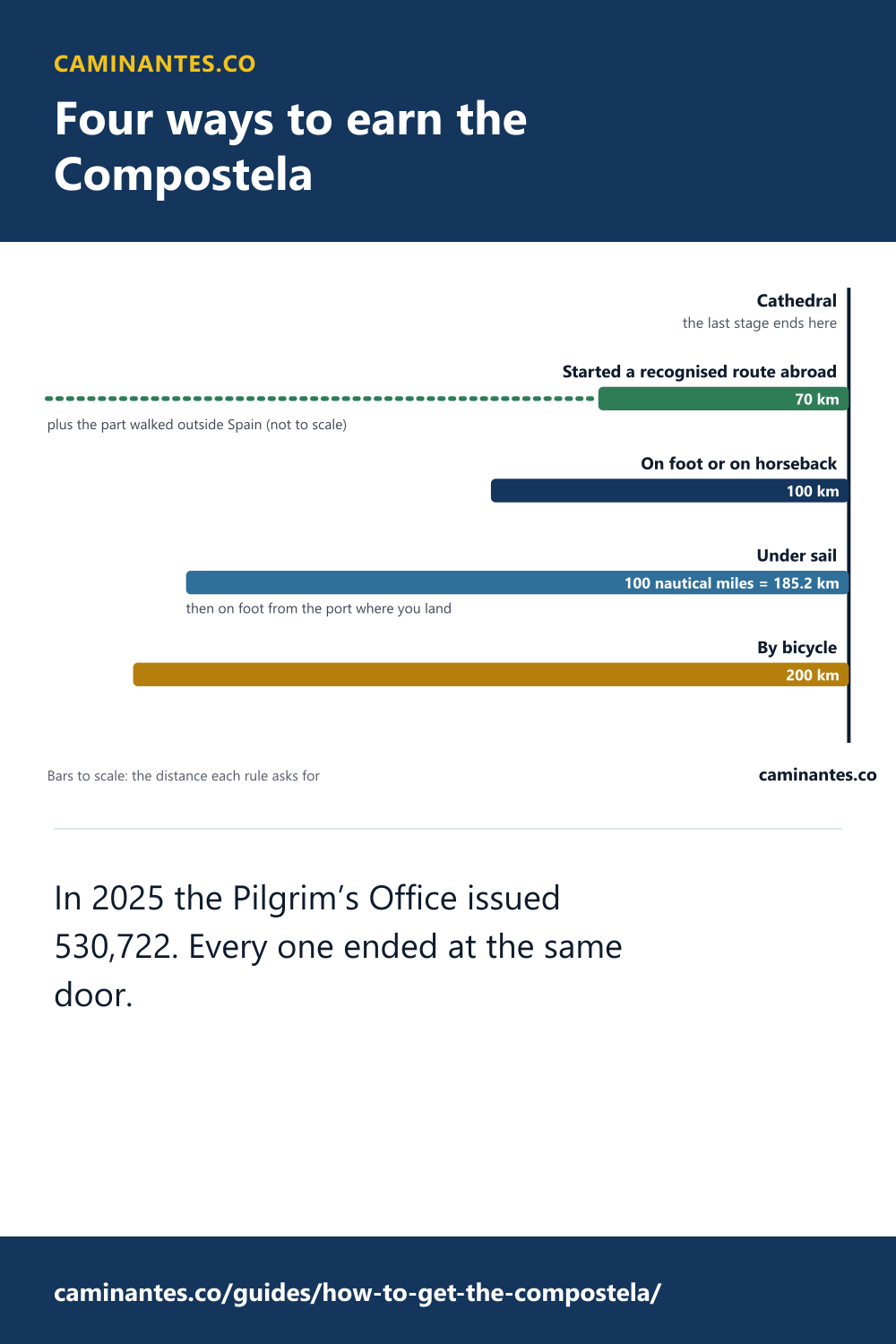
Put the rules side by side and they are simpler than any summary: the distance depends on how you travel, and the finishing line never moves. 100 km on foot or on horseback, 200 km by bicycle, 70 km inside Spain if you began a recognised route abroad, and, on the office’s Spanish page, 100 nautical miles under sail (185.2 km) before walking on from the port. In 2025 the office issued 530,722 Compostelas, and every one of them ended at the same door.
Download this drawing as a poster (PNG)Free to use on your blog or in your group. A link back to this page is all we ask.
Compostela in hand, you have an afternoon: what to see in Santiago.
The credencial, and the rule people miss
You need a credencial, the pilgrim passport, and you need it stamped. Get one before you start, from a pilgrim association, a cathedral, or the first albergue you stay in.
You will read almost everywhere that you need two stamps a day over the final 100 km. That phrase does not appear anywhere in the Pilgrim's Office rules, in English or in Spanish. What the rules actually say is narrower, and conditional:
If you only do the minimum required distance, you must always get your Credencial stamped at the start and end of each stage, including the corresponding date, to show that the pilgrim has resumed the Way in the same place where they last stopped.
Three differences worth holding on to. It is per stage, not per day. It applies only if you walk just the minimum, so if you started at Saint-Jean it does not apply to you at all. And the point of it is continuity: it exists to show you started again where you stopped, not to make you collect a quota.
In practice, if you are walking from Sarria, stamp where you set off each morning and where you stop each evening. Bars, cafés, albergues, churches, town halls, pharmacies and a surprising number of vending machines all give stamps. Getting them is easy. Remembering is the hard part.
The last stage has to be the last stage
The rules add one more condition that is easy to miss and hard to undo:the final stage must be the one arriving at the Cathedral.
That is what stops you walking your 100 km somewhere convenient and travelling the rest. You can walk the Camino in stages across several years, as long as they run in chronological and geographical order, but the piece you finish on has to be the piece that ends in Santiago.
Know these words before your Camino. Spanish is preparation, the same as boots and stages. Try the free topic
The exception nobody explains properly
If you have read that you can start the Camino Inglés at A Coruña, that advice is incomplete in a way that matters.
A Coruña to Santiago is roughly 75 km, which is short of 100. The usual explanation is that you make up the difference by walking 25 km at home and adding the two together. That gets to the right answer by the wrong route, and the real rule is more useful because it is more general:
If a pilgrim has already started a route on foot outside Spain along one of the recognised routes, the required distance in Spain shall be no less than 70 kilometres.
Nothing is being added together. Starting a recognised route abroadlowers the Spanish requirement to 70 km, and A Coruña's 75 km clears that on its own. This is the mechanism behind the Celtic Camino: Irish pilgrims walk a recognised route at home, have it certified by Camino Society Ireland, and bring that certificate to Santiago. The certificate matters because it is the proof you started abroad, and it comes from the society rather than from a bar.
So both of these are true, and most guides tell you only one: start at Ferrol, about 120 km, and it is straightforward. Start at A Coruña with no qualifying route behind you, and 75 km is simply short.
The Distance Certificate is a different document
The Compostela confirms that you completed the pilgrimage. It does not say where you began or how far you walked, which surprises people who have just spent five weeks crossing Spain.
The Distance Certificate is a separate document that prints your starting point, your route and your kilometres. It costs 3 euros, and you ask for it at the same desk at the same time. The Compostela and the reception service are free, and it is the certificate sales that pay for them. If the distance is part of what the walk meant to you, ask for both. Nobody offers it unprompted.
The question about your reasons
When you present your credencial you are asked why you walked. This is not a test and there is no right answer, but the answer does decide which certificate you receive.
Religious or spiritual reasons, including simply an attitude of search, earn the Compostela. Cultural, sporting or personal reasons earn a certificate of welcome instead. Both are free, both are real, and no one will cross-examine you. Answer honestly rather than reciting what you think unlocks the better document.
Arriving in Santiago
The Pilgrim's Office is a short walk from the Cathedral and the queue is part of the experience, for better and worse. You can fill in your details online before you arrive, which shortens the desk part considerably and is worth doing on the morning of your last day rather than in the queue itself.
Bring your credencial with every stamp in it. That is the only evidence that matters, and there is no digital fallback if you lose it.
What to do in the Cathedral itself, from km 0 to the hug and the tomb, is inour step-by-step cathedral guide.
What changes in a Holy Year
2027 is a Xacobeo, and the rules for the Compostela do not change in a Holy Year. What changes is the queue. More pilgrims arrive, and the Pilgrim's Office is the one place every single one of them has to pass through.
If you are walking in 2027, read the Xacobeo 2027 guide as well. The Holy Door opens on 31 December 2026, and the practical planning consequences start well before that.
The short version
- Last 100 km on foot, last 200 km by bike, ending in Santiago.
- The final stage has to be the one arriving at the Cathedral.
- Carry a credencial and get it stamped.
- There is no two-a-day rule. If you walk only the minimum, stamp at the start and end of each stage, with dates.
- Start a recognised route abroad and Spain's requirement drops to 70 km, which is what makes A Coruña work.
- Ask for the Distance Certificate too, if the kilometres mattered.
- Answer the question about your reasons honestly.
Common questions
How many kilometres do I need to walk for the Compostela?
The last 100 km into Santiago on foot or horseback, or the last 200 km by bicycle, continuous and on one recognised route. It is not 100 km anywhere, and the final stage has to be the one arriving at the Cathedral. On the Camino Francés that means starting at Sarria or earlier. If you began a recognised route outside Spain, the distance required inside Spain drops to 70 km.
Do I have to be religious to get a Compostela?
You have to answer the question honestly, and the honest answer still gets you a certificate. The Compostela itself is issued to pilgrims walking for religious or spiritual reasons, including simply an attitude of search. If your reasons are cultural, sporting or personal, the Pilgrim’s Office issues a certificate of welcome instead. Both are real, both are free, and nobody will interrogate you.
How many stamps do I need?
There is no two-a-day rule, despite how often it is repeated. The Pilgrim’s Office asks for a credencial stamped along the way, and adds one condition: if you walk only the minimum distance, stamp at the start and end of each stage with the date, so it is clear you resumed where you stopped. Walk further than the minimum and that condition does not apply to you. Bars, albergues, churches, town halls and even some vending machines give stamps.
Can I start in A Coruña and still get a Compostela?
Yes, but only if you started a recognised route outside Spain first. Doing that drops the distance required inside Spain from 100 km to 70 km, and A Coruña to Santiago is about 75 km, so it clears the bar on its own. That is how the Celtic Camino works: Irish pilgrims walk a recognised route at home, get it certified by Camino Society Ireland, and bring that certificate to Santiago. Walk from A Coruña with no qualifying route behind you and 75 km is simply short. In that case start the Camino Inglés at Ferrol instead, which is roughly 120 km.
Does the Compostela cost anything?
The Compostela is free, and so is the reception service. The separate Distance Certificate, which prints where you started and how far you walked, costs 3 euros, and those sales are what fund the office. A protective tube for carrying either home costs a little more.
What is the difference between the Compostela and the Distance Certificate?
The Compostela is the Latin certificate confirming you completed the pilgrimage. It does not say where you started or how far you walked. The Distance Certificate is a separate document that does, which is why people who walked the whole Francés from Saint-Jean often want both. You ask for them at the same desk.
Keep reading
Xacobeo 2027: the Holy Door opens on 31 December 2026. Plan for the crowd now
What a Holy Year did to pilgrim numbers last time, why you cannot book Galicia’s public albergues, and how to plan around both.
How far should you walk in a day? What pilgrims on each route actually do
The real average stage length on all ten routes, from the stage data rather than from advice, and how to set your own number.
Plan your first Camino stage in 50 seconds (video)
A short walkthrough of picking a route and planning a first stage in Caminantes, with a full transcript for anyone who would rather read.
Take it with you
Caminantes is free, works offline, and plans your stages around your own legs rather than a guidebook's.