Caminantes
Santiago de Compostela Cathedral: what pilgrims do when they arrive
By August Frederik Kramer · Last updated 12 October 2026
A plaque with a scallop shell in the middle of the Praza do Obradoiro marks the end of the Way.
Maestro Mateo’s portal of 1188, behind the façade. Seen on a booked visit, not on the way in.
Round the south side to the free door, 7:00 to 21:00. No backpacks.
Small stairs behind the high altar lead up to the statue. Hug him from behind.
The silver urn with the relics, in the crypt under the altar.
From 16 October 2026, until further notice, in the nearby church of San Agustín.
On the Quintana. It opens on 31 December 2026, for the 2027 Holy Year.
At the Pilgrim’s Office, Rúa das Carretas 33, with your stamped credencial.
The short version
Km 0, Platerías, the hug, the tomb, the Compostela. Leave the pack behind.
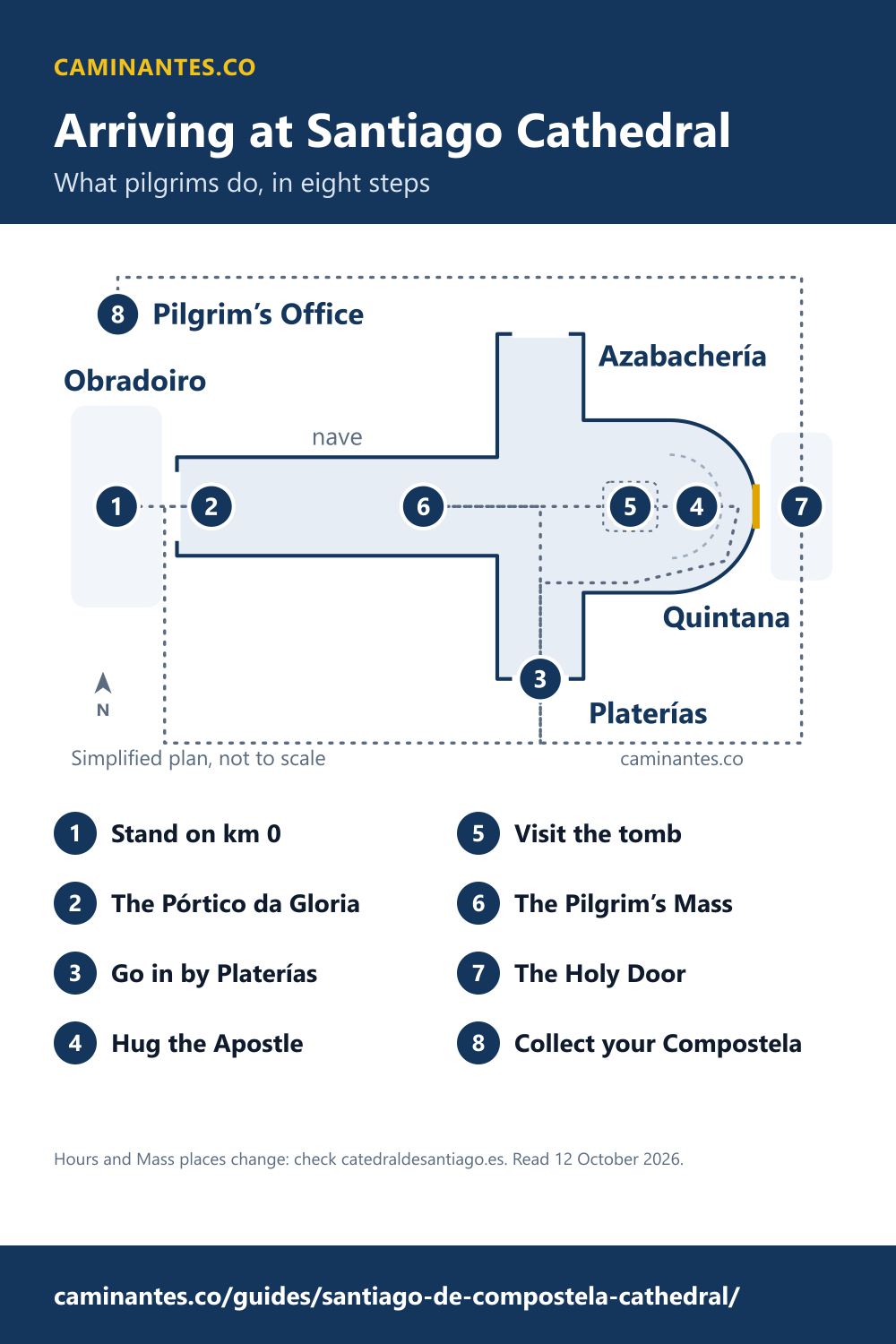
After weeks of yellow arrows, the Camino ends in one building, and almost nobody tells you what to do once you are standing in front of it. Pilgrims do the same few things in the same order: the square, the door, the hug, the tomb, the Mass, the certificate. Walk them on the plan above, then read the details below, including two changes this autumn: the Mass has moved out of the cathedral for now, and the Holy Door opens on 31 December 2026.
Coming in on foot? The last stretch, from the hill where pilgrims first see the spires: Monte do Gozo.
After the cathedral, the rest of the old town in 2, 4 or 6 hours, measured: what to see in Santiago.
Where do pilgrims go in?
Not through the great Obradoiro staircase. The free entrance is the Platerías door on the south side, the only Romanesque façade the cathedral has left. As of 12 October 2026, the cathedral and the Apostle’s tomb are open every day from 7:00 to 21:00, there are no visits during services, and nobody goes in with a backpack, for security. Leave it at your albergue or hotel first. Hours change; check the cathedral’s visit page on the day.
Hugging the Apostle, and the tomb
Above the high altar sits a seated statue of Saint James. Pilgrims reach it by small stairs in the ambulatory, the walkway round the back of the altar, come up into the little room behind the statue, the camarín, and embrace it from behind. Then, below the altar, the crypt: the silver urn with the relics, which the cathedral’s own pilgrim rites call the real end of the journey.
You will not be alone. In September 2025 the Pilgrim’s Office issued 81,534 Compostelas, about 2,718 a day; across the whole of 2025 it was 530,722, about 1,454 a day. Many of them make for the same narrow stairs, so expect to queue in the busy months. Here is how the crowd builds month by month.
The Pilgrim’s Mass, and where it is now
The Pilgrim’s Mass is normally said at the high altar. From 16 October 2026, until further notice, the Masses at 9:30, 12:00, and 19:30 are in the church of San Agustín, close to the cathedral, because works on the high altar mean services there are suspended. The 7:30 Mass stays in the cathedral, in the Capilla de la Comunión. Visits to the cathedral carry on as normal. This is the cathedral’s own notice; check it before you plan your last day around a Mass.
The giant censer swings only on certain days, and as of this autumn the cathedral says it is out of service for restoration. Our Botafumeiro page has every date it is meant to fly.
Know these words before your Camino. Spanish is preparation, the same as boots and stages. Try the free topic
The Pórtico da Gloria
Behind the Baroque Obradoiro façade is the portal it was built to protect: Maestro Mateo’s Pórtico da Gloria, with Saint James on the central column. An inscription on its lintels dates it to 1188, and the cathedral was consecrated in 1211. A restoration from 2008 to 2018 brought back its painted colours. To protect it, visits are in small groups, with a paid museum ticket or a free one, both booked through the cathedral. At its foot kneels the figure tradition calls the Santo dos Croques, said to be Mateo himself.
The Holy Door and the 2027 Holy Year
At the east end, on the Praza da Quintana, is the Holy Door. It opens only in a Holy Year, which the cathedral defines as a year when 25 July, the feast of Saint James, falls on a Sunday; that happens in a cycle of 11, 6, 5, and 6 years. The next is 2027, and the door opens on 31 December 2026. For a year, pilgrims can walk in through it. What 2027 means for the crowds.
Then the Compostela
The certificate is not given out in the cathedral. It is at the Pilgrim’s Office, Rúa das Carretas 33, a short walk from the Obradoiro. Here is what you need to get it, from the stamps to the last 100 km.
Sources. Cathedral of Santiago: visit page, pilgrimage page (pilgrim rites and Holy Year), Pórtico de la Gloria page, and its notice of 17 September 2026 on moving the Pilgrim’s Masses to San Agustín. Compostelas a day are ours, from the Pilgrim’s Office’s published counts. All read on 12 October 2026. The plan is a simplified drawing, not a survey.
Common questions
What do pilgrims do when they arrive at Santiago Cathedral?
They stop at km 0 in the Praza do Obradoiro, go in by the Platerías door, hug the statue of Saint James behind the high altar, visit his tomb in the crypt, attend the Pilgrim’s Mass and collect the Compostela at the Pilgrim’s Office, Rúa das Carretas 33.
Is Santiago Cathedral free to enter?
Yes. Entry is free by the Platerías door, every day from 7:00 to 21:00 as of 12 October 2026. The Pórtico da Gloria and the museum are separate, booked visits.
Can I take my backpack into the cathedral?
No. The cathedral does not let anyone in with a backpack, for security. Leave it at your albergue or hotel first.
Where is the Pilgrim’s Mass now?
From 16 October 2026, until further notice, the Masses at 9:30, 12:00, and 19:30 are in the church of San Agustín, near the cathedral, because of works at the high altar. The 7:30 Mass stays in the cathedral.
When is the Holy Door open?
Only in a Holy Year, when 25 July falls on a Sunday. The next is 2027, and the door opens on 31 December 2026.
Keep reading
The Cruz de Ferro is not the top of the Camino
Leave your stone at 1,494 m, then keep climbing: the Camino Francés tops out at 1,505 m, 5.5 km later. Walk it from Astorga to Molinaseca.
Baiona to Santiago: 6 days, 126.9 km, and 26.9 km to spare
The coastal Camino Portugués from Baiona, day by day: 363 people a day out of Baiona, 458 from Vigo, then 975 from Redondela.
The Camino from Astorga: 12 days, 256.7 km, over the Cruz de Ferro
The Camino Francés from Astorga, measured day by day. Day 2 climbs to 1,505 m near the Cruz de Ferro, then drops 982 m to Molinaseca.
Take it with you
Caminantes is free, works offline, and plans your stages around your own legs rather than a guidebook's.