Caminantes
Botafumeiro: when it swings, how it swings, and how to see it
By August Frederik Kramer · Last updated 7 October 2026
- 82°
- swing
- 66
- km/h now
- 17.2
- m above the lowest point
A model, not a measurement: a simple pendulum 20 m long, swung out to 82°, passes the bottom at about 66 km/h, within 3% of the cathedral’s 68.
Motion is off on this device, so here is the swing at its widest.
The Botafumeiro is the giant censer of Santiago Cathedral, 53 kg of silver-plated brass on a rope from the dome, swung across the transept until it almost touches the vault. You can only see it fly on certain days, and this autumn not even then. Here is every day it is meant to swing, worked out year by year, what the cathedral says today, and how eight men on a rope do it.
When does the Botafumeiro swing?
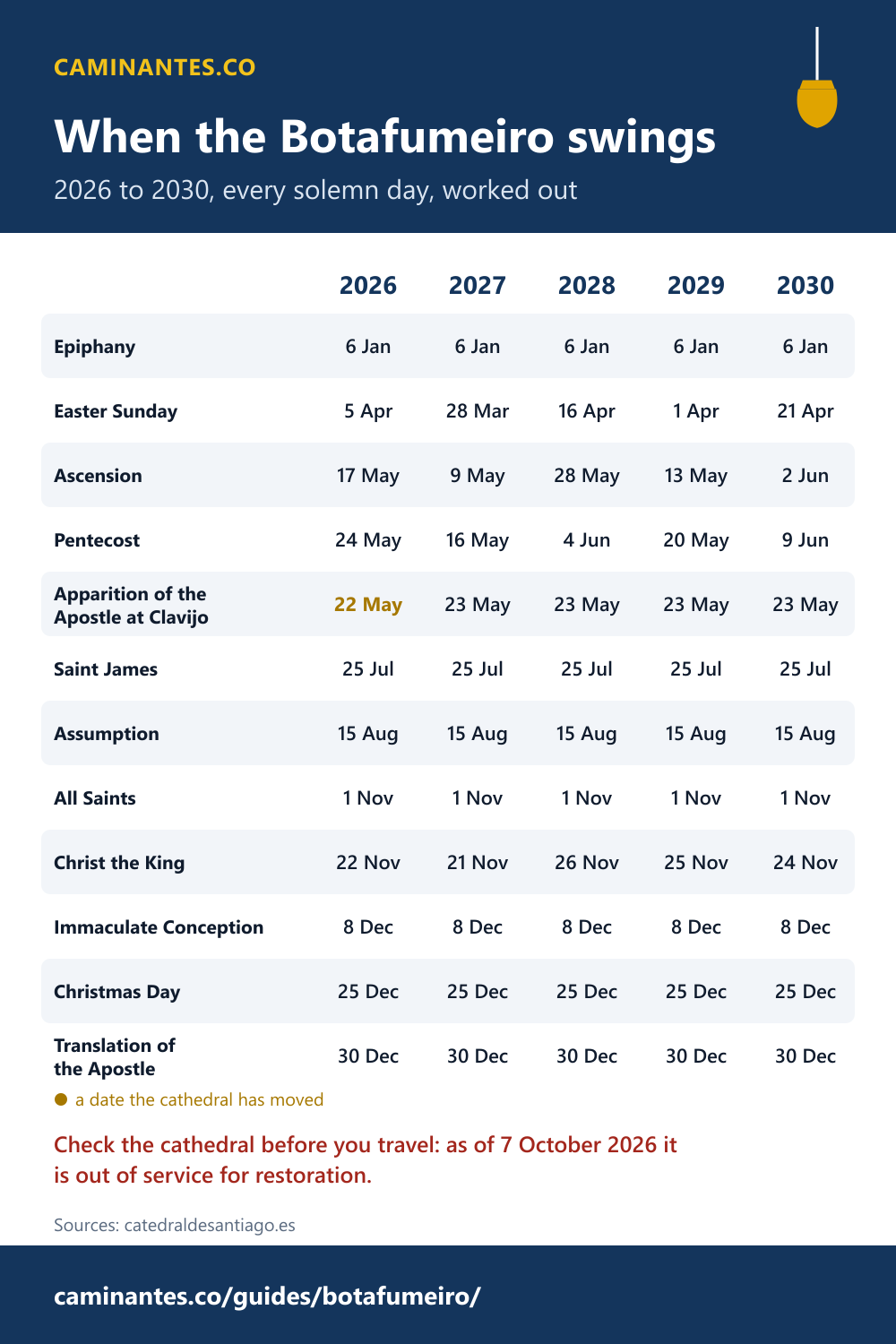
The cathedral lists 12 solemnities. Seven fall on the same date every year; four hang from Easter, and Christ the King is the last Sunday before Advent, so the calendar below computes them for each year. Two details from the cathedral’s own 2026 calendar: in Spain the Ascension is kept on the Sunday, 42 days after Easter, and the Apparition at Clavijo, 23 May, can be moved, as it was in 2026, to Friday 22 May. On most of these days the Botafumeiro flies in the procession at 11:40 before the main Mass.
| Epiphany | |
|---|---|
| Easter Sunday | |
| Ascension | |
| Apparition of the Apostle at Clavijo | moved by the cathedral this year |
| Pentecost | |
| Saint James | |
| Assumption | |
| All Saints | |
| Christ the King | |
| Immaculate Conception | |
| Christmas Day | |
| Translation of the Apostle |
| Epiphany | |
|---|---|
| Easter Sunday | |
| Ascension | |
| Pentecost | |
| Apparition of the Apostle at Clavijo | the cathedral can move it |
| Saint James | |
| Assumption | |
| All Saints | |
| Christ the King | |
| Immaculate Conception | |
| Christmas Day | |
| Translation of the Apostle |
| Epiphany | |
|---|---|
| Easter Sunday | |
| Apparition of the Apostle at Clavijo | the cathedral can move it |
| Ascension | |
| Pentecost | |
| Saint James | |
| Assumption | |
| All Saints | |
| Christ the King | |
| Immaculate Conception | |
| Christmas Day | |
| Translation of the Apostle |
| Epiphany | |
|---|---|
| Easter Sunday | |
| Ascension | |
| Pentecost | |
| Apparition of the Apostle at Clavijo | the cathedral can move it |
| Saint James | |
| Assumption | |
| All Saints | |
| Christ the King | |
| Immaculate Conception | |
| Christmas Day | |
| Translation of the Apostle |
| Epiphany | |
|---|---|
| Easter Sunday | |
| Apparition of the Apostle at Clavijo | the cathedral can move it |
| Ascension | |
| Pentecost | |
| Saint James | |
| Assumption | |
| All Saints | |
| Christ the King | |
| Immaculate Conception | |
| Christmas Day | |
| Translation of the Apostle |
What the cathedral says now
As of 7 October 2026, the cathedral’s page says the Botafumeiro is temporarily out of service because of restoration work. Some guides still promise it daily until the end of 2026; the cathedral’s own notice is the one to trust. Check its liturgy page before you plan a day around it.
Outside these days it swings when a pilgrim group has asked for it in advance. The cathedral takes requests at botafumeiro@catedraldesantiago.es; it does not publish a price on its site.
Know these words before your Camino. Spanish is preparation, the same as boots and stages. Try the free topic
How big is it, and how does it swing?
The cathedral gives 53 kg and 1.5 m, hung 20 m up, and a top speed of 68 km/h. Swung by 8 men in mauve robes, the tiraboleiros, it travels a 65 m arc between the Azabachería and Platerías doors, rises to about 21 m at each end and reaches its widest swing, about 82°, in roughly 80 seconds.
Not every source agrees on the weight. Some give 62 kg since a silver plating in 2006, English Wikipedia gives 80 kg, and figures from 50 to 160 kg have been printed. We use the cathedral’s.
The speed checks out. Treat it as a simple pendulum 20 m long swung out to 82°, and it passes the bottom at about 66 km/h, within 3% of the cathedral’s 68, after dropping about 17.2 m. One full swing there and back takes about 10.3 seconds.
The men do not push it. They pull the rope as the censer passes the bottom and let it out at each end, shortening and lengthening the pendulum the way a child pumps a swing, and every pass adds energy. The physicist Juan R. Sanmartín worked this out in 1984 in the American Journal of Physics, calling it parametric pumping in the Middle Ages.
The rope is 65 m long, 5 cm thick and weighs 90 kg; it has been synthetic since 2004.
What the name means, and its history
Botafumeiro is Galician, literally a smoke expeller. The first written trace is a note in the Codex Calixtinus, which calls it Turibulum Magnum, the great censer.
The censer in use is José Losada’s, made of silver-plated brass in 1851; a silver replica, given to the cathedral in 1971, waits in the museum. An older silver censer was taken by Napoleon’s troops in 1809. The mechanism that lifts it under the dome was restored in 2024.
It has fallen. On 25 July 1499, with Catherine of Aragon in the cathedral, it flew out through the window above the Platerías door; it came loose again in 1622 and in 1937. Nobody was hurt in any of them.
The Pilgrim Mass
The Pilgrim Mass is celebrated every day at 07:30, 09:30, 12:00, and 19:30 at the high altar. The cathedral lets nobody in with a backpack, and offers simultaneous translation through an app for Android and Apple. From 16 October 2026, until further notice, the cathedral holds the 9:30, 12:00 and 19:30 Masses in the nearby church of San Agustín while the high altar is worked on; our cathedral guide has the details and the rest of the pilgrim’s arrival.
Two words on the door are worth knowing: the peregrino is you, the pilgrim, and the mochila is the backpack you leave behind. Both are in our free Spanish topic for the Camino.
The Holy Year
The cathedral opens the Holy Door on 31 December 2026 at 17:00, the start of the 2027 Holy Year. What that means for the crowds is in our Xacobeo 2027 guide.
Not sure how to say the place names on the way? Here is how to pronounce them.
With time to spare before or after the swing: what to see in Santiago in 2, 4 or 6 hours.
Sources. Cathedral of Santiago, liturgy page and 2026 calendar; Pilgrim’s Office FAQ, “When is the Botafumeiro used?”; Wikipedia, “Botafumeiro”, in English and Spanish; J. R. Sanmartín, “O Botafumeiro: Parametric pumping in the Middle Age”, American Journal of Physics 52 (1984). All read on 7 October 2026. Easter dates computed with the anonymous Gregorian algorithm.
Common questions
Does the Botafumeiro swing every day?
No. It swings on 12 solemn days a year and when a pilgrim group has booked it. As of 7 October 2026, the cathedral says it is temporarily out of service for restoration.
When can I see the Botafumeiro?
On the solemnities in the calendar above, usually in the procession at 11:40 before the main Mass. Check the cathedral’s liturgy page before you go.
What does Botafumeiro mean?
It is Galician for, literally, a smoke expeller: a censer.
Has the Botafumeiro ever fallen?
Yes: in 1499, when it flew out through a window, and again in 1622 and 1937. Nobody was hurt.
How much does the Botafumeiro weigh?
The cathedral says 53 kg, for 1.5 m of censer. Other sources give from 50 to 160 kg.
Keep reading
Lisbon to Santiago: 31 days, 620.2 km, and an empty first half
The whole Camino Portugués from Lisbon, measured day by day: 18 days to Porto with at most 19 people a day setting out, then a path that fills to 975 a day.
Ultreia et suseia meaning: what pilgrims say, and what to answer
Ultreia is “further on”, suseia “higher up”: words from 12th-century pilgrim hymns in the Codex Calixtinus. What each part means, and the answer: et suseia.
Camino Sanabrés: 18 days, 358.2 km, and the hundred from Ourense
Granja de Moreruela to Santiago day by day: 5,654 m of climbing, Galicia from day 7. From Ourense, 109.9 km that climb 482 m more than the hundred from Sarria.
Take it with you
Caminantes is free, works offline, and plans your stages around your own legs rather than a guidebook's.