Caminantes
Ultreia et suseia meaning: what pilgrims say, and what to answer
By August Frederik Kramer · Last updated 6 October 2026
Somewhere on the Camino a pilgrim will call out a word that is not Spanish: Ultreia! It was written down in the twelfth century, and it has a proper answer. Here is what each word of Ultreia et suseia, Deus adjuva nos means, where the line was first written down, and what to say back.
What each word means
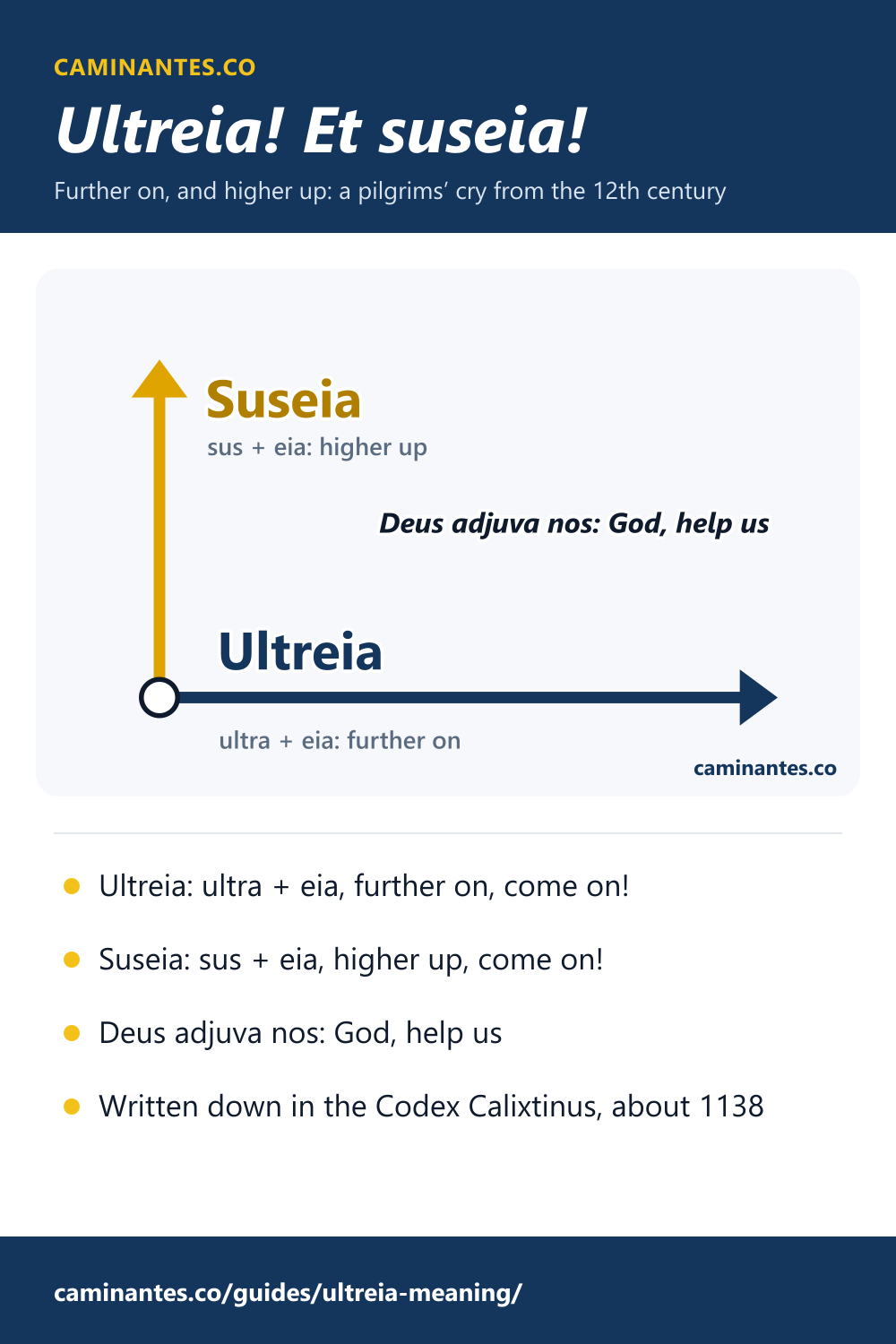
The line is four pieces, and three of them end the same way. eia is a Latin cry, “come on!”, the sound you make to get someone moving. Put a direction in front of it and you have the whole idea: forward, and up.
Tap any word of the line.
- Ultreia
- ultra beyond, furthereia come on!Further on, come on! Keep going.
- et
- et andAnd. The Codex has a single e here; whether that e meant “and” or was part of the cry, readers differ.
- suseia
- sus up, high up (Old French, from Latin sursum)eia come on!Higher up, come on! Keep climbing.
- Deus adjuva nos
- Deus Godadjuva help (an order: help!)nos usGod, help us.
All together
“Further on, come on! And higher up, come on! God, help us.” In short: onward, and upward.
Where it comes from
The words are written down in the Codex Calixtinus, the twelfth-century book about Saint James and the pilgrimage, most likely compiled between 1138 and 1145. Ultreia turns up in it at least three times:
- Dum pater familias, a pilgrims’ hymn in the appendix, known as the song of the Flemish pilgrims. It opens in a Germanic tongue, Herru Santiagu, Got Santiagu, and then sings E ultreia, e suseia, Deus adiuva nos.
- Ad honorem regis summi, another hymn of the appendix: E ultreia esus eia decantemus iugiter, “let us sing it without end”.
- Book I, chapter XXVI, part of the mass for the feast of Saint James, where the peoples of every tongue come to the tomb crying suseia, ultreia.
The Codex writes “e ultreia, e suseia” and adiuva; the modern line has et and adjuva. Both spellings are right; the modern one is the one in songs and on rings. The language is a mix too: eia and ultra are Latin, sus is Old French.
What to answer
Answer Ultreia! with Et suseia! Said together, the two halves make the old cry: further on, and higher up. Be honest with yourself about one thing: in the Codex the words stand side by side in hymns, and nothing there says one pilgrim called and another answered. The Spanish Wikipedia puts it as “it seems” that the old greeting worked that way. The call and answer is how pilgrims use it today.
- A pilgrim calls Ultreia!You say Et suseia!
- A pilgrim calls ¡Buen Camino!You say ¡Buen Camino!
Know these words before your Camino. Spanish is preparation, the same as boots and stages. Try the free topic
Who says it today
In 1989 it became a song: “Ultreïa”, the “Chant des pèlerins de Compostelle”, written by Jean-Claude Benazet. Its refrain is the old line, and according to French Wikipedia it is sung on the way, at Conques and at the pilgrims’ mass in Santiago. You will hear it from pilgrims who know the song, and see it on rings, shells and tattoos.
The greeting you will hear every day is Spanish, ¡Buen Camino!, and it is answered with the same two words. Ultreia is the old one, and the rarer one, a little like meeting someone who knows the old song. If you want the Spanish of the Camino itself, start with the free words.
What Santiago and Compostela mean is in the meaning of Camino de Santiago.
Ultreia, ultreya or ultreïa?
All three. Ultreia, Ultreya, and Ultreïa: ultreya is the Spanish spelling, ultreïa the French one (the two dots tell you to say the i on its own), and ultreia the Latin of the Codex. For a tattoo, a ring or a shell, “Ultreia et suseia” is the form people search for most, and the Codex’s own “E ultreia, e suseia” is just as old.
Say it ool-TRAY-ah et soo-SAY-ah.
The Spanish words of the Camino, said aloud, are in how to pronounce the Camino.
Read next
What Buen Camino means, and how to answer it.
Sources. Wikipedia in Spanish (“Ultreia”, which quotes the Codex lines), in French (“Ultreïa”, for the 1989 song; that article is marked as needing sources) and in English (“Codex Calixtinus”, for the date); Wiktionary for sus and eia. The Codex itself spells e ultreia, e suseia and adiuva.
Common questions
What does ultreia et suseia mean?
Roughly “further on, and higher up”. Ultreia is Latin ultra (beyond) plus eia (come on!); suseia is Old French sus (up) plus the same eia. The full line ends Deus adjuva nos, “God, help us”.
What do you answer to ultreia?
Et suseia. Said together they make the old cry: further on, and higher up.
Where does ultreia come from?
From hymns in the Codex Calixtinus, a 12th-century book about Saint James and the pilgrimage, most likely compiled between 1138 and 1145. A song written in 1989 made it well known again.
Is it ultreia or ultreya?
Both. Ultreya is the Spanish spelling, ultreïa the French one, ultreia the Latin of the Codex.
Do people still say ultreia on the Camino?
Some do, especially those who know the 1989 song. The everyday greeting is Buen Camino, answered with Buen Camino.
Keep reading
Camino Sanabrés: 18 days, 358.2 km, and the hundred from Ourense
Granja de Moreruela to Santiago day by day: 5,654 m of climbing, Galicia from day 7. From Ourense, 109.9 km that climb 482 m more than the hundred from Sarria.
How to pronounce Camino de Santiago, and every town on the way
Camino de Santiago is kah-MEE-noh deh sahn-TYAH-goh. Hear it said, then all 184 stage towns in Spain: 110 of them have a letter an English reader gets wrong.
Camino de Santiago meaning: Santiago, Compostela, word by word
Santiago is Saint James fused into one word, and Compostela is most likely a burial ground, not a field of stars. Of the 211 towns our 10 routes stop in, 12 carry a saint’s title; only the last carries James.
Take it with you
Caminantes is free, works offline, and plans your stages around your own legs rather than a guidebook's.