Caminantes
What does Buen Camino mean?
By August Frederik Kramer · Last updated 26 September 2026
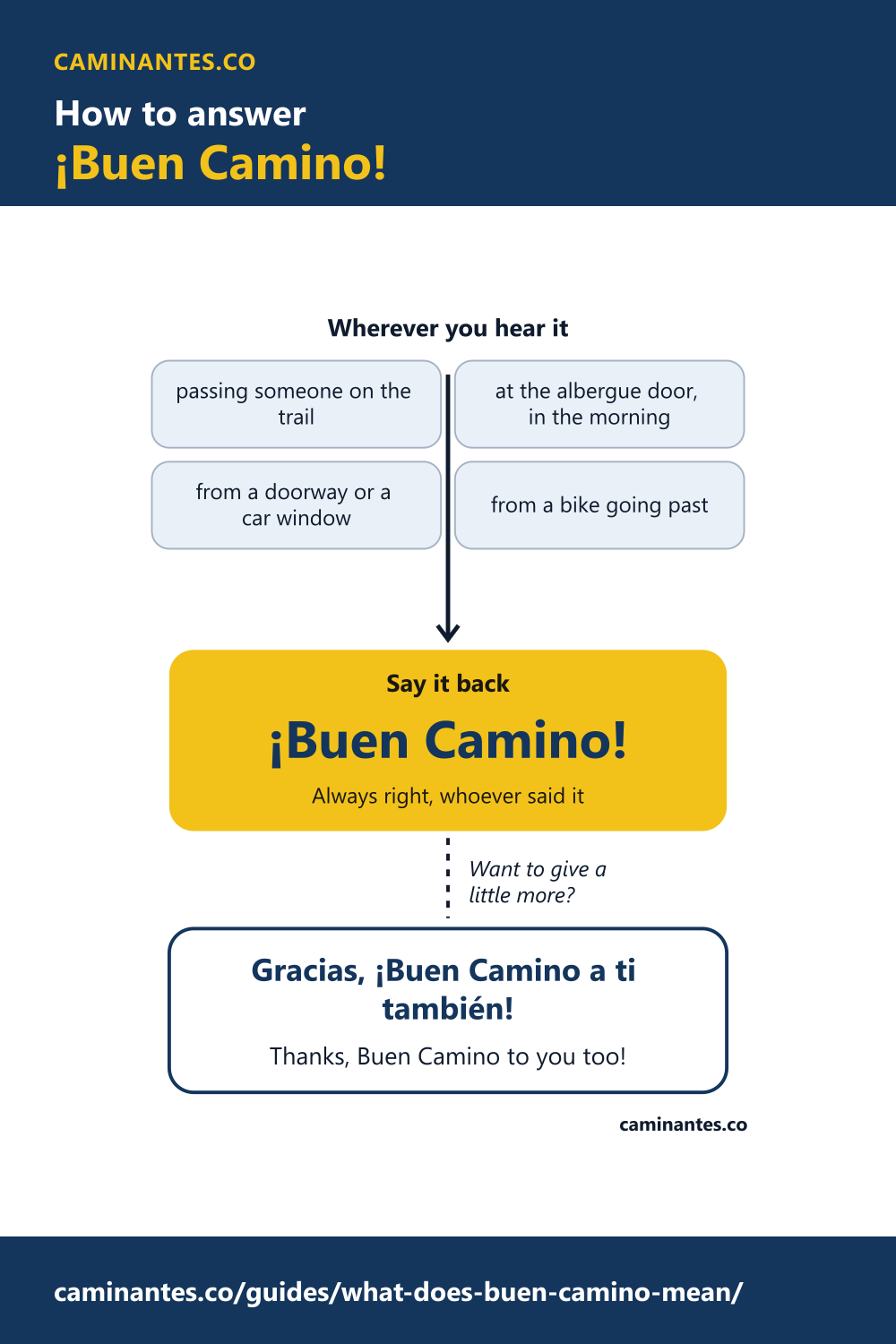
¡Buen Camino! means have a good Camino, and word for word it is good path. It is the only Spanish you are guaranteed to need, because it is said to you before you have asked anything of anybody: from a doorway, from a passing bike, from the pilgrim overtaking you on a hill. It works as hello, as goodbye and as good luck, and the reply is the same two words back.
Why one phrase does three jobs
On a normal street you would need a greeting, a farewell and a good wish, and you would have to pick the right one for the time of day. On the route you need none of that. Two people passing in opposite directions have nothing to negotiate and about a second and a half to do it in, so the language settled on a single phrase that fits every case, and the whole route uses it.
That is also why it sounds odd translated. have a good Camino is what it does.Good path is what it says. Neither is what an English speaker would have thought to say in the same moment, which is most of why people look it up.
How to answer it
Say it back. The convention has no more to it than that, and a pilgrim who answers ¡Buen Camino! with the same two words has done the thing correctly. If you want to give it a little more, the product's own example is the one you will hear most:
Gracias, ¡Buen Camino a ti también!
Thanks, Buen Camino to you too!
You will also hear it used as a goodbye at an albergue door in the morning, when neither of you is going anywhere for another minute. That is not a mistake. It is the phrase doing its third job.
Download this as a card (PNG)Free to share or print for your group. A link back to this page is all we ask.
Some pilgrims call out something much older instead: Ultreia, and what to answer.
Who will say it to you
Nobody counts greetings, so any claim that you will hear it forty times a day is a guess. The Pilgrim’s Office does count people, though, by month and by the town they started in, and that is enough to answer a better question: how many people walk the same stage as you, on the same day? Every one of them can say it to you.
In September 2025, the busiest month, about 155 pilgrims a day walked day 1 of the Camino Francés, out of Saint-Jean-Pied-de-Port. On day 32, out of Sarria, it was about 1,104: 7.1 times as many. One September day out of Sarria puts more people on the path than a whole week out of Saint-Jean.
Estimated from the Pilgrim’s Office counts of where people start, so treat both as rough figures.
The whole crowd, stage by stage, is drawn in the 36 stages of the Camino Francés.
So if you start in Sarria, learn the answer before anything else. You will need it on your first morning.
Know these words before your Camino. Spanish is preparation, the same as boots and stages. Try the free topic
How it is said
Roughly BWEHN kah-MEE-noh. Two things trip English speakers up. The u is not silent: buen is one syllable and the u glides into the e, so it is nearer bwen than boo-en. And Spanish vowels do not shift with the letters around them, so thei in camino is alwaysee. Those five steady vowels are the reason this walk's vocabulary is easier to say than to remember.
The other 15 words you will hear daily
These are not a phrasebook's opening chapter. They are what a yellow arrow, a hostel desk and a pharmacy counter actually use on this walk, and most of them will not appear in a general Spanish course at all. Each is given the way the course gives it, with its gender and one of its own example sentences.
| Spanish | Meaning | Form | In a sentence |
|---|---|---|---|
| el peregrino | the pilgrim | noun, m; la peregrina for a woman | Soy peregrino, voy a Santiago. I am a pilgrim, I am going to Santiago. |
| la credencial | the pilgrim passport | noun, f | Necesita la credencial para dormir aquí. You need the pilgrim passport to sleep here. |
| el sello | the stamp | noun, m | ¿Me puede poner un sello? Could you give me a stamp? |
| la flecha amarilla | the yellow arrow | noun, f | Sigue la flecha amarilla. Follow the yellow arrow. |
| el camino | the way, the path | noun, m | El camino sube hasta el pueblo. The path climbs up to the village. |
| la etapa | the stage, the day's walk | noun, f | La etapa de hoy son veinticinco kilómetros. Today's stage is twenty-five kilometres. |
| la mochila | the backpack | noun, f | Mi mochila pesa ocho kilos. My backpack weighs eight kilos. |
| la bota | the boot | noun, f | Las botas están mojadas. My boots are wet. |
| la ampolla | the blister | noun, f | Tengo una ampolla enorme. I have a huge blister. |
| la farmacia | the pharmacy | noun, f | ¿Hay una farmacia en el pueblo? Is there a pharmacy in the village? |
| el albergue | the pilgrim hostel | noun, m | El albergue abre a la una. The albergue opens at one o'clock. |
| el hospitalero | the albergue host | noun, m; la hospitalera for a woman | El hospitalero me selló la credencial. The host stamped my pilgrim passport. |
| la litera | the bunk bed | noun, f | Prefiero la litera de abajo. I prefer the bottom bunk. |
| ¿hay camas libres? | are there free beds? | Buenas tardes, ¿hay camas libres? Good afternoon, are there free beds? | |
| completo | full, no vacancies | Lo siento, está completo. I'm sorry, we are full. |
The three that cause the most trouble
completo is the one to learn first, because it is the answer you least want and the one you will understand instantly once you know it: full, no vacancies. It is said kindly and it is not negotiable.
la credencial and el sello are the pair that decides whether the walk counts: the pilgrim passport and the stamp. Every desk, bar and church on the route knows both words, and a pilgrim who knows neither spends a lot of the first week pointing.
Where these words come from
All 16 are the free half of our own Camino course, which is open to anybody with no account and nothing to fill in. This page is generated from that same data rather than typed out here, so it cannot drift away from what the course actually says. If you want to practise them rather than read them,Camino basics is where they live, and the other nine courses covereating,rooms,transport,the pharmacy,paperwork,numbers,verbs,weather andpilgrim conversation.
If what you are really asking is how much Spanish the walk needs rather than what one phrase means, that is a different question and it has its own page: the Spanish you actually need on the Camino.
Common questions
What does Buen Camino mean?
Literally "good path". In use it means "have a good Camino", and it carries hello, goodbye and good luck at once. It is what pilgrims say to each other in passing, in both directions, and what locals call from doorways and car windows. You will hear it more than every other Spanish phrase on the route put together.
How do you reply to Buen Camino?
Say the same words back. That is the whole convention and nobody expects more. If you want to give it a little more: "Gracias, ¡Buen Camino a ti también!" is "Thanks, Buen Camino to you too!".
How is Buen Camino pronounced?
Roughly BWEHN kah-MEE-noh. The u in buen is not silent, it glides into the e, so the word is one syllable rather than two. The c is hard. Spanish vowels do not change with the letters around them, which is why the same five sounds carry every word on this page.
Is Buen Camino religious?
No, and it is said freely to pilgrims of every reason for walking. The route is a Christian pilgrimage and the greeting grew up on it, but the phrase itself is a wish for a good walk. Nobody is asking what you believe when they say it.
Do you say Buen Camino to cyclists?
Yes. Anybody on the route travelling under their own power gets it, on foot or on a bike, and they will say it first as often as not because they reach you faster. Walkers going the other way get it too.
What else will I hear every day?
The 15 words below this page's greeting: peregrino (the pilgrim), credencial (the pilgrim passport), sello (the stamp), flecha amarilla (the yellow arrow), camino (the way, the path), and ten more. They are not phrasebook Spanish. They are the words a signpost, a hostel desk and a pharmacy counter use on this specific walk.
Keep reading
The Variante Espiritual: 74.8 km on foot, or 41.7 km and a boat
The direct line from Pontevedra to Pontecesures is 34.7 km; walking the whole variant is 74.8 km, more than double. Take the Traslatio and it is 7.0 km more than not going at all.
The credencial: 10 stamps from Sarria, and the rule everyone misquotes
"Two stamps a day" is not in the Pilgrim’s Office rules. On our split that is 10 stamping moments from Sarria, and 10 to 12 across the 7 routes that reach Santiago.
Which shoes for the Camino? The Francés descends 10,355 m
Every shoe guide for this walk is written about climbing. 20 of the Francés’s 36 stages descend more than they climb, and the biggest descent day comes 25 days after the biggest climb.
Take it with you
Caminantes is free, works offline, and plans your stages around your own legs rather than a guidebook's.