Caminantes
Camino de Santiago Holy Year 2027: the Xacobeo
By August Frederik Kramer · Last updated 10 August 2026
2027 is a Holy Year on the Camino de Santiago. If you have been putting off the walk, this is the year with the most reason to go, and the most reason to plan early. The decisions that matter most are the ones you make before you book anything.
The dates that matter
| Date | What happens | Detail |
|---|---|---|
| 31 December 2026 | The Holy Door opens | The archbishop strikes the sealed wall three times with a silver hammer in the Praza da Quintana. This is the evening before the Holy Year, not 1 January. |
| 1 January 2027 | The Holy Year proper begins | The Jubilee runs the full calendar year. Every day of it counts, including February and November. |
| Sunday 25 July 2027 | The feast of Saint James | The date the whole thing hangs on, and the single busiest day in Santiago. The Sunday is what makes 2027 a Holy Year at all. |
| 31 December 2027 | The door is sealed again | Walled up until the next Holy Year in 2032. |
A note on the first row, because plenty of pages get it wrong: the Holy Door is opened on 31 December 2026, not on 1 January. If you want to be there for the opening ceremony, that is the night to be in Santiago.
Why 2027 is different
A Jacobean Holy Year, called a Xacobeo in Galicia, happens whenever 25 July, the feast of Saint James, falls on a Sunday. That lines up only 14 times a century. In 2027 it does, so the Holy Door of Santiago Cathedral, sealed shut in every ordinary year, stands open for the whole of the year.
For religious pilgrims the significance is the Jubilee: a plenary indulgence for those who reach the tomb of the Apostle during the year. For everyone else, the practical consequence is simpler and harder to ignore. The trail will be fuller than you have been told to expect.
How much busier, honestly
Every Camino site will tell you 2027 will be busy. Almost none of them will tell you by how much, because the honest answer is that nobody knows yet, including the Pilgrim’s Office, which has not published a 2027 forecast. What can be said is what happened last time.
2010 is the last clean comparison. It was the previous Holy Year untouched by the pandemic, and pilgrim numbers went from roughly 147,000 in 2009 to roughly 272,000 in 2010, an increase of about 86%. Sources differ slightly on the exact totals, but not on the shape: a Holy Year came close to doubling the traffic.
Why 2021 and 2022 are not in that comparison. The last Holy Year was 2021, and Pope Francis extended it through 2022, the first time a Jubilee has ever run for two years. It was announced on the night the door opened, explicitly to spread the crowds out. Between the pandemic and a Jubilee stretched over twice the normal span, those two years tell you almost nothing about what a normal Holy Year does to a normal year. Anyone quoting them at you for 2027 is reaching.
So resist multiplying. 2025 was already a record at 530,722 pilgrims collecting a Compostela, up about 6% on 2024, and 2010’s 86% jump came off a base less than a third of that size. The infrastructure has grown a great deal since then too. Applying 2010’s multiplier to 2025’s total would give you a number no one is forecasting.
The useful conclusion is not a total. It is that where the pressure lands is entirely predictable, even when the size of it is not.
What that means on the ground
- Beds go first, not food or water. The last 100 km from Sarria on the Camino Francés is the tightest stretch in any year and will be the first to fill in 2027.
- Late July is the peak of the peak. The feast day itself draws crowds into Santiago independently of the walking season, and in 2027 it falls on a Sunday, which pulls a weekend around it.
- The quieter routes stop being a compromise. A Holy Year is the best possible argument for walking the Primitivo, del Norte or Vía de la Plata instead, all of which absorb crowds far better than the Francés. The Invierno is quieter still.
The thing most Holy Year advice gets wrong
You will read “book everything months in advance” everywhere. For private albergues, hostales and hotels, that is correct and you should. For the public network it is not advice at all, because Galicia’s public albergues do not take reservations. Beds are assigned in order of arrival, and the priority order runs: pilgrims with physical limitations first, then pilgrims on foot, then on horseback, then by bicycle, then anyone travelling with a support vehicle. Maximum stay is one night.
There was an online booking platform for the public network for a while, introduced during the COVID years. It is gone, and the site it ran on no longer resolves. Do not plan around it, and be wary of guides that still list it.
That single fact should change your plan more than any other on this page:
- Shorter stages beat longer ones in a Holy Year, because arriving early is the only lever you have on a bed you cannot reserve. A 30 km day that gets you in at six in the evening is a worse plan in 2027 than a 20 km day that gets you in at one.
- Decide in advance which nights are private. Mixing is fine, and on the pinch points it is the sane choice. Book those, and treat the public nights as the flexible ones.
- Have a fallback town in mind for every stage, not just an end point. The question is never “is there a bed”, it is “how far do I have to walk to the next one at seven in the evening”.
If you are unsure what daily distance you can actually sustain, that is worth settling before you book anything: see how many km a day pilgrims really average, computed from the real stage data for all ten routes.
Know these words before your Camino. Spanish is preparation, the same as boots and stages. Try the free topic
A planning timeline from here
Working backwards from a 2027 walk, roughly:
- Twelve to eighteen months out: pick the route and the month. These are the only two decisions that are genuinely hard to reverse later, and neither costs anything. The route comparison puts distance, days and total ascent side by side, and the season guide covers heat, rain and daylight month by month.
- Winter 2026 to 2027: book flights and the pinch points. Sarria onwards if you are walking the Francés, any city stop, and any stage ending on a Saturday. This is also when the shoulder-season decision pays off, because April and October beds are still findable at this stage.
- Three months out: build the actual stage plan. Not a guidebook’s, yours, around the distance you know you can hold. This is the part the app is for, and it works offline once the route is cached.
- One month out: walk with the pack you are taking. Holy Year or not, the first week is what ends most Caminos, and it is the one variable entirely within your control. See the packing list.
How to plan for a Holy Year
The instinct is to book everything. The better move is to decide your shape early and your beds later.
- Pick the route first. If your dates are fixed in high summer, choose a route that can take it.
- Then pick your daily distance honestly. A Holy Year is the wrong year to discover that 27 km days do not suit you, because there is less slack in the beds ahead of you when you need to stop early.
- Then book the pinch points. Sarria onwards, any city, and anywhere your stage ends on a Saturday.
- Consider going in the shoulder season. April, May, late September and October are still Holy Year walking, with the Holy Door open, and a fraction of the July pressure. The Jubilee does not care which month you arrive.
Earning the Jubilee, precisely
Worth separating two things that get run together constantly.
The Compostela is the cathedral’s certificate for the walk itself. The requirement is the last 100 km on foot or horseback, or 200 km by bicycle, evidenced by stamps in your credencial. That rule is identical in a Holy Year. A Holy Year does not shorten it, lengthen it or change it. The full rules for the Compostela cover the two-stamp stretch and the A Coruña exception, which are the two details that catch people out.
The Jubilee indulgence is a separate, religious matter, and it is the thing that only exists in a Holy Year. The conditions are to visit the tomb of Saint James in the cathedral, pass through the Holy Door, pray for the Pope’s intentions, and receive the sacraments of confession and communion. Those sacraments do not have to happen on the same day: roughly a fortnight either side of the visit is accepted.
You can earn one without the other. Plenty of people walk the last 100 km, collect a Compostela and never go through the Holy Door. Plenty of others pass through the door having arrived by bus.
When is the next Holy Year?
The next one is 2027. After that come 2032, 2038, 2049, 2055, 2060, 2066 and 2077.
The rule behind it is simple. There is a Holy Year whenever 25 July, the feast of Saint James, falls on a Sunday. Nobody decides it year by year; it comes straight out of the calendar.
That is why the gaps are uneven. They repeat in a cycle of 6, 5, 6 and 11 years:
- 2021 to 2027: 6 years
- 2027 to 2032: 5 years
- 2032 to 2038: 6 years
- 2038 to 2049: 11 years
- 2049 to 2055: 6 years, and the cycle starts over
The eleven-year gap is the one that surprises people, and almost no summary explains it. The Gregorian calendar repeats its days of the week on a 28-year cycle, and that long gap is where the cycle resets. It checks out easily enough: 2021 plus 28 is 2049, and 2027 plus 28 is 2055.
If you cannot make 2027
The next real opportunity is 2032. That is a long wait, and it is worth saying plainly: the Camino is the same walk in an ordinary year, with more space on it. The Jubilee is a reason to go, not a requirement. If crowds are what you are trying to avoid, 2028 will be one of the quieter years on the trail for exactly the same reason 2027 will be one of the busiest.
What a Holy Year actually did, measured
There is one complete before-and-after in the office’s record. 2010 was a Holy Year and it drew 272,417 pilgrims against 147,467 the year before: +84.7%. The year after fell back to 183,378, -32.7% on the Holy Year, and that is the figure usually quoted. The one that is not quoted is the third: 2011 still stood 24.4% above 2009. A Holy Year does not borrow pilgrims from the following year. It raises the floor.
And it did not do what everyone expects. The three months that carry the most pilgrims in an ordinary year grew slowest, and their share of the year fell from 56.3% to 51.7%. July grew 58.3%, the least of any month. December grew 490.2%.
That is growth in per cent, and the quiet months start from almost nothing. Counted in people, high season still took the biggest share of the extra: the three busiest months added 46% of the 124,950 extra pilgrims, and August alone added 25,937, more than any other month. What a Holy Year changes is the shape of the year, not where the crowd is. If you are deciding when to walk in 2027, expect the summer to be busier than ever, and the quiet months to be the ones that feel least like a normal year.
| Month | 2009 | 2010 | Growth |
|---|---|---|---|
| January | 525 | 1,188 | +126.3% |
| February | 702 | 1,640 | +133.6% |
| March | 1,856 | 5,882 | +216.9% |
| April | 10,327 | 19,587 | +89.7% |
| May | 16,507 | 28,851 | +74.8% |
| June | 19,361 | 33,757 | +74.4% |
| July | 26,838 | 42,472 | +58.3% |
| August | 35,605 | 61,542 | +72.8% |
| September | 20,649 | 36,855 | +78.5% |
| October | 11,732 | 26,600 | +126.7% |
| November | 2,354 | 8,076 | +243.1% |
| December | 1,011 | 5,967 | +490.2% |
It did not land evenly on the routes either. Starts at Sarria rose 155.7% and at Tui 329.2%, while Saint-Jean-Pied-de-Port, the start most articles are about, rose 11.9%. Saint-Jean’s share of recorded starts fell from 30.9% to 15.6%. A Holy Year is felt on the last hundred kilometres, not over the Pyrenees.
Download this as a Holy Year poster (PNG)Free to use in your group or on your blog. A link back to this page is all we ask.
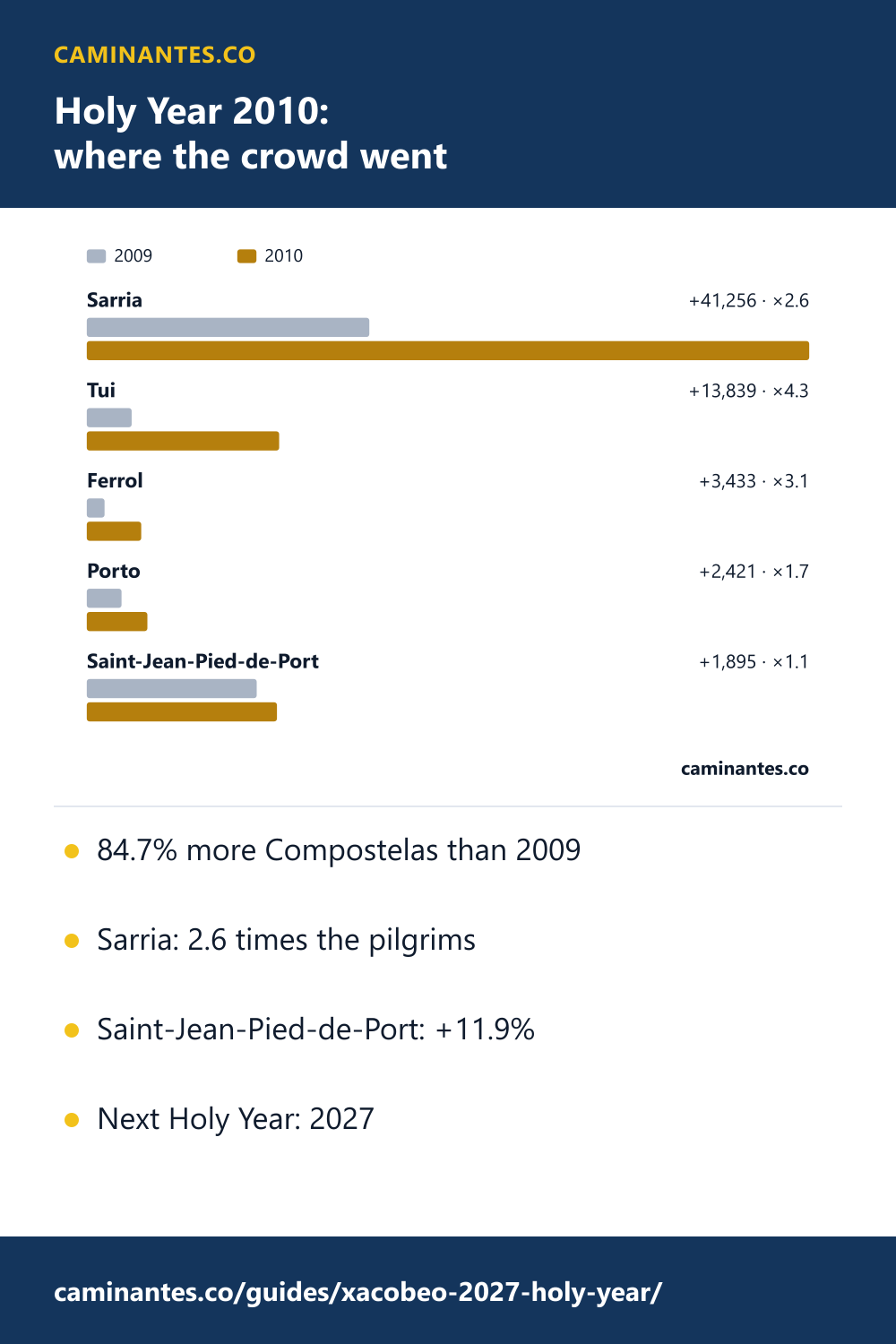
Counted in people rather than percent: in 2010 Sarria gained 41,256 starts and Saint-Jean 1,895. For every extra pilgrim who set off from Saint-Jean, about 22 more set off from Sarria. Start in the Pyrenees and the last Holy Year barely changed how many set off with you; start in Sarria and the crowd was 2.6 times the year before.
The people who came were Spanish. The Spanish share of arrivals went from 54.3% in 2009 to 69.2% in the Holy Year and back to 53.3% the year after. The surge was domestic and it went home again.
2021 was also a Holy Year and it is left out of this comparison on purpose. It came in 48.5% below 2019, the last year before the pandemic, and it was the first jubilee ever extended into a second year. 2022 then ran 25.9% above 2019. There is no clean reading of a Holy Year in those numbers, and anybody offering you one is reading a pandemic.
Which leaves arithmetic rather than a forecast. 2025 closed at 530,722. 2026 had reached 454,669 by September 20, 2026, which the office puts at 7% up on the same point last year, so 2026 lands near 567,873. Applying the 2010 multiple of 1.85 to that gives roughly 1,050,000 for 2027.
Treat that as a ceiling rather than an expectation, and here is the measured reason. The 2010 surge was overwhelmingly Spanish, and Spanish pilgrims were 54.3% of arrivals then against 43.0% in 2025. The pool that surged is a much smaller part of the whole than it was, so the same multiple is unlikely to repeat.
Every figure here counts Compostelas issued to pilgrims arriving in Santiago. That is a floor on the number who walked, not a count of everyone on the routes.
Common questions
What is a Camino Holy Year?
A Jacobean Holy Year, or Xacobeo, happens whenever 25 July, the feast of Saint James, falls on a Sunday. It happens only 14 times a century. During a Holy Year the Holy Door of Santiago Cathedral is opened and pilgrims who reach the Apostle’s tomb can receive a plenary indulgence.
How much busier will the Camino be in 2027?
Nobody credibly knows yet, and be sceptical of anyone who gives you a precise figure. The last clean comparison is 2010, the previous Holy Year unaffected by the pandemic, when numbers went from roughly 147,000 to roughly 272,000, an increase of about 86%. But that was from a far smaller base than today, and 2025 already set a record at 530,722. What is predictable is not the total but where the pressure lands: the last 100 km from Sarria, the cities, and late July.
When does the Holy Door open for 2027?
On 31 December 2026, the evening before the Holy Year begins, when the archbishop knocks down the wall sealing it. It stays open for the whole of 2027 and is sealed again on 31 December 2027.
Can I book a bed in the public albergues in advance for 2027?
No. Galicia’s public albergue network does not take advance reservations at all. Beds go by order of arrival, with priority to pilgrims with physical limitations, then those on foot, then on horseback, then by bicycle. A COVID-era online booking platform existed for a while and is gone. In a Holy Year this matters more than usual: the only accommodation you can lock in ahead is private, so plan shorter days if you intend to rely on the public network.
When is the next Holy Year after 2027?
2032, then 2038, 2049, 2055, 2060, 2066 and 2077. A Holy Year falls whenever 25 July, the feast of Saint James, lands on a Sunday, which gives an uneven cycle of 6, 5, 6 and 11 years. If 2027 does not suit you, the next opportunity is five years away.
Do I need to do anything differently to earn the Jubilee?
The Jubilee indulgence and the Compostela are two different things and it is worth not confusing them. The Compostela is the cathedral’s certificate for walking the last 100 km with stamps, and the rule is the same in a Holy Year as any other. The Jubilee asks you to visit the tomb of Saint James, pass through the Holy Door, pray for the Pope’s intentions, and go to confession and receive communion, which can be done within roughly a fortnight either side of your visit.
When should I book for 2027?
For private beds on the popular stretches, treat it as you would a festival: Sarria onwards is the tightest, and if you are walking between May and September you should be booking months rather than days ahead. For the public network there is nothing to book, so your lever there is arriving early, which means planning shorter stages.
Keep reading
How far should you walk in a day? What pilgrims on each route actually do
The real average stage length on all ten routes, from the stage data rather than from advice, and how to set your own number.
Plan your first Camino stage in 50 seconds (video)
A short walkthrough of picking a route and planning a first stage in Caminantes, with a full transcript for anyone who would rather read.
The best Camino apps in 2026, compared by someone who built one
Six apps on planning, offline maps, elevation and beds. I built one of them, and I say so where it matters.
Take it with you
Caminantes is free, works offline, and plans your stages around your own legs rather than a guidebook's.