Caminantes
Where does the Camino de Santiago start? All ten routes
By August Frederik Kramer · Last updated 7 September 2026
Ask where the Camino de Santiago starts and you will usually be given a town: Saint-Jean-Pied-de-Port, at the foot of the Pyrenees. That is a correct answer to a different question. It is where the Camino Francés starts, and the Camino Francés is one route out of 10.
The rest have their own starting points, spread across 3 countries and nearly a thousand kilometres of possible commitment. Of the 10 routes, 2 do not begin in Spain and 3 do not end in Santiago. One begins in Santiago and walks away from the cathedral, which makes it the one route where the usual answer is precisely backwards.
Below is every starting point, what it commits you to, and what the first day out of that town actually measures.
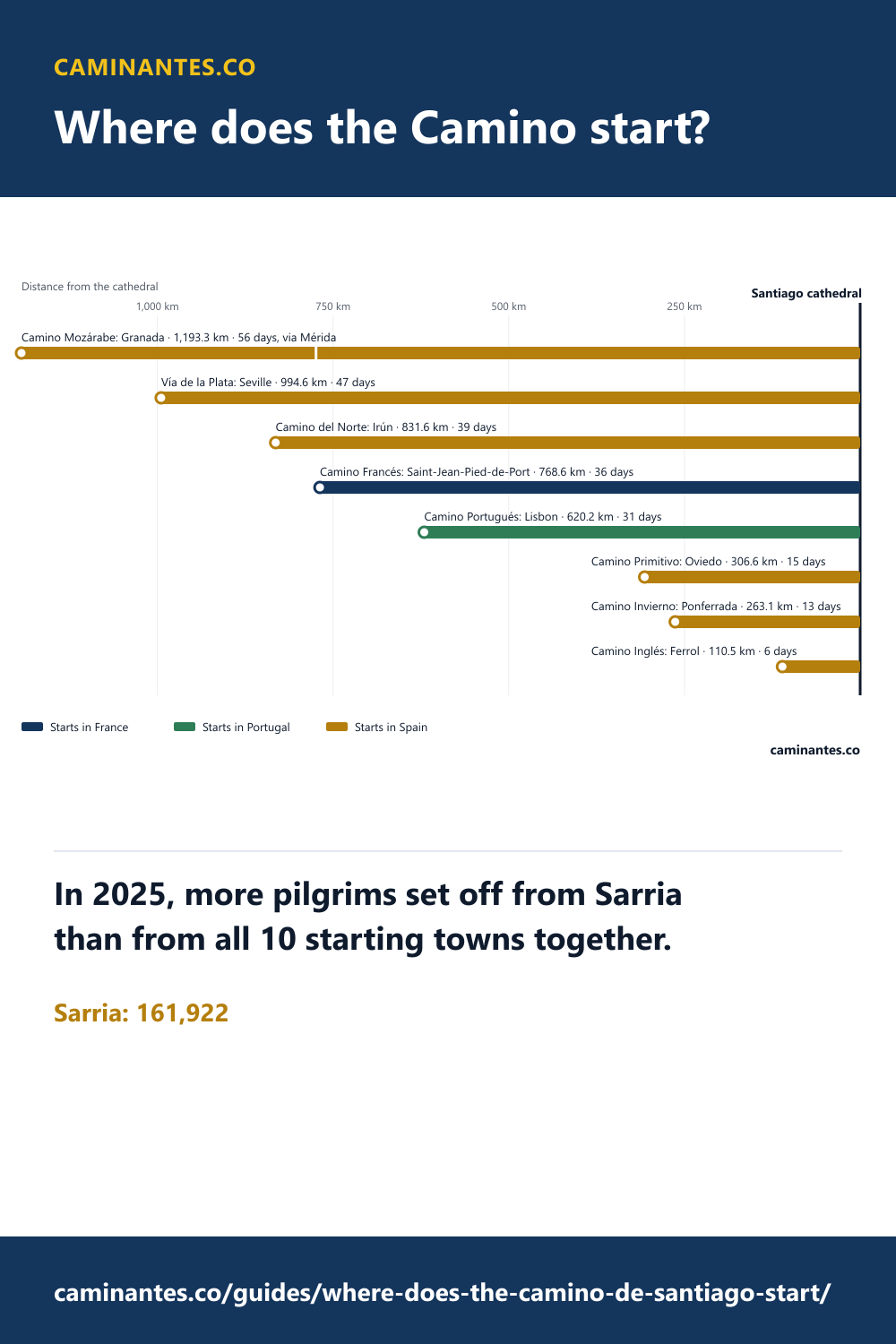
Here is the whole answer in one picture. Every route is drawn to the same scale, and every bar ends where the walk ends. Most end on the same line: the cathedral.
Camino Finisterre: starts at the cathedral, walks 85.0 km to Finisterre
The Camino Lebaniego is not drawn: it runs 66.5 km to Santo Toribio de Liébana and never comes near Santiago.
Download this picture as a poster (PNG)Free to use on your blog or in your group. A link back to this page is all we ask.
The ten routes themselves, drawn from their tracks on one map, and the last stretch where three of them run together, are on the Camino de Santiago map.
Every starting point, measured
Ordered by how far you would be walking. Distances and stage counts are measured along the tracks the app navigates by, and the climb figure is for day one alone, not the whole route.
| Route | Starts at | Ends at | Distance | Days | Day one |
|---|---|---|---|---|---|
| Vía de la Plata | Seville | Santiago de Compostela | 994.6 km | 47 | 17.7 km, 53 m |
| Camino del Norte | Irún | Santiago de Compostela | 831.6 km | 39 | 24.5 km, 596 m |
| Camino Francés | Saint-Jean-Pied-de-Port (France) | Santiago de Compostela | 768.6 km | 36 | 25.9 km, 1,351 m |
| Camino Portugués | Lisbon (Portugal) | Santiago de Compostela | 620.2 km | 31 | 23.9 km, 101 m |
| Camino Mozárabe | Granada | Mérida | 419.0 km | 19 | 19.1 km, 34 m |
| Camino Primitivo | Oviedo | Santiago de Compostela | 306.6 km | 15 | 24.8 km, 329 m |
| Camino Invierno | Ponferrada | Santiago de Compostela | 263.1 km | 13 | 19.7 km, 460 m |
| Camino Inglés | Ferrol | Santiago de Compostela | 110.5 km | 6 | 17.7 km, 153 m |
| Camino Finisterre | Santiago de Compostela | Finisterre | 85.0 km | 5 | 21.1 km, 429 m |
| Camino Lebaniego | San Vicente de la Barquera | Santo Toribio de Liébana | 66.5 km | 3 | 26.7 km, 486 m |
Days are our own stages rather than a guidebook's, so they are a plan you can move rather than a schedule you have to keep. Day one is the first of those stages out of the starting town.
The two that do not start in Spain
This is the part that confuses people, and it confuses them for a good reason: the most-walked route on the list begins in another country.
The Camino Francés starts at Saint-Jean-Pied-de-Port in France, on the northern side of the Pyrenees, and crosses into Spain on its first day. That first day is 25.9 km with 1,351 m of climbing, and it is the single hardest day of all 36 on that route. Nothing later comes close. It is worth knowing before you book a flight to Biarritz and start walking the morning after you land.
The Camino Portugués starts in Lisbon, Portugal, 620.2 km out. Most people who walk it do not start there: they start in Porto, roughly halfway, which is a different walk and a much shorter one. Both are honestly called the Camino Portugués, which is why published distances for it disagree so wildly.
Know these words before your Camino. Spanish is preparation, the same as boots and stages. Try the free topic
The three that never reach Santiago
7 of the 10 routes finish at the cathedral. The other 3 are still called Caminos, are still walked as pilgrimages, and end somewhere else entirely.
- Camino Mozárabe runs 419.0 km from Granada to Mérida.
- Camino Finisterre runs 85.0 km from Santiago de Compostela to Finisterre.
- Camino Lebaniego runs 66.5 km from San Vicente de la Barquera to Santo Toribio de Liébana.
The Camino Finisterre is the strangest answer on this page. It starts at the cathedral in Santiago, the place every other route is trying to reach, and walks 85.0 km west to Finisterre on the Atlantic. People walk it in the days after they arrive, when they find they are not finished.
Where people actually set off
Where a route starts and where people start it are two different questions. The Pilgrim’s Office counts where everyone who arrives began, and in 2025 only 3 of its 10 busiest starting towns were the start of any route.
- A route starts here
- Somewhere along a route
The office counts only people who asked for a Compostela in Santiago. · caminantes.co
More people set off from Sarria (161,922) than from all 10 routes’ starting towns put together, which is at most 103,704 even counting every town too small for the office’s list at the most it could be. Sarria is the start of no route. It sits 114.4 km out on the Camino Francés, just past the 100 km a Compostela asks for.
So which one should you start from?
That is a different question and it has a longer answer. The short version is that the starting point decides three things at once: how long you will be away, how hard the first week is, and how much company you will have. The table above settles the first. Our guide to which route to walk compares all ten on climb per kilometre and longest single stage, which is what settles the second.
If your constraint is time rather than preference, the honest answer is usually not a whole route. It is the last stretch of one, and there is a specific place on each route where a walk becomes long enough to earn a Compostela. That is measured in our guide to the last 100 km.
Getting to the start
We have deliberately not printed timetables here. Bus and train times on these routes change every season and a page full of them is wrong within a year, which is worse than a page that does not have them.
What is stable is which starting towns are easy to reach and which are not, and that turns out to be most of the difficulty. Look down the "starts at" column and most of the entries are cities: Lisbon, Seville, Granada, Oviedo, Ponferrada, Santiago. You can fly into or take a direct train to those, walk out of the station, and begin.
Two are not cities, and they are the two worth planning around. Saint-Jean-Pied-de-Port, the start of the most-walked route of the ten, is a village in the French Pyrenees with a small station at the end of a branch line, normally reached by changing at Bayonne. And San Vicente de la Barquera, where the Camino Lebaniego starts, is a coastal town on the Cantabrian bus network rather than a rail hub. Both are perfectly reachable. Both take a connection more than people expect, and both are worth checking before you book the flight rather than after.
How these figures were measured
Every distance, stage count and climb figure on this page is measured along the same GPS tracks the Caminantes app navigates by, sampled against elevation data rather than copied from a guidebook. That is why they sometimes disagree with the numbers on an operator's website by a few kilometres.
They are honest to about a kilometre. A variant route, a detour around a closed bridge, or a different guidebook's line will move any of them. What the figures are good for is comparison: because all ten were measured the same way, the gaps between them are real, which is not true of a table assembled from ten different sources.
Common questions
Where does the Camino de Santiago start?
There is no single starting point. Ten routes carry the name and each has its own, running from San Vicente de la Barquera on the Camino Lebaniego, 66.5 km out, to Seville on the Vía de la Plata at 994.6 km. The one most people mean is Saint-Jean-Pied-de-Port, where the Camino Francés begins, and that town is in France rather than Spain.
Does the Camino de Santiago start in France?
The most-walked one does. The Camino Francés starts at Saint-Jean-Pied-de-Port on the French side of the Pyrenees, which is why the route is called the French Way. It is one of 10 routes, and the only other one that begins outside Spain is the Camino Portugués, which starts in Lisbon, Portugal. The remaining 8 all start inside Spain.
Where does the Camino de Santiago end?
7 of the 10 finish at the cathedral in Santiago de Compostela. 3 do not: the Camino Mozárabe ends at Mérida, the Camino Finisterre ends at Finisterre, the Camino Lebaniego ends at Santo Toribio de Liébana. That last group is why a lot of the advice online contradicts itself, because the answer depends entirely on which route is being described.
Which Camino route starts in Santiago?
The Camino Finisterre. It begins at the cathedral and walks 85.0 km west to Finisterre on the Atlantic coast, so it is the one route where the usual answer is exactly backwards. People walk it after arriving, as a continuation rather than a pilgrimage in its own right.
What is the shortest Camino route?
The Camino Lebaniego, from San Vicente de la Barquera to Santiago: 66.5 km over 3 of our stages. It is long enough to earn a Compostela, which is the reason it exists as a short option at all, and it is the shortest of the routes that actually reach the cathedral.
How hard is the first day?
It varies more than anything else on this page. Day one out of Saint-Jean-Pied-de-Port on the Camino Francés is 25.9 km and climbs 1,351 m over the Pyrenees, and it is the hardest day of that entire route. Day one out of Seville on the Vía de la Plata is 17.7 km and climbs 53 m. Both are day one of a Camino, and they are not the same kind of day.
How were these distances measured?
Along our own tracks, sampled the same way the elevation figures are, and honest to about a kilometre. Variants, detours and a different guidebook's line all move them. Treat them as measurements you can compare against each other, which is the thing most published figures do not let you do, rather than as the one true number.
Keep reading
How long is the Camino? Ten routes, one honest answer each
Every route measured in kilometres and miles, plus how far is left from Roncesvalles, Burgos, León, Astorga and Sarria. And why the figures elsewhere disagree, which comes down to three things, and none of them is carelessness.
Which Camino should you walk? Three numbers decide it, and one is never published
All ten routes side by side on days, climb per kilometre, and the longest single stage. That last one usually settles the choice, and almost nobody prints it.
The last 100 km: one town misses the line by two hundred metres
Where a Compostela-qualifying walk starts on all seven routes into Santiago, measured from the tracks. One route sits exactly on the line, and three cannot answer the question at all.
Take it with you
Caminantes is free, works offline, and plans your stages around your own legs rather than a guidebook's.