Caminantes
Which Camino is hardest? Measured two ways
By August Frederik Kramer · Last updated 26 September 2026
"Which Camino is hardest" has no answer until you say which kind of hard. Measured by climbing per kilometre, the hardest of the ten is the Camino Lebaniego at 32.1 m per km, and it is also the shortest route on the network. Measured by distance it is the Vía de la Plata at 994.6 km, which is only the 8th steepest.
Two questions, two nearly opposite answers
The ten routes differ by 3.1 times in how much they climb per kilometre, and by 15.0 times in how far they go. Those are not the same ranking. The steepest route comes 10th of ten by length; the longest comes 8th of ten by steepness.
So the honest answer depends on what will actually stop you. If it is your knees on a descent or your lungs on a climb, read the metres per kilometre column. If it is five weeks away from home, read the kilometres. Almost nobody publishes both, and the routes that get called hard in conversation are usually being judged on the second while the reader is worried about the first.
Both questions on one map
Here are the ten routes with length across and steepness up. The dashed lines mark the middle of the ten on each axis, so every corner is its own kind of hard. Short and steep holds 4 routes. Long and gentle holds 4. Both are full.
Download this chart as a poster (PNG)Free to share in your group or on your blog. A link back to this page is all we ask.
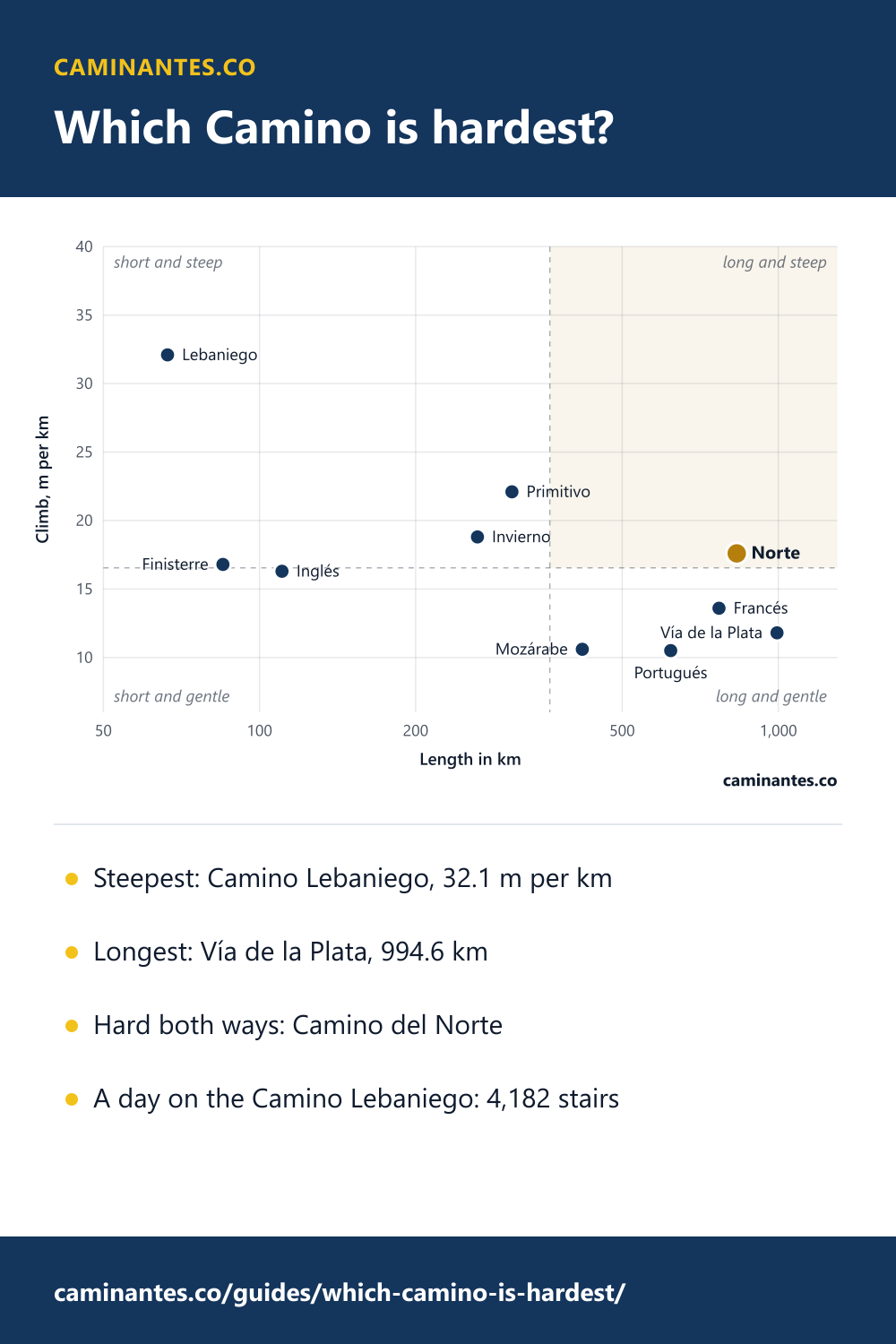
The corner that is long and steep holds exactly one dot: the Camino del Norte. That is the whole answer to "which Camino is hardest" in one picture. It is the only route that asks for a long time and a lot of climbing at once.
The ten, steepest first
Climb per kilometre is total measured ascent divided by the published distance. It is the fairest single number for "how steep is this walk", because it does not reward a route for being short.
| Route | km | Days | Ascent | m per km | Hardest day |
|---|---|---|---|---|---|
| Camino Lebaniego | 66.5 | 3 | 2,134 | 32.1 | 963 |
| Camino Primitivo | 306.6 | 15 | 6,777 | 22.1 | 698 |
| Camino Invierno | 263.1 | 13 | 4,941 | 18.8 | 704 |
| Camino del Norte | 831.6 | 39 | 14,663 | 17.6 | 836 |
| Camino Finisterre | 85.0 | 5 | 1,431 | 16.8 | 429 |
| Camino Inglés | 110.5 | 6 | 1,802 | 16.3 | 623 |
| Camino Francés | 768.6 | 36 | 10,446 | 13.6 | 1,351 |
| Vía de la Plata | 994.6 | 47 | 11,724 | 11.8 | 538 |
| Camino Mozárabe | 419.0 | 19 | 4,452 | 10.6 | 685 |
| Camino Portugués | 620.2 | 31 | 6,519 | 10.5 | 417 |
The steepest route is the shortest one
The Camino Lebaniego is 66.5 km in 3 days and climbs 32.1 m per km, which is 3.1 times the Camino Portugués at 10.5 m per km. Three days is not long enough for anybody to call a route hard, and that is exactly why this one surprises people: the gradient is the steepest on the network and the walk is over before your legs have decided anything about it.
The longest route is not a steep one
The Vía de la Plata is 994.6 km, 15.0 times the length of the Camino Lebaniego, and it climbs 11.8 m per km, which places it 8th of ten. It is hard in a way no gradient shows: weeks of it, in heat, with the beds far apart. That is a real difficulty and it is not the one the word "steep" describes.
Know these words before your Camino. Spanish is preparation, the same as boots and stages. Try the free topic
The one that is hard both ways
If you want a single answer, the Camino del Norte is the route that ranks high on both axes: 4th of ten for climbing per kilometre at 17.6 m per km, and 2th for distance at 831.6 km. It is the only one near the top of both lists, which is why it has the reputation it has.
The kilometres the climbing hides
In 1892 the Scottish climber William Naismith put a price on a hill in distance: 600 m of ascent costs as much as 5 km on the flat. Convert each route’s climbing that way and every route gets longer. The gold part of each bar is distance you did not know you had signed up for.
The route that hides the most is not the longest. It is the Camino del Norte: its climbing is worth 122.2 km, which at its own daily pace is 5.7 extra days on the trail, almost a week nobody writes into the plan. The Vía de la Plata is longer and hides 97.7 km.
The hardest single day, and the route without one
The biggest climbing day on any of the ten is on the Camino Francés: Saint-Jean-Pied-de-Port to Orreaga / Roncesvalles, 25.9 km for 1,351 m of ascent. It is day one. Whatever the route is called overall, that is the day people remember.
And the opposite is worth knowing too. The Camino Portugués has the mildest worst day of the ten: its hardest single stage climbs 417 m. If the thing you want is a route with no day that frightens you, that is the measured answer.
What barely changes is the daily distance
Across all ten routes the average stage runs between 17.0 and 22.2 km. The routes differ 3.1 times in steepness and 15.0 times in length, and the distance you actually walk on a given day hardly moves. What changes between an easy Camino and a hard one is not how far you go each day. It is how much you climb doing it.
Your daily climb, in stairs
Metres of ascent mean little until your legs have done them. So here is an average day on each route as ordinary stairs, at 17 cm a step. The measuring stick is the Empire State Building Run-Up, the race up 86 floors: 1,576 steps.
On the Camino Lebaniego an ordinary day is 4,182 stairs, more than two Empire State Buildings before dinner. On the Camino Portugués it is 1,235, less than one. The distance you walk each day barely changes between the two. The staircase changes 3.4 times.
Why our own route pages say something different
Each route page here carries a one-word label, and those labels are about total effort rather than gradient: the length, the heat, how far apart the beds are, whether anybody else is walking. So a route can be labelled easy and sit in the steeper half of this table, or labelled hard and sit in the flatter half. Neither is a mistake. They answer different questions, and this page is the gradient one.
How this was measured
Distance is the sum of our own stage plan for each route. Ascent is measured from that route’s GPS track, sampled every 100 m against an elevation model, smoothed, with climbs under 3 m discarded as noise; the same accumulator produces every figure on this site. All ten are treated identically, and that is the part that matters: the absolute numbers are estimates, but the comparison between routes holds, and the comparison is exactly what disappears when figures are collected from ten different sources. Published total-ascent figures for a single route vary by more than half, and almost none of them state a method.
Common questions
Which Camino route is the hardest?
By climbing per kilometre it is the Camino Lebaniego, at 32.1 m per km over 66.5 km. By distance it is the Vía de la Plata at 994.6 km. The route that ranks high on both is the Camino del Norte: 4th for steepness and 2th for length.
Which Camino route is the easiest?
The flattest is the Camino Portugués at 10.5 m per km, which is a third of the Camino Lebaniego. The Camino Portugués also has the mildest hardest day of the ten at 417 m of climbing, so it is the route least likely to hand you a day you remember for the wrong reason.
Is the Camino Francés hard?
It is 7th of ten for climbing per kilometre at 13.6 m per km, so it is average on gradient and long at 768.6 km. It also holds the single hardest day on the network, Saint-Jean-Pied-de-Port to Orreaga / Roncesvalles, 25.9 km and 1,351 m of ascent, which is day one.
How much climbing is there per day?
That depends on the route far more than on the day. The average stage is 17.0 to 22.2 km on every one of the ten, so the distance is near constant; the climbing inside it ranges from 10.5 to 32.1 m per km.
Does a short route mean an easy route?
No, and the data says the opposite. The shortest of the ten, the Camino Lebaniego, is the steepest per kilometre on the network. Short and steep is a common combination, because a route that only exists to cross one range has nowhere to flatten out.
Where do these figures come from?
From each route’s own GPS track, sampled every 100 m, with the same method applied to all ten so the comparison between them is sound. Distance comes from our stage plan. Nothing here is copied from a guidebook, which matters because published ascent figures for the same route disagree by more than half.
Keep reading
What does Buen Camino mean, and how do you reply?
Word for word it is "good path". What it actually does, how to answer it, who says it, and the fifteen other words you will hear every day.
The Variante Espiritual: 74.8 km on foot, or 41.7 km and a boat
The direct line from Pontevedra to Pontecesures is 34.7 km; walking the whole variant is 74.8 km, more than double. Take the Traslatio and it is 7.0 km more than not going at all.
The credencial: 10 stamps from Sarria, and the rule everyone misquotes
"Two stamps a day" is not in the Pilgrim’s Office rules. On our split that is 10 stamping moments from Sarria, and 10 to 12 across the 7 routes that reach Santiago.
Take it with you
Caminantes is free, works offline, and plans your stages around your own legs rather than a guidebook's.