Caminantes
Santiago to Muxía: the other end of the Camino, and how to walk both ends
By August Frederik Kramer · Last updated 15 October 2026
Where are you walking to?
0days
0.0km from Santiago
Tap a plan. The days light up on the map, one by one.
3 days, 85.0 km. As on our Finisterre guide.
- Day 1: Santiago to Negreira21.1 km
- Day 2: Negreira to Olveiroa33.3 km
- Day 3: Olveiroa to Finisterre30.6 km
3 days, 87.2 km. Right at Hospital for Muxía.
- Day 1: Santiago to Negreira21.1 km
- Day 2: Negreira to Olveiroa33.3 km
- Day 3: Olveiroa to Muxía32.8 km
4 days, 113.2 km. Then the coast to Muxía.
- Day 1: Santiago to Negreira21.1 km
- Day 2: Negreira to Olveiroa33.3 km
- Day 3: Olveiroa to Finisterre30.6 km
- Day 4: Finisterre to Muxía28.2 km
4 days, 115.4 km. Then the coast to Finisterre.
- Day 1: Santiago to Negreira21.1 km
- Day 2: Negreira to Olveiroa33.3 km
- Day 3: Olveiroa to Muxía32.8 km
- Day 4: Muxía to Finisterre28.2 km
Download the poster (PNG)Free to print and share. Please keep caminantes.co on it.
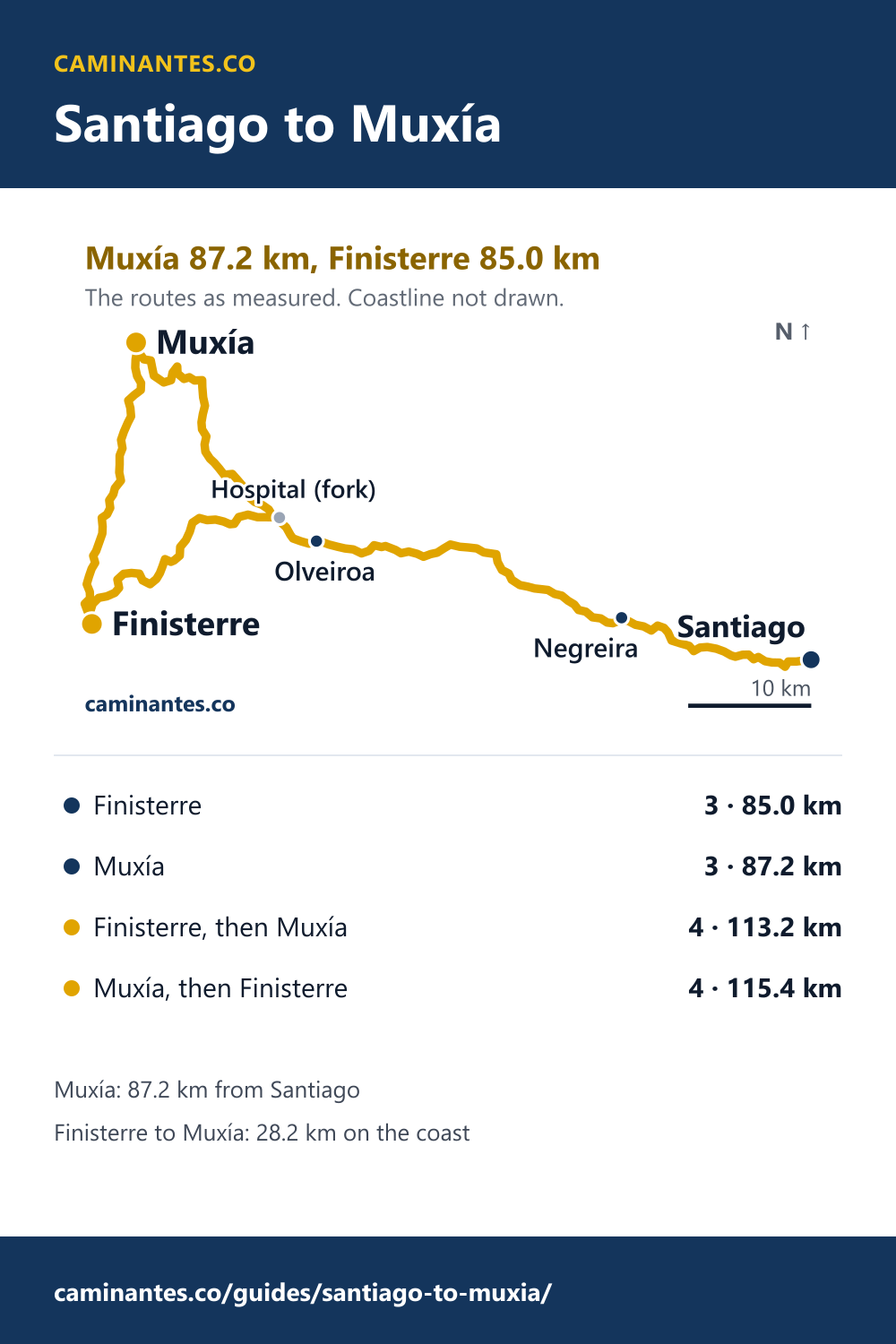
Muxía is the Camino’s other end of the world. On foot it is 87.2 km from Santiago, only 2.2 km more than Finisterre, because the two share the road as far as Hospital, 59.5 km out. Between the two towns runs a coastal path of 28.2 km, so both ends cost just one extra day: 4 days in all.
Where the road splits: Hospital
The two ends share the road out of Santiago, through Negreira and Olveiroa. 5.1 km after Olveiroa, at Hospital, 59.5 km from Santiago, the waymarks part: left for Finisterre through Cee, right for Muxía through Dumbría, 27.7 km to go. Sleep in Olveiroa and the day to Muxía is 32.8 km, against 30.6 km to Finisterre.
Both ends: the coast between them
Muxía and Finisterre are 28.2 km apart on the path along the coast, through Lires, and you can walk it either way. So both ends cost one day more than one: 4 days and 113.2 km if you go to Finisterre first, 115.4 km if you go to Muxía first. The order changes the total only because Muxía is 2.2 km further from Santiago.
The sanctuary on the rocks
The Santuario da Virxe da Barca stands on the rocks at the tip of the town, with the sea on three sides. The present church was built between 1716 and 1719. On Christmas Day 2013 lightning set it on fire and destroyed the roof and the interior; it was restored by 2015. The legend behind it says the Apostle James, discouraged at preaching in Hispania, was praying here when the Virgin came across the sea in a stone boat to comfort him.
The stone boat
The boat, the legend says, is still there, turned to stone in front of the church. The Pedra de Abalar, a great flat slab, is the boat itself, and it rocks, they say, only for someone free of sin. The Pedra dos Cadrís is the sail: people pass underneath it for aches in the hips and the back. A third rock, the Pedra do Temón, is the rudder.
A Ferida, the wound
Just above the sanctuary stands A Ferida, “the wound”: a granite block 11 m tall and weighing 400 tonnes, split by a crack, by the sculptor Alberto Bañuelos. It remembers the Prestige, the oil tanker that broke in two and sank off this coast on 19 November 2002, and the volunteers who came from all over Spain to clean the beaches.
The Muxiana
Muxía has its own certificate, the Muxiana. The town’s tourist office issues it when you show your credencial with stamps from the way, and the public albergue has issued it at times too. Finisterre’s is the Fisterrana. Neither is the Compostela, which you collect in Santiago.
How the Compostela works: the Compostela guide.
Know these words before your Camino. Spanish is preparation, the same as boots and stages. Try the free topic
Planning it
The first two days are the same whichever end you choose: 21.1 km to Negreira, then 33.3 km to Olveiroa. We measure the climbing on those days, and on the road to Finisterre, but hold no heights for the Muxía legs, so this page gives distances only.
The climbing day by day, and the three, four and five day plans: Santiago to Finisterre.
The film that ends here, and the others on the same road: Camino movies and books.
Santiago to Hospital is our measured track, the same as on the Finisterre guide. The Hospital to Muxía branch and the coastal path are measured on OpenStreetMap’s route for the walk and scaled onto our track; OpenStreetMap’s Santiago to Finisterre comes within 1% of our own. The sanctuary, the stones and A Ferida are from the Spanish and Galician Wikipedia articles on Muxía and the sanctuary; the Muxiana from viajecaminodesantiago.com.
Common questions
How far is Muxía from Santiago?
87.2 km on foot, through Negreira, Olveiroa and the fork at Hospital. On our plan it is 3 days.
Is Muxía or Finisterre further from Santiago?
Muxía, by 2.2 km: 87.2 km against 85.0 km. They share the road for the first 59.5 km.
How far is it from Finisterre to Muxía?
28.2 km on the path along the coast, through Lires. It is one day’s walk, and you can walk it in either direction.
Can I walk to both Finisterre and Muxía?
Yes, in 4 days: three to one end, then a day along the coast to the other. That is 113.2 km going to Finisterre first, 115.4 km going to Muxía first.
What is the Muxiana?
Muxía’s own certificate for walking there. The town’s tourist office issues it on your stamped credencial. It is not the Compostela.
Keep reading
Leaving Villafranca del Bierzo, the hill way climbs 5.4 times as much
Two ways to Trabadelo: the valley road with 85 m of climbing, or the Pradela way over the ridge with 458 m and 2.8 km more. Walk both, and open the Door of Forgiveness.
Portomarín: the town that moved uphill when the river rose
At 92.4 km from Santiago it is too close to start for the Compostela. Drain the reservoir that drowned the old town and watch its church move up the hill.
Monte do Gozo: the cathedral is 5.0 km away and 97 m below
Walk the last stretch from Lavacolla, spot the spires from the Hill of Joy, and see why the first to see them was crowned king.
Take it with you
Caminantes is free, works offline, and plans your stages around your own legs rather than a guidebook's.