Caminantes
Melide on the Camino: where the Primitivo joins the Francés, and the pulpo
By August Frederik Kramer · Last updated 14 October 2026
In September, at least 1,104 people a day walk the Francés out of Sarria. On the third day they reach Melide.
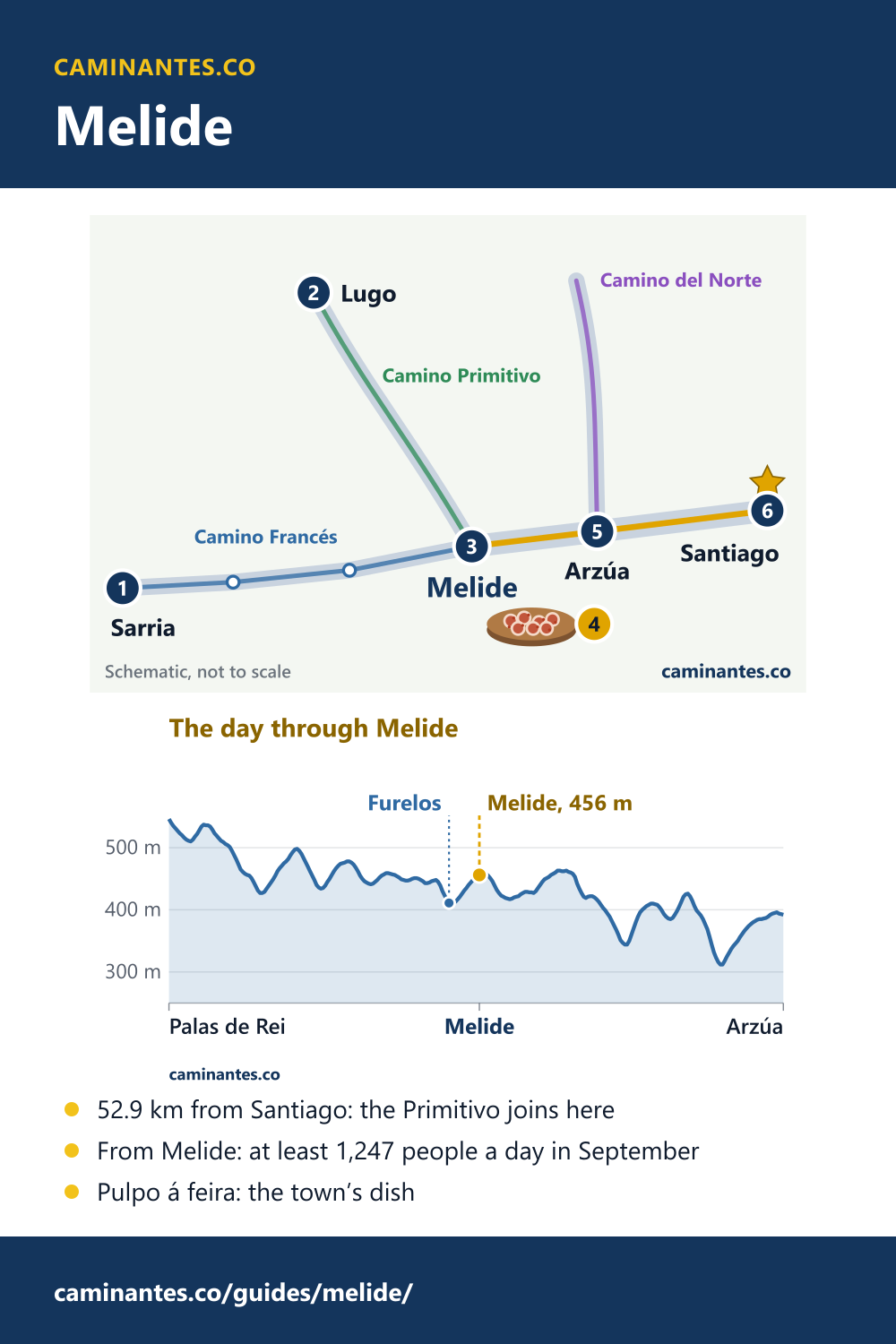
That is Melide. From here, 52.9 km from Santiago, you share the path with the Primitivo, and from Arzúa with the Norte.
Tap the button to send the next group of pilgrims.
- The Francés, from SarriaIn September, at least 1,104 people a day walk the Francés out of Sarria. On the third day they reach Melide.
- The Primitivo, from LugoThe Primitivo comes down from Lugo, at the end of its longest day (31.8 km): about 143 people a day.
- Melide: one pathAt Melide the two become one path, and stay one to Santiago: at least 1,247 people a day, 13% more than before.
- Pulpo á feiraTime to eat: pulpo á feira, octopus boiled in a copper pot and served on a wooden plate with paprika, olive oil and coarse salt.
- Arzúa: the Norte joinsAt Arzúa, the end of the same day, the Camino del Norte joins too: about 110 more people a day.
- SantiagoThree Caminos, one path: at least 1,357 people a day in September on the last stretch into Santiago.
Melide is where the Camino Primitivo joins the Camino Francés, 52.9 km from Santiago. In September, at least 1,104 people a day walk the Francés out of Sarria, and the Primitivo adds about 143 more here: 13% more people on the path from Melide on.
Where the Primitivo meets the Francés
The Camino Primitivo starts in Oviedo and reaches Melide after 253.7 km on our plan, at the end of its longest day: 31.8 km from Carricova. From there its walkers follow the Francés for the last 52.9 km. If you started on the Francés, Melide comes on the third day from Sarria, 14.3 km into the walk from Palas de Rei.
The whole route from Oviedo: the Camino Primitivo.
How much busier it gets
In 2025 the Pilgrim’s Office counted 27,867 pilgrims who came by the Primitivo and 21,481 by the Norte. Spread over the months the way all routes are (the model our Sarria page uses), that is about 143 people a day joining at Melide in September, and about 110 more at Arzúa, on top of at least 1,104 a day on the Francés out of Sarria. From Melide the path carries at least 1,247 a day, 13% more; from Arzúa, at least 1,357. These are floors: the Francés count includes only the starting towns the office names.
The day: Palas de Rei to Arzúa
The day through Melide is 28.3 km, with 455 m of climbing and 609 m of descent. 12.9 km in, you cross the river at Furelos on its medieval bridge, already named in the Codex Calixtinus, and 1.4 km later you are in Melide, at 456 m. It is a good place for a long lunch, with the rest of the day still ahead to Arzúa.
Download the poster (PNG)Free to print and share. Please keep caminantes.co on it.
All five days from Sarria: Sarria to Santiago.
The first night out of Sarria: Portomarín.
Where this day starts, and the hardest day before it: Palas de Rei.
The same evening the Norte joins too, and Santiago is two days off: Arzúa.
Know these words before your Camino. Spanish is preparation, the same as boots and stages. Try the free topic
Pulpo á feira
Melide is known as the capital of pulpo á feira, “fair-style octopus”, the dish Galicia makes on market days: the octopus is boiled whole in a copper pot, cut into slices about a centimetre thick and served on a wooden plate with paprika, olive oil and coarse salt. The town has held a market since the Middle Ages, and its pulperías are a usual stop for pilgrims. It has its own sweets too: the melindre, which has a festival of its own, and the rico, a biscuit made only here.
What to see in Melide
Besides the bridge at Furelos: the church of Santa María de Melide, from the end of the 12th century, with paintings from the 16th; the parish church of San Pedro, once the church of the convent and hospital of Sancti Spiritus, founded in the 14th century; and the Museo da Terra de Melide, in an old pilgrims’ hospital founded in 1502.
Distances and heights are from our stage plan and our elevation profile of the Camino Francés, sampled every 100 m. The distance from Melide to Santiago is the shared stretch as our Primitivo guide measures it; the two tracks of the same road differ by a few hundred metres. Pilgrim numbers are the Pilgrim’s Office’s for 2025. The map is a schematic. The history is from the Spanish and Galician Wikipedia articles on Melide and the Spanish article on pulpo a la gallega; “capital of pulpo á feira” is how the guide at viajecaminodesantiago.com puts it.
Common questions
Where does the Camino Primitivo join the Camino Francés?
At Melide, 52.9 km from Santiago. From there the two are one path.
How far is Melide from Santiago?
52.9 km on our track. On the plan from Sarria it is the middle of the third day, which ends in Arzúa; Santiago is two days on from there.
How far is it from Palas de Rei to Melide?
14.3 km, crossing the bridge at Furelos 1.4 km before the town.
Is the Camino busier after Melide?
Yes. In September the Primitivo adds about 143 people a day to at least 1,104 on the Francés: 13% more. At Arzúa the Norte adds about 110 more.
What is Melide known for?
Pulpo á feira, octopus boiled in a copper pot and served on a wooden plate with paprika, olive oil and coarse salt, and its sweets, the melindre and the rico.
Keep reading
Muxía is only 2.2 km further than Finisterre
Both ends of the world are three days from Santiago, and a 28.2 km coastal path joins them. Pick a plan on the map: one end, or both in four days.
Leaving Villafranca del Bierzo, the hill way climbs 5.4 times as much
Two ways to Trabadelo: the valley road with 85 m of climbing, or the Pradela way over the ridge with 458 m and 2.8 km more. Walk both, and open the Door of Forgiveness.
Portomarín: the town that moved uphill when the river rose
At 92.4 km from Santiago it is too close to start for the Compostela. Drain the reservoir that drowned the old town and watch its church move up the hill.
Take it with you
Caminantes is free, works offline, and plans your stages around your own legs rather than a guidebook's.