Caminantes
Tui to Santiago: 6 days and 118.4 km from the Spanish border
By August Frederik Kramer · Last updated 29 September 2026
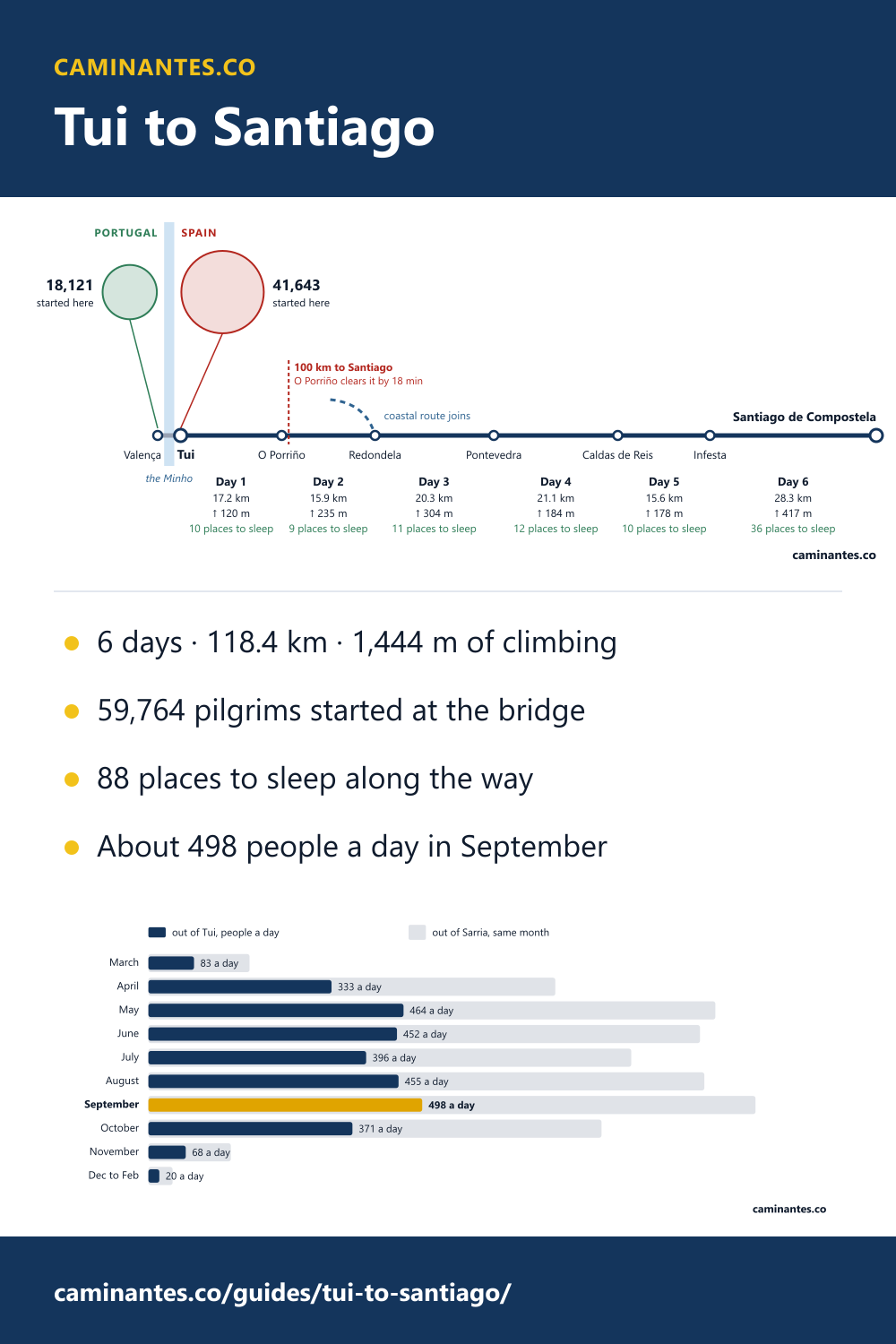
Tui to Santiago is the last week of the Camino Portugués: what Sarria is to the Francés, the Portugués has in Tui. It starts at a bridge: Tui on the Spanish bank of the Minho, Valença on the Portuguese one, and in 2025 59,764 pilgrims set out from the two towns, almost twice as many as from Saint-Jean-Pied-de-Port. It is 118.4 km in 6 days, and the 100 km line comes 18 minutes into day two.
How many days from Tui to Santiago?
Six, on our plan: 118.4 km at 19.7 km a day. Day one is Tui to O Porriño, the rest follow our stage plan for the whole Camino Portugués. Here is the trip on one line, drawn to scale, from the river to the cathedral.
Download this as a poster (PNG)Free to use on your blog or in your group. A link back to this page is all we ask.
Tui or Valença?
The international bridge over the Minho joins the two towns, and people start on both ends of it. In 2025 the Pilgrim’s Office recorded 41,643 starts in Tui and 18,121 in Valença do Minho, on the Portuguese bank. Tui alone is the third busiest start town on any route, after Sarria and Porto.
For the Compostela it makes no difference: both are well past the 100 km line. Valença gives you a walled fortress and a walk across the river on day one; Tui gives you a cathedral and a bed already in Spain. If you want to weigh Tui against starting in Porto instead, that is the Porto or Tui guide.
How hard is it?
Not very, as Caminos go. All six days together climb 1,444 m, about what the Camino Francés climbs on its first day out of Saint-Jean alone (1,351 m). The highest the path gets is 258 m above the sea: stand the Eiffel Tower (330 m) on the beach and its top would be higher.
The longest day is Infesta to Santiago de Compostela, 28.3 km. The steepest is Redondela to Pontevedra, 304 m up in 20.3 km. Neither needs more than an early start.
Where to sleep
There are 88 places to sleep on these six days, mapped within 300 m of the track: from 9 on the day into Redondela to 36 on the day into Santiago de Compostela. We do not add up beds here, because only 17% of the places on this route publish a bed count. For every stage of every route, see where the beds are.
Know these words before your Camino. Spanish is preparation, the same as boots and stages. Try the free topic
When is it busiest?
In September. About 498 people a day walk out of Tui then, against about 20 a day from December to February. That is about half of Sarria in the same month (1,104 a day), so the Portugués from Tui is busy, not crowded.
The drawing stops counting at Redondela, the end of day 2. That is where the Camino Portugués por la costa joins, and 89,503 pilgrims finished that way in 2025, so the last 85.4 km are busier than the bars show. Choosing between the two routes from Porto is the coastal route guide.
How this is counted: everyone who finished the central Camino Portugués in 2025, less the 3,646 who started in O Porriño, spread across the months the way all Compostelas were. The same sum gives the Sarria page its figures. It is an estimate, not a census.
Does Tui get you the Compostela?
Yes, with room to spare. The Compostela asks for the last 100 km on foot, and the line falls 18.4 km after Tui, early on day two. O Porriño, where day one ends, is only 101.2 km out: 1.2 km over the line, about 18 minutes of walking. Redondela, the next stage town, is 85.4 km out and does not qualify. See where the last 100 km starts on every route.
The rule asks for two stamps a day over the last 100 km, which from O Porriño is 5 stages: 10 stamps. Stamp day one as well; Tui cathedral has one. What counts and what does not is in the credencial guide. If you want a quieter way through the middle, the Variante Espiritual leaves north of Pontevedra and rejoins at Pontecesures.
The six stages
| Day | Stage | km | Up (m) | Down (m) | Places to sleep |
|---|---|---|---|---|---|
| 1 | Tui → O Porriño | 17.2 | 120 | 123 | 10 |
| 2 | O Porriño → Redondela | 15.9 | 235 | 252 | 9 |
| 3 | Redondela → Pontevedra | 20.3 | 304 | 300 | 11 |
| 4 | Pontevedra → Caldas de Reis | 21.1 | 184 | 186 | 12 |
| 5 | Caldas de Reis → Infesta | 15.6 | 178 | 172 | 10 |
| 6 | Infesta → Santiago de Compostela | 28.3 | 417 | 182 | 36 |
Stage ends are from our own plan, generated from the route, so a guidebook may split it differently. Day one is measured from Tui itself. The whole route from Lisbon is on the Camino Portugués page, and the last 100 km of every route on the last 100 km guide.
Common questions
How many days is Tui to Santiago?
6 days on our plan: 118.4 km at about 19.7 km a day. With 88 places to sleep along the way, a shorter day is always possible.
How far is Tui from Santiago?
118.4 km along the Camino Portugués, measured on its own track. That is 18.4 km more than the 100 km the Compostela asks for.
Is Tui to Santiago hard?
No harder than a good week of walking: 1,444 m of climbing in 6 days, and the path never gets higher than 258 m. The longest day is Infesta to Santiago de Compostela, 28.3 km.
Should I start in Tui or Valença?
Either. Valença is across the bridge in Portugal and adds 3.9 km, about 59 minutes; both qualify for the Compostela. In 2025, 41,643 pilgrims started in Tui and 18,121 in Valença.
Is O Porriño far enough for the Compostela?
Only just: O Porriño is 101.2 km out, 1.2 km over the line. Start in Tui and the question never comes up.
When is Tui to Santiago busiest?
In September, with about 498 people a day leaving Tui. From December to February it is about 20 a day.
Keep reading
Burgos to Santiago: 23 days, 485.7 km and the whole meseta
Nine flat days across the meseta climb 1,066 m; two mountain days after León climb 1,103 m. 406 places to sleep, and about 175 people a day through Burgos in September.
Sarria to Santiago: 5 stages, 114.4 km and 1,854 m of climbing
The Camino most people actually walk, measured: more climbing than the whole meseta, 155 places to sleep, and about 1,104 people a day on the path in September.
Camino Portugués coastal route: 23.2 km longer, 246 m less climbing
Coast against central from Porto, measured the same way: 269.6 km against 246.4 km, one more day but flatter. And 47% of Portugués pilgrims took the coast in 2025.
Take it with you
Caminantes is free, works offline, and plans your stages around your own legs rather than a guidebook's.