Caminantes
Burgos to Santiago: the whole meseta, then the mountains
By August Frederik Kramer · Last updated 30 September 2026
Burgos to Santiago is the Camino Francés with the first mountains taken off and everything else kept: 485.7 km in 23 days, a little over three weeks on our plan. It is the flattest of the common starts, 11.5 m of climbing per kilometre, because it begins with the whole meseta: 9 days, 181.1 km and only 1,066 m of climbing, before two mountains and Galicia take the total to 5,587 m.
Before Burgos, the forest climb over the Montes de Oca: Montes de Oca, walked in pictures.
The day into Burgos: Atapuerca, the cross on the sierra and the caves of the oldest Europeans, in pictures.
How many days from Burgos to Santiago?
23 on our plan: 485.7 km at 21.1 km a day. It is really two walks of very different shape. The first 9 days cross the meseta to León, 181.1 km at 5.9 m of climbing per kilometre. The last 14 climb 4,521 m, over the Montes de León and up to O Cebreiro. Here is all of it, drawn to scale.
Download this as a poster (PNG)Free to use on your blog or in your group. A link back to this page is all we ask.
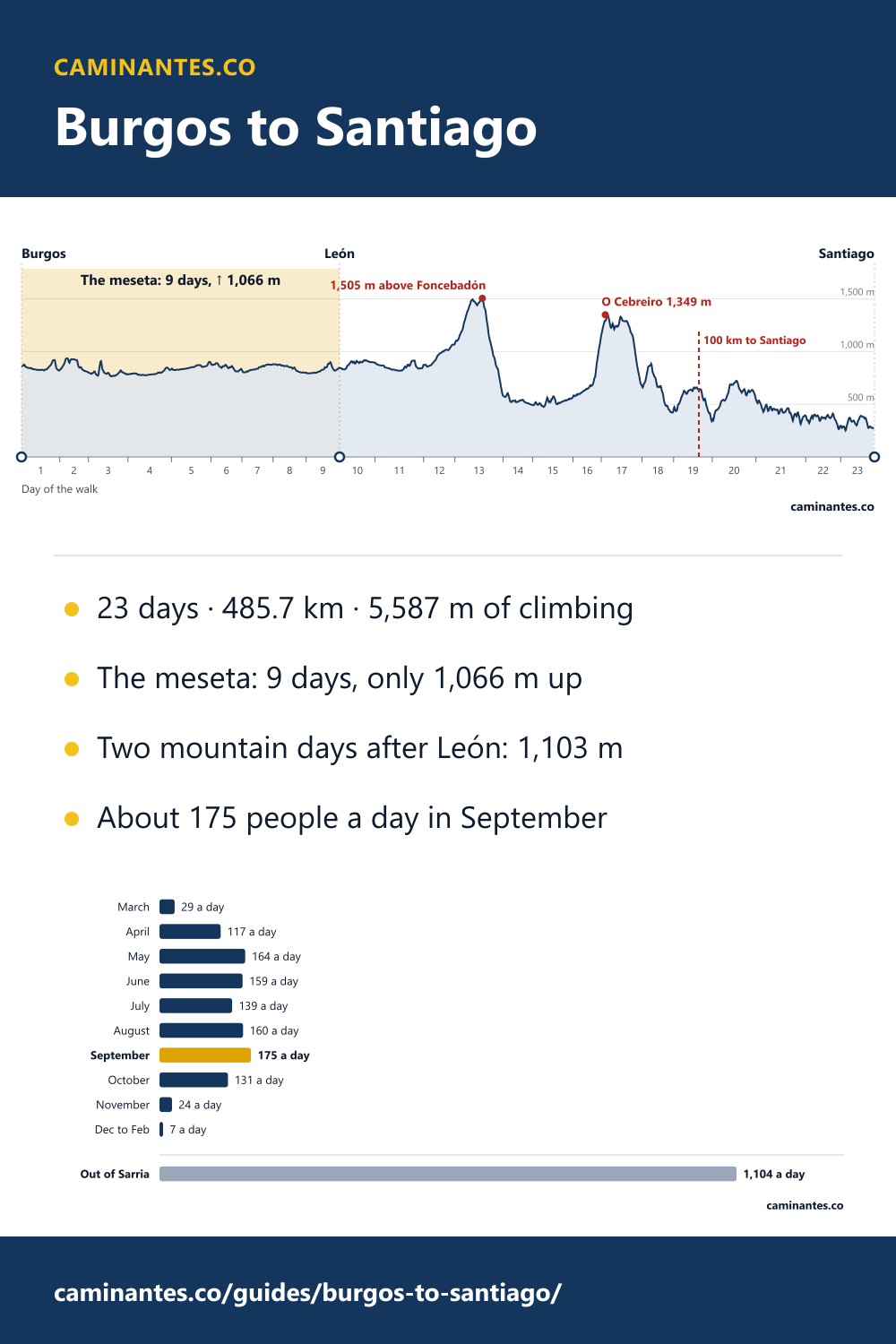
The meseta: flat, high and long
The meseta is 37% of the distance from Burgos and 19% of the climbing. It is 181.1 km end to end, more than four marathons, and in all that way it climbs 1,066 m. It is not low, though: it sits between 765 and 936 m above the sea, a high plain with nothing to stop the wind.
The flattest day on the whole Camino Francés is here: day 8, El Burgo Ranero to Mansilla de las Mulas, climbs 17 m. The meseta tires the head more than the legs. That is its reputation, and the reason many people skip it; the other starts are weighed in the Camino Francés from each start.
On day three, the arch of San Antón and the one real climb of the meseta: Castrojeriz and the Alto de Mostelares.
On day four, the Canal de Castilla, its four locks and San Martín: Frómista.
Further on, the town that calls itself the middle of the Camino, measured: Sahagún.
The longest stretch with no village on the meseta, measured: Carrión de los Condes to Calzadilla.
After León: two mountains in 14 days
What the meseta saves, the second half spends. Day 13, Santa Marina de Somoza to Molinaseca, climbs 487 m to the route’s high point, 1,505 m above Foncebadón, and comes down 982 m, the biggest descent of the walk. Day 16, Trabadelo to La Laguna de Castilla, climbs 616 m towards O Cebreiro. Those two days climb 1,103 m between them, more than all 9 days of the meseta. There is more on the second in our O Cebreiro guide. The longest day is day 21, Palas de Rei to Arzúa, 28.3 km.
Know these words before your Camino. Spanish is preparation, the same as boots and stages. Try the free topic
Where to sleep, and where it gets thin
There are 406 places to sleep along the 23 days, mapped within 300 m of the track, and they are not spread evenly. The meseta has about 12 a day and the stretch after León about 21, and the two thinnest days of the whole walk are both on the meseta: day 5, into Población de Arroyo, has 3, and day 7, into El Burgo Ranero, has 4. On those two, know where you will stop before you set out. Every stage of every route is in where the beds are.
How busy is it?
Quiet, by Camino standards. In September, the busiest month, about 175 people a day walk through Burgos. Out of Sarria in the same month it is about 1,104 a day, roughly 6 times as many: the crowd arrives for the last five days, not for yours. From December to February it is about 7 a day.
How many people start in Burgos is not published. The Pilgrim’s Office lists its 20 biggest starting towns, and Burgos is not among them, so fewer than 3,646 people started there in 2025, the figure for the smallest town on that list. We do not guess any closer than that.
How this is counted: everyone the Pilgrim’s Office recorded as starting at Saint-Jean-Pied-de-Port or Roncesvalles in 2025, 34,210 people who all walk through Burgos, spread across the months the way all Compostelas were. People who started in Pamplona, Logroño or Burgos itself are not in it, so it is a floor, not a census.
The Compostela and the stamps
From Burgos the 100 km the Compostela asks for are never in question: the meseta alone is longer. The 100 km line itself falls on day 19, 14.4 km after Sarria, which is where the crowd joins. See where the last 100 km starts on every route.
The rule that asks for a stamp at the start and end of every stage is written for people who walk only the minimum, so it does not apply to you. A stamp a day is plenty, 23 for the whole walk, and the credencial guide says what counts.
The 23 stages
| Day | Stage | km | Up (m) | Down (m) | Places to sleep |
|---|---|---|---|---|---|
| 1 | Burgos → Hornillos del Camino | 21.8 | 121 | 159 | 20 |
| 2 | Hornillos del Camino → Villaquirán de la Puebla | 16.4 | 153 | 180 | 6 |
| 3 | Villaquirán de la Puebla → Boadilla del Camino | 22.5 | 241 | 259 | 22 |
| 4 | Boadilla del Camino → Carrión de los Condes | 24.8 | 102 | 50 | 18 |
| 5 | Carrión de los Condes → Población de Arroyo | 22.4 | 94 | 50 | 3 |
| 6 | Población de Arroyo → Sahagún | 17.6 | 105 | 159 | 10 |
| 7 | Sahagún → El Burgo Ranero | 17.7 | 96 | 29 | 4 |
| 8 | El Burgo Ranero → Mansilla de las Mulas | 18.9 | 17 | 101 | 12 |
| 9 | Mansilla de las Mulas → León | 19.0 | 137 | 96 | 17 |
| 10 | León → Villadangos del Páramo | 20.2 | 156 | 105 | 6 |
| 11 | Villadangos del Páramo → Astorga | 27.6 | 152 | 176 | 8 |
| 12 | Astorga → Santa Marina de Somoza | 17.8 | 233 | 21 | 12 |
| 13 | Santa Marina de Somoza → Molinaseca | 27.4 | 487 | 982 | 16 |
| 14 | Molinaseca → Camponaraya | 16.8 | 89 | 176 | 10 |
| 15 | Camponaraya → Trabadelo | 23.0 | 289 | 207 | 16 |
| 16 | Trabadelo → La Laguna de Castilla | 16.1 | 616 | 34 | 23 |
| 17 | La Laguna de Castilla → Triacastela | 23.2 | 371 | 850 | 12 |
| 18 | Triacastela → Sarria | 18.0 | 274 | 499 | 36 |
| 19 | Sarria → Portomarín | 22.0 | 339 | 440 | 25 |
| 20 | Portomarín → Palas de Rei | 24.9 | 512 | 318 | 40 |
| 21 | Palas de Rei → Arzúa | 28.3 | 455 | 609 | 31 |
| 22 | Arzúa → O Pedrouzo | 19.9 | 280 | 379 | 27 |
| 23 | O Pedrouzo → Santiago de Compostela | 19.3 | 268 | 289 | 32 |
Stage ends are from our own plan, generated from the route, so a guidebook may split it differently. All 36 days of the Francés are in the Camino Francés stages, the last five in Sarria to Santiago, and the route itself on the Camino Francés page.
Common questions
How many days is Burgos to Santiago?
23 days on our plan: 485.7 km at about 21.1 km a day, a little over three weeks. The first 9 cross the meseta to León.
How far is Burgos from Santiago?
485.7 km along the Camino, measured on its own track, with 5,587 m of climbing.
Is Burgos to Santiago hard?
It starts easy and gets harder. The 9 days of the meseta climb 1,066 m in all; after León, two mountain days alone climb 1,103 m, to 1,505 m above Foncebadón and towards O Cebreiro.
How many people start the Camino in Burgos?
The Pilgrim’s Office does not list Burgos among its 20 biggest starts, so fewer than 3,646 started there in 2025. In September about 175 people a day walk through Burgos, against about 1,104 out of Sarria.
Where are the fewest places to sleep between Burgos and Santiago?
On the meseta. Day 5, into Población de Arroyo, has 3 places along it and day 7, into El Burgo Ranero, has 4. After León there are about 21 a day.
Keep reading
Sarria to Santiago: 5 stages, 114.4 km and 1,854 m of climbing
The Camino most people actually walk, measured: more climbing than the whole meseta, 155 places to sleep, and about 1,104 people a day on the path in September.
Camino Portugués coastal route: 23.2 km longer, 246 m less climbing
Coast against central from Porto, measured the same way: 269.6 km against 246.4 km, one more day but flatter. And 47% of Portugués pilgrims took the coast in 2025.
Camino Francés stages: all 36, and 2 in 3 walk only 5
Every stage drawn at one scale, the body-mind-soul saying tested, and the hardest day by an 1892 formula. Day 1 walks like 37.2 km.
Take it with you
Caminantes is free, works offline, and plans your stages around your own legs rather than a guidebook's.