Caminantes
Sahagún: is it really the halfway point of the Camino?
By August Frederik Kramer · Last updated 21 October 2026
Saint-Jean-Pied-de-Port. At the foot of the Pyrenees. Santiago is 768.6 km ahead. Where is the middle?
Out of Carrión de los Condes. 368.4 km behind you. Out of Carrión the track runs dead straight: 17.1 km with no village to Calzadilla de la Cueza.
The middle. Here: 384.3 km behind you and 384.3 km ahead. No town and no sign, just the track, 1.1 km before Calzadilla. It is day 18 of 36.
The statues. The hermitage of the Virgen del Puente, and the statues that name Sahagún the centre of the Camino. They stand 21.4 km past the middle.
Sahagún. Sahagún, 24.1 km past the middle: 408.4 km behind you, 360.2 km to go. You have walked 53.1% of the way.
The middle is 24.1 km behind you. Sahagún is still the place to celebrate it: the town gives you a certificate for it, the Carta Peregrina, and from here more of the Camino is behind you than ahead.
0.0km behind you
768.6km to Santiago
Download the poster (PNG)Free to print and share. Please keep caminantes.co on it.
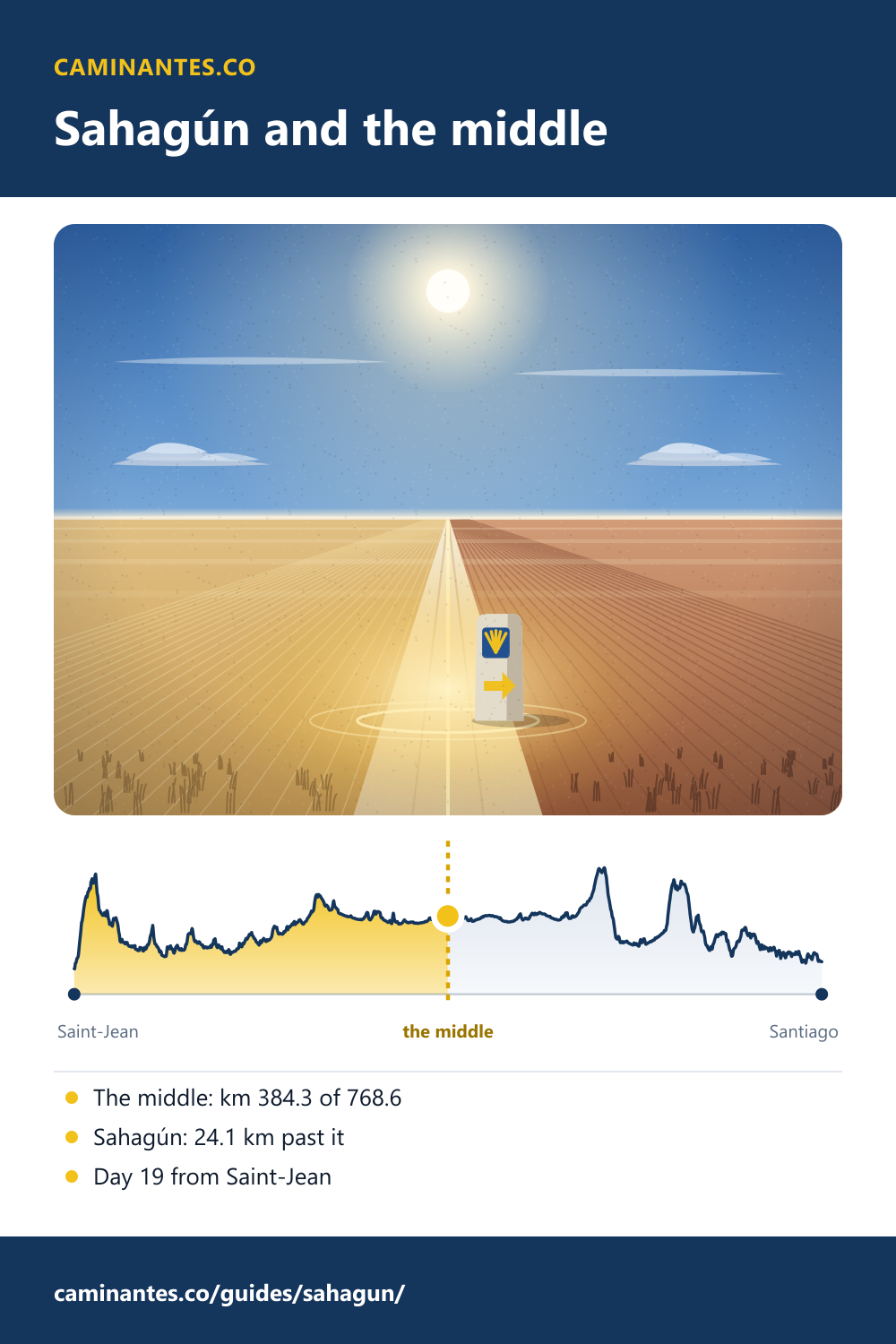
Sahagún calls itself the centre of the Camino Francés, and gives pilgrims a certificate for getting there. We measured it. Our track from Saint-Jean to Santiago is 768.6 km, so the middle is at km 384.3, out on the empty plain 1.1 km before Calzadilla de la Cueza. Sahagún comes 24.1 km later, at the end of day 19 on our plan.
Where the middle really is
Half of 768.6 km is 384.3 km. On our plan that point falls on day 18 of 36, the middle day too, 15.9 km into the day from Carrión de los Condes to Población de Arroyo. It is on the long straight track out of Carrión de los Condes: 17.1 km with no village, and the middle comes 1.1 km before the first one, Calzadilla de la Cueza. Nothing marks it. Sahagún is 24.1 km further on, at km 408.4: 53.1% of the way.
Some count the Camino from Roncesvalles, the end of the first day. Then the middle moves to km 397.3 from Saint-Jean, between Terradillos de los Templarios and Moratinos, and Sahagún is still 11.1 km past it. Either way the town is a little more than halfway, which is a good place to stop and look back.
The empty stretch the middle lies on, walked at your pace: Carrión de los Condes to Calzadilla.
The statues by the Ermita del Puente
2.8 km before the town the Camino passes the Ermita de la Virgen del Puente, a small brick hermitage by a bridge from the 12th century, once a chapel and a pilgrim hospital. It is the first building on the Camino in the province of León. Beside it stands a group of sculptures put up in 2013 and called “Sahagún, centro geográfico del Camino de Santiago”, the geographical centre of the Camino. On our track they are 21.4 km past the middle.
The Carta Peregrina, the halfway certificate
Sahagún gives pilgrims a certificate for reaching the middle of the Camino Francés, the Carta Peregrina. It began in 2013, the idea of the Iacobus pilgrims’ association, backed by the town council. The only place in town that gives it out is the Santuario de La Peregrina, the old Franciscan convent founded in 1257. Show your credencial, the pilgrim passport with your stamps.
Brick churches
Sahagún’s old churches are brick, in the Mudéjar style. San Tirso, from the 12th century, has a stone central apse, brick side apses and a square brick tower over the crossing, open in tiers of arches. San Lorenzo, from the 13th century, is brick from top to bottom; its tower, also in tiers of arches, is from the 14th. The Arco de San Benito, the baroque gateway of the old monastery, was built in 1662 in place of a ruined Romanesque portal.
Where it is on the walk
On our plan of 36 days from Saint-Jean, day 19 runs from Población de Arroyo to Sahagún: 17.6 km and 105 m of climbing. From Sahagún it is 360.2 km to Santiago, 17 more days. From Burgos it is day 6. The day before, day 18, is the one with the middle in it.
Know these words before your Camino. Spanish is preparation, the same as boots and stages. Try the free topic
Two days before, the canal locks and the Romanesque church: Frómista.
Earlier on the meseta: Castrojeriz and the climb to Mostelares.
The whole meseta, day by day: the Camino from Burgos.
The next city on the way: the Camino from León.
Every stage of the Francés, one by one: the stages guide.
Distances: our own track and stage plan of the Camino Francés, the same the stages and Burgos pages use. The churches, the arch, the Santuario and the Ermita: Spanish Wikipedia, Sahagún. The statues: Diario de León, 1 August 2013. The Carta Peregrina: Sahagún Digital, iLeón and caminodesantiagofrances.com.
Common questions
Is Sahagún the halfway point of the Camino Francés?
Close, but not quite. On our 768.6 km track from Saint-Jean the middle is at km 384.3, 1.1 km before Calzadilla de la Cueza. Sahagún is 24.1 km further on, at 53.1% of the way.
What is the Carta Peregrina, and where do I get it?
A certificate the town has given since 2013 for reaching the middle of the Camino Francés. You get it at the Santuario de La Peregrina in Sahagún, the only place that gives it out, by showing your credencial.
How far is Sahagún from Santiago?
360.2 km on our track of the Camino Francés, 17 more days on our stage plan.
Which day of the Camino Francés is Sahagún?
The end of day 19 of 36 from Saint-Jean on our plan, day 6 from Burgos. Day 19 runs from Población de Arroyo, 17.6 km.
Keep reading
Puente la Reina: over the Alto del Perdón to the queen’s bridge
Walk the first day out of Pamplona in five pictures: up past the iron pilgrims on the Perdón, down the stones, to the bridge built for pilgrims. 24.1 km.
Arzúa: two days left to Santiago
Santiago is 39.2 km away: 19.9 km to O Pedrouzo, then 19.3 km. Walk the countdown stop by stop, and pick out the town’s cheese.
Castrojeriz: the arch of San Antón and the climb to Mostelares
A morning of flat plain, a road under a ruined arch, a town under its castle, then a wall. Walk it stop by stop and watch the climb count up: day 16 from Saint-Jean.
Take it with you
Caminantes is free, works offline, and plans your stages around your own legs rather than a guidebook's.