Caminantes
Atapuerca: the oldest Europeans, and the cross above Burgos
By August Frederik Kramer · Last updated 24 October 2026
San Juan de Ortega. Dawn at the monastery in the clearing. San Juan de Ortega, born in 1080, spent his life building roads and bridges for pilgrims, and this church in the Montes de Oca was his.
Atapuerca. Atapuerca, 6.3 km on, past Agés. The bare back of the sierra rises behind the village, and in the field by the road a standing stone recalls a battle fought here in 1054.
Alto de Atapuerca. The Alto de Atapuerca, 8.6 km out and 1,070 m up: a wooden cross on a pile of stones, and Burgos far off on the plain. From here to the city the Camino only goes down.
Burgos. Burgos, 24.7 km from San Juan de Ortega. The two openwork spires of the cathedral, begun in 1221, stand over the old town.
24.7km from San Juan de Ortega
133m climbed
Walked: 24.7 km from San Juan de Ortega to Burgos, with 133 m of climbing. Day 13 of our plan ends here, 485.7 km from Santiago. Now dig down into the hill, below.
Download the poster (PNG)Free to print and share. Please keep caminantes.co on it.
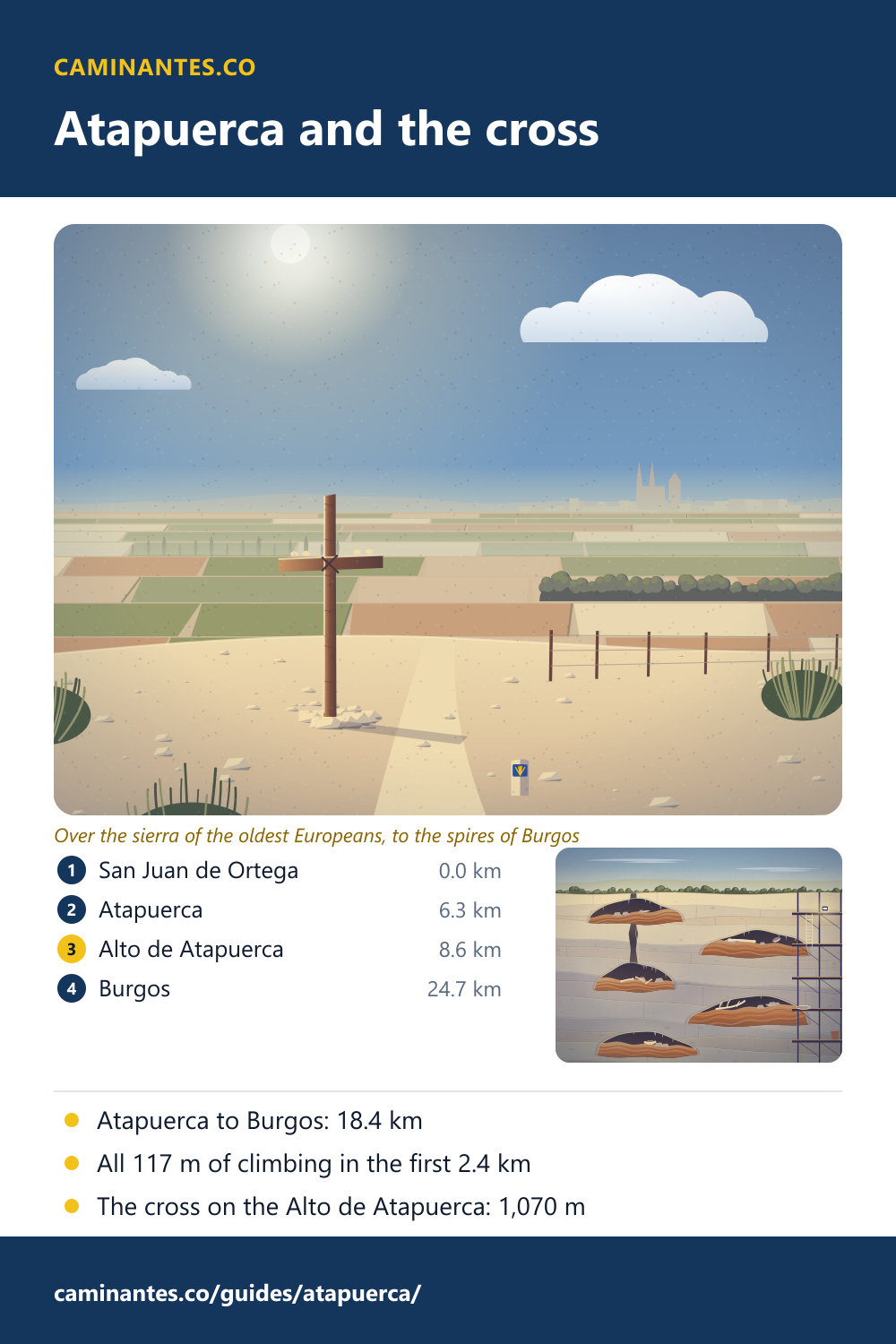
The Camino crosses the Sierra de Atapuerca on the day into Burgos. On our track that day is 18.4 km, and every one of its 117 m of climbing comes in the first 2.4 km, up a stony track to a wooden cross at 1,070 m. The other 16.0 km only go down. About 3.1 km away, in a railway cutting through the same hill, lies what UNESCO calls the earliest and most abundant evidence of humankind in Europe.
All the climbing in the first 2.4 km
On our plan of the Camino Francés, day 13 runs from Atapuerca to Burgos: 18.4 km, with 117 m up and 209 m down. The climbing is all at the start. Just out of the village the track turns up the sierra, stony and without shade, along the fence of an army training ground, to the wooden cross on the Alto de Atapuerca, 2.4 km out and 1,070 m high on our profile. By then you have done all 117 m of the day’s climbing. The last 16.0 km lose 209 m, down to the plain and into Burgos.
The oldest Europeans
0years ago, about
0times as long ago as Burgos cathedral was begun
The hill today. The dig sites lie in an old railway cutting through the Sierra de Atapuerca, about 3.1 km from the Camino as the crow flies. Dig down, one find at a time.
Cueva Fantasma. Flint scrapers and points left by Neanderthals, about 70,000 to 100,000 years ago.
Galería. Animal bones and stone tools in a cave about 300,000 years old.
Sima de los Huesos. The pit of bones: the remains of 28 people, about 430,000 years old. In 2016 their DNA showed they were early relatives of the Neanderthals.
Gran Dolina. A camp about 850,000 years old: deer and horse bones, stone tools and about 180 human fossils, of a species named Homo antecessor.
Sima del Elefante. A piece of a face between 1.1 and 1.4 million years old, the oldest human face found so far in western Europe.
The five are different caves, put in order of age here, not as they lie in the hill.
The caves of the Sierra de Atapuerca have been a UNESCO World Heritage Site since 2000. UNESCO calls them the earliest and most abundant evidence of humankind in Europe, with fossils from nearly a million years ago into the Common Era. In 2025 the excavators described a piece of a face from the Sima del Elefante, between 1.1 and 1.4 million years old, the oldest human face found so far in western Europe. At the Gran Dolina, a tooth of Homo antecessor was dated directly in 2018 to between 772,000 and 949,000 years. The sites are about 3.1 km from the Camino as the crow flies, and you can only see them on a guided visit, booked ahead, from Atapuerca or from Burgos.
Know these words before your Camino. Spanish is preparation, the same as boots and stages. Try the free topic
San Juan de Ortega and the light of the equinox
San Juan de Ortega was born in 1080 and spent his life helping pilgrims by building roads and bridges; the bridge over the river Vera between Agés and Atapuerca is his work. His church stands in a clearing in the woods of the Montes de Oca. Twice a year, at the spring and autumn equinoxes, around 21 March and 22 September, a ray of the late afternoon sun comes in through a window and slowly lights a Romanesque capital carved with the Annunciation.
Atapuerca and the battle of 1054
Atapuerca is a small village at the foot of the sierra and, on our plan, where day 12 ends: 18.2 km from Villafranca Montes de Oca, with 245 m of climbing. Just before it, a stone recalls the battle of Atapuerca, fought on 1 September 1054 between two brothers: Fernando I of León and García Sánchez III of Pamplona, called “of Nájera”, who died in it. He is the king of the falcon and the cave in the legend of Nájera.
The king who died here is the king of the falcon and the cave: Nájera and its legend.
The day in figures
On our plan of the Camino Francés this is day 13 of 36 from Saint-Jean: Atapuerca to Burgos, 18.4 km with 117 m of climbing and 209 m of descent. Burgos is 282.9 km from Saint-Jean and 485.7 km from Santiago, 23 days to go. The official way into the city runs past the airport and through 3.8 km of industrial estate; Gronze recommends the variant by Castañares, half a km longer and much more pleasant.
From Burgos on: the Camino from Burgos to Santiago, day by day.
Every stage of the Francés, one by one: the stages guide.
Distances, climbs and days are measured on our track of the Camino Francés, the same rows the Burgos page prints; the monastery, the cathedral and the dig sites are placed on that track from OpenStreetMap. The cross, the climb, the fence, the bridge over the Vera, the guided visits and the way into Burgos are from Gronze’s stage page. The sites’ listing and UNESCO’s words are from UNESCO; Cueva Fantasma, Galería and the Gran Dolina camp from the Museum of Human Evolution’s 2024 campaign report; the Sima de los Huesos from the Max Planck Society; the dated tooth from phys.org on Duval and colleagues; the face from the Sima del Elefante from Huguet and colleagues, Nature 2025. The light of the equinox is from Castilla y León’s tourism site and the Spanish Wikipedia on San Juan de Ortega, which also gives the saint’s life; the battle from the Spanish Wikipedia; the cathedral’s 1221 from UNESCO. Ages are rounded as their sources give them, and dates in deep time move as the dating improves.
Common questions
How far is it from Atapuerca to Burgos?
18.4 km on our track, with 117 m of climbing and 209 m of descent.
Is the climb out of Atapuerca hard?
It is short and stony: 117 m in the first 2.4 km, to the cross at 1,070 m. After that the day only goes down.
Can you visit the Atapuerca sites from the Camino?
Yes, on a guided visit booked ahead; visits leave from Atapuerca and from Burgos. The sites are about 3.1 km from the Camino as the crow flies.
How old are the Atapuerca fossils?
The oldest, a piece of a face from the Sima del Elefante, is between 1.1 and 1.4 million years old. The Homo antecessor camp at the Gran Dolina is about 850,000 years old, and the Sima de los Huesos about 430,000.
When does the light of the equinox fall in San Juan de Ortega?
At the spring and autumn equinoxes, around 21 March and 22 September, in the late afternoon, when a ray of sun lights the capital of the Annunciation.
Keep reading
What to see in Santiago de Compostela after you arrive
The old town is smaller than it looks: every stop here is within 899 m of Km 0 on foot. Pick 2, 4 or 6 hours and walk the squares, the market and the two views.
Camino de Santiago movies and books, on the real map
The Way, Kerkeling, Buen camino and a documentary all start in Saint-Jean. Pick one and watch its walk draw on our measured map, with the km, days and climb.
Two weeks on the Camino: where to start on every route
Pick the days you can walk and how far you like to walk in one, and see the furthest start on all seven routes into Santiago, with the km and the climbing, from our measured stages.
Take it with you
Caminantes is free, works offline, and plans your stages around your own legs rather than a guidebook's.