Caminantes
Nájera and the legend of the cave
By August Frederik Kramer · Last updated 22 October 2026
Logroño. First light. Logroño’s towers stand behind you across still water, and the vineyards start at the edge of town.
Navarrete. Navarrete, 12.2 km out, climbs its hill under a big church tower. Red earth and vine rows on every side; 192 m climbed so far.
Alto de San Antón. The top of the day, 21.1 km out: 373 of the day’s 376 m of climbing are done. La Rioja lies below you in squares of vines and stubble.
Nájera. The end of the day: 29.3 km. The red cliffs glow over the town, and at their foot stands the monastery built over the cave.
29.3km from Logroño
376m climbed
Day done: 29.3 km and 376 m of climbing to Nájera. Day 8 from Saint-Jean, 578.2 km left to Santiago. Now read the legend of the cave, below.
Download the poster (PNG)Free to print and share. Please keep caminantes.co on it.
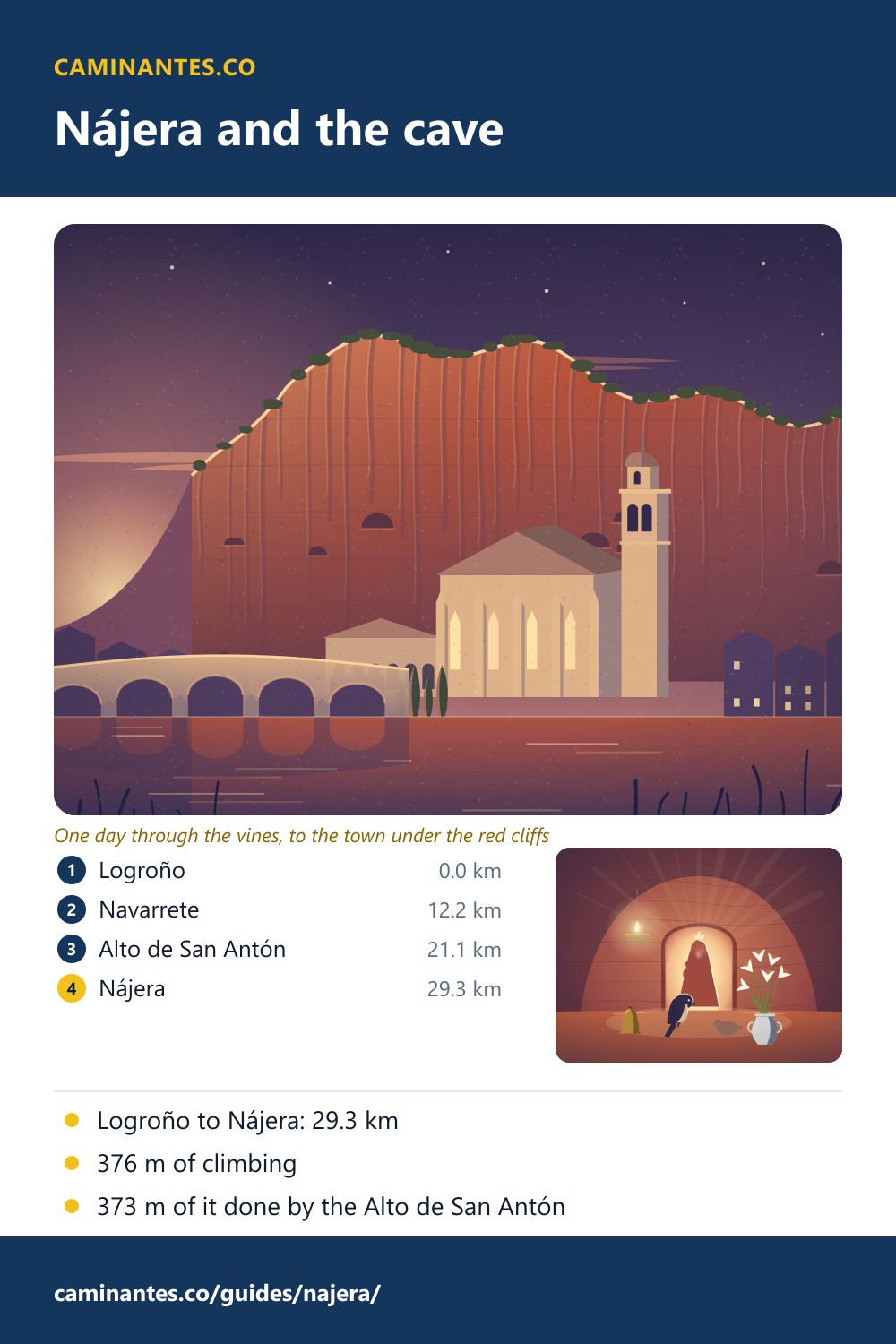
Nájera is where the long day out of Logroño ends: 29.3 km through the vineyards of La Rioja, with 376 m of climbing. Almost all of it, 373 m, is behind you at the Alto de San Antón, 21.1 km out; the last 8.2 km run down to the river Najerilla and a town under red cliffs, where a king once followed his falcon into a cave. 578.2 km to go.
All the climbing comes first
The day from Logroño is long, 29.3 km on our plan, but it is not steep. It rises gently through the vineyards past Navarrete and Ventosa to the Alto de San Antón, at 658 m on our profile, 21.1 km out. By then you have done 373 of the day’s 376 m of climbing, 99%. The last 8.2 km lose 171 m on the way down to Nájera, so the end of the day is easier than its length suggests.
The legend of the cave
The hunt. In 1044, the story goes, King García Sánchez III was out hunting. His falcon went after a partridge, and the partridge flew for the rock.
The cave. Both birds vanished into a cave at the foot of the cliff. The king climbed in after them, and light came from inside.
What the king found. In the cave stood an image of the Virgin, with a lit lamp, a bell and a jar of lilies. At its feet the falcon and the partridge sat side by side, heads bowed.
The monastery. The king built a church over the cave, consecrated in 1052. Today’s Gothic church of Santa María la Real stands on the spot, and the cave still opens beneath its choir.
Nájera’s monastery has a founding story. According to the legend, in 1044 King García Sánchez III of Pamplona was hunting when his falcon chased a partridge into a cave. Following them in, he found a small chapel in the rock with an image of the Virgin, a lamp, a bell and a jar of lilies, and the two birds at its feet, side by side. The king took it as a sign and founded a church over the cave. The jar of lilies became the emblem of the monastery, and García founded an order of knights named after it, the Order of the Jarra, or Terraza.
Santa María la Real
The first church was consecrated on 12 December 1052. The church you see today is later: Gothic, built between 1422 and 1453. Its choir stalls were carved between 1493 and 1495, and the cloister, built between 1517 and 1528, is called the Cloister of the Knights because so many nobles chose to be buried there. Under the choir opens the cave where the image is believed to have appeared, and where it has stayed since. The church also holds the royal pantheon of the kings of Nájera-Pamplona, with twelve tombs; the tomb of Doña Blanca of Navarre is a 12th-century Romanesque work.
Know these words before your Camino. Spanish is preparation, the same as boots and stages. Try the free topic
Nájera, between the rocks
Nájera stands on the river Najerilla, under a wall of red rock. Its Arabic name was Náxara, which some sources explain as “place between rocks”. After 923 it gave its name to a kingdom, the Kingdom of Nájera, and its kings were buried in the monastery. On the Camino, it is where most people sleep after the long day from Logroño, and the next morning the way climbs out past the cliffs toward Santo Domingo de la Calzada.
The day in figures
On our plan of the Camino Francés this is day 8 of 36 from Saint-Jean: Logroño to Nájera, 29.3 km with 376 m of climbing and 265 m of descent. Nájera is 190.4 km from Saint-Jean and 578.2 km from Santiago, 28 days to go. The next day runs to Santo Domingo de la Calzada, 21.7 km with 370 m of climbing.
Starting in the Rioja: the Camino from Logroño, day by day.
The next day ends at the chicken that crowed: Santo Domingo de la Calzada.
Every stage of the Francés, one by one: the stages guide.
Distances, climbs and days are measured on our track of the Camino Francés, the same rows the Logroño page prints; Navarrete, Ventosa, the Alto de San Antón and the monastery are placed on that track from OpenStreetMap. The legend’s king, year, cave and objects, the dates of the church, the stalls and the cloister, and the cave under the choir are from the Spanish Wikipedia on Santa María la Real; the partridge, and the two birds at the image’s feet, from Senditur’s page on the monastery; the twelve royal tombs, Doña Blanca’s, and the way into the cave from the church from Spain’s tourism site; the town, its name, the kingdom and the Order of the Jarra from the article on Nájera. The legend is a legend: no document records the hunt.
Common questions
How far is it from Logroño to Nájera?
29.3 km on our track, with 376 m of climbing and 265 m of descent. It is one of the longer days of the Francés, but not a steep one.
Where is the hardest part of the day?
The climb to the Alto de San Antón, 21.1 km out. By the top you have done 373 of the day’s 376 m of climbing; the last 8.2 km are mostly downhill.
What is the legend of Nájera?
In 1044, the story goes, King García Sánchez III followed his falcon, which was chasing a partridge, into a cave, and found an image of the Virgin with a lamp, a bell and a jar of lilies. He founded the monastery of Santa María la Real over the cave.
Can you see the cave?
Yes. The cave opens beneath the choir of the church of Santa María la Real, and visitors reach it from inside the church.
How far is Nájera from Santiago?
578.2 km on our track of the Camino Francés, 28 days on our stage plan.
Keep reading
Frómista: the four locks of the Canal de Castilla and San Martín
Walk the towpath along the Canal de Castilla, fill four locks and watch a barge climb, then reach one of Spain’s best-known Romanesque churches: day 17 from Saint-Jean.
Carrión de los Condes and the long road with no village
Out of Carrión the Camino Francés runs 17.1 km on the old Roman road with no village, the longest gap between two villages on the whole route. Pick your pace and walk it with the clock running.
Palas de Rei: the hardest day from Sarria, over the Sierra Ligonde
Walk the day from Portomarín in five pictures: past the hillfort, up to the highest point between Sarria and Santiago, down to Palas de Rei. 24.9 km.
Take it with you
Caminantes is free, works offline, and plans your stages around your own legs rather than a guidebook's.