Caminantes
Los Arcos to Viana: the octagon of Torres del Río
By August Frederik Kramer · Last updated 24 October 2026
Los Arcos. First light in the square. The tower of Santa María stands over the arcades, and the day ahead is 27.8 km.
Torres del Río. 7.8 km out, 59 m climbed. The church of the Santo Sepulcro has eight sides and a small lantern on top. Sansol sits across the ravine behind you.
The top of the day. The highest point of the day, 573 m, 11.3 km out. The climb out of Torres was the biggest of the day, 109 m. Ahead, the track drops into the ravines and climbs out again.
Viana. 18.3 km out, 271 m climbed. Under the great portal of Santa María, a plain white slab marks the grave of Cesare Borgia.
Logroño. The end of the day: 27.8 km and 342 m. The stone bridge over the Ebro takes you into Logroño, and out of Navarra into La Rioja.
27.8km from Los Arcos
342m climbed
Day done: 27.8 km and 342 m of climbing from Los Arcos to Logroño. Day 7 from Saint-Jean, 607.4 km left to Santiago. Now count the sides of the church at Torres del Río, below.
Download the poster (PNG)Free to print and share. Please keep caminantes.co on it.
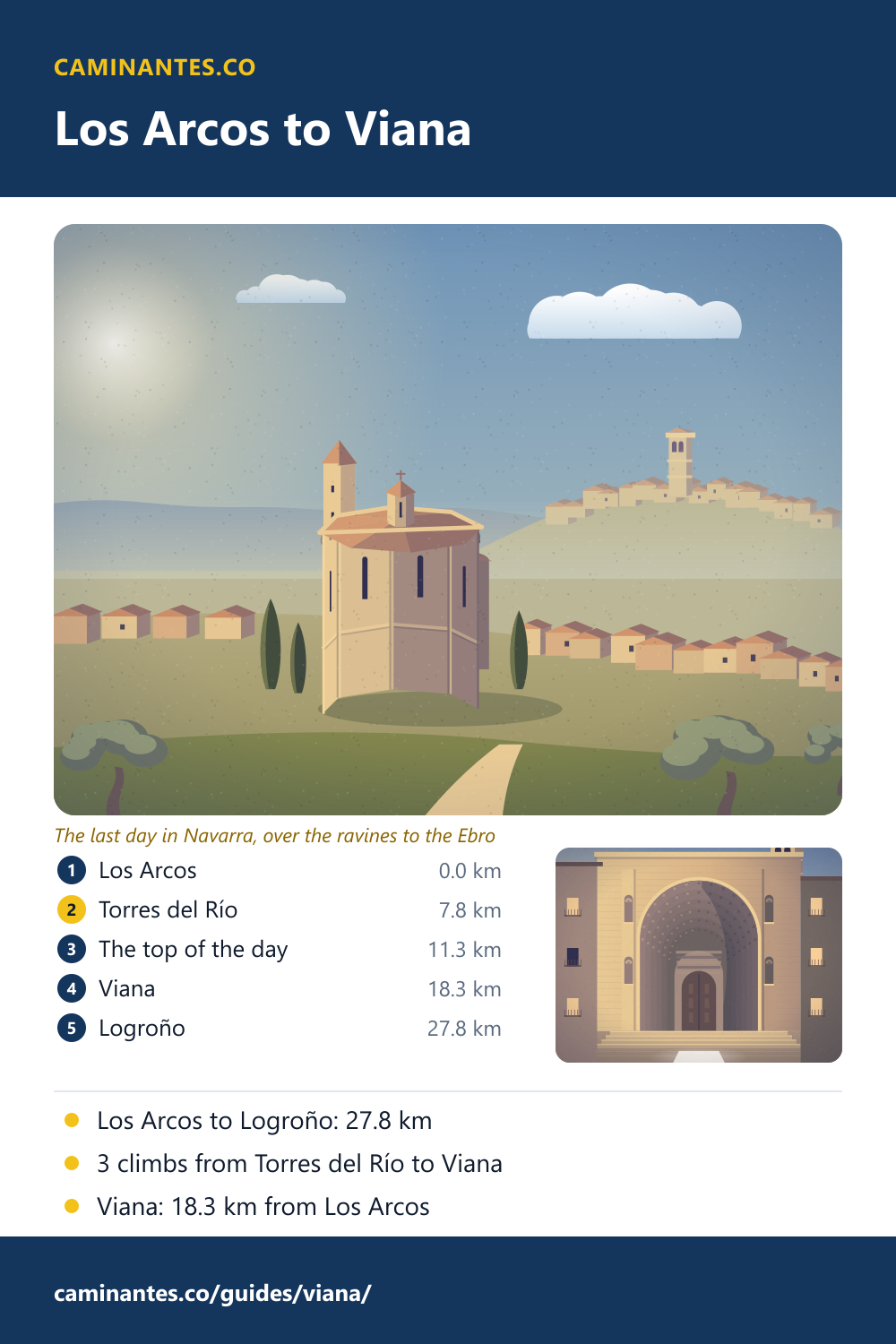
The last day in Navarra starts in Los Arcos and ends across the Ebro in Logroño: 27.8 km with 342 m of climbing on our track. At 7.8 km you reach Torres del Río and its eight-sided church. Then the way rolls over 3 climbs to Viana, 18.3 km out, where Cesare Borgia lies outside the church door. From Logroño, 607.4 km to go.
Up and down, counted
Guides call this stretch rolling. On our profile it is 10.5 km from Torres del Río to Viana, with 203 m up and 197 m down, in 3 separate climbs of more than 20 m. The first, out of Torres, is the biggest: 109 m, to the highest point of the day at 573 m. After Viana the last 9.5 km to Logroño are gentler: 69 m up and 169 m down.
The octagon of Torres del Río
Press the button and walk round the walls.
The church of the Santo Sepulcro is small, Romanesque, from the 12th century, and it has eight sides. Who built it is still argued over: the Templars, or the order of the Holy Sepulchre. Inside, eight ribs cross to make an eight-pointed star round a small octagon in the middle, a vault often compared with the domes of the mosque of Córdoba. The little lantern on the roof was added later. The church was declared a national monument in 1931.
Viana and Cesare Borgia
Viana is the last town in Navarra. Cesare Borgia, once captain general of the papal armies, came here in 1507 leading the army of Navarre for his brother-in-law, the king. On 12 March 1507, chasing riders out of the castle he was besieging, he was ambushed and killed outside the town. He was buried in the church of Santa María. Later his tomb was destroyed and his bones put under the street in front, to be walked on. Since 1953 they have lain under a white marble slab at the foot of the church’s portal, outside. A request to move them inside, made for the 500th anniversary of his death, was refused.
The day in figures
On our plan of the Camino Francés this is day 7 of 36 from Saint-Jean: Los Arcos to Logroño, 27.8 km with 342 m of climbing and 418 m of descent. Viana is not a stage end on our plan, but it splits the day in two: 18.3 km to Viana, then 9.5 km to Logroño. The day before, Estella to Los Arcos, is 20.5 km with 339 m of climbing. Logroño is 161.2 km from Saint-Jean and 607.4 km from Santiago.
Know these words before your Camino. Spanish is preparation, the same as boots and stages. Try the free topic
The day before, in pictures: Puente la Reina to Estella and the wine fountain.
Starting in the Rioja: the Camino from Logroño, day by day.
Every stage of the Francés, one by one: the stages guide.
Distances, climbs and days are measured on our track of the Camino Francés, the same rows the Estella and Logroño pages print. The villages and the two churches are placed on that track from OpenStreetMap, and a climb counts when the way rises more than 20 m before it drops 20 m again. The church at Torres del Río, its century, its builders, its vault, its lantern and 1931 are from the Spanish Wikipedia on the Santo Sepulcro. Cesare Borgia’s death, burial and grave are from the Spanish and English Wikipedia articles on him, and the bridge into Logroño from the article on the Puente de Piedra.
Common questions
How far is it from Los Arcos to Logroño?
27.8 km on our track, with 342 m of climbing and 418 m of descent. Viana is 18.3 km out.
How far is it from Los Arcos to Viana?
18.3 km, with 271 m of climbing. Torres del Río and its octagonal church are at 7.8 km.
Is the stage from Los Arcos hard?
It is long rather than steep. Between Torres del Río and Viana the way climbs 3 times, 203 m in all, and comes down as much again. The biggest climb, out of Torres, is 109 m.
Where is Cesare Borgia buried?
In Viana, under a white marble slab outside the church of Santa María, at the foot of its portal. He was killed near Viana in 1507.
Why is the church at Torres del Río eight-sided?
Nobody knows for sure. Round and eight-sided churches often recall the church of the Holy Sepulchre in Jerusalem, and this one is named after it. Whether the Templars or the order of the Holy Sepulchre built it is still argued over.
Keep reading
Montes de Oca: the forest climb to San Juan de Ortega
Walk Villafranca Montes de Oca to San Juan de Ortega in five pictures: the steep climb into the oaks, the memorial at La Pedraja, the firebreak through the pines. 11.9 km with no village.
Atapuerca: the oldest Europeans, and the cross above Burgos
Walk from San Juan de Ortega over the stony sierra to the cross above Burgos, then dig down through the caves of the oldest Europeans, one find at a time. Atapuerca to Burgos: 18.4 km.
What to see in Santiago de Compostela after you arrive
The old town is smaller than it looks: every stop here is within 899 m of Km 0 on foot. Pick 2, 4 or 6 hours and walk the squares, the market and the two views.
Take it with you
Caminantes is free, works offline, and plans your stages around your own legs rather than a guidebook's.