Caminantes
Hospital de Órbigo: the long bridge, the jousting knight and the way to Astorga
By August Frederik Kramer · Last updated 13 October 2026
0m crossed
300m to go
The León end of the bridge, in Puente de Órbigo. 300 m of stone ahead.
You crossed it. 300 m of bridge, and the river took about 20 m of them. The rest of the arches stand over the floor of the valley and a mill channel.
Tap the button to walk to the next stop. In the middle, break a lance.
- The León end0 m
- The river Órbigo20 m
- The Paso Honroso150 m
- The mill channel291 m
- Hospital de Órbigo300 m
Download the poster (PNG)Free to print and share. Please keep caminantes.co on it.
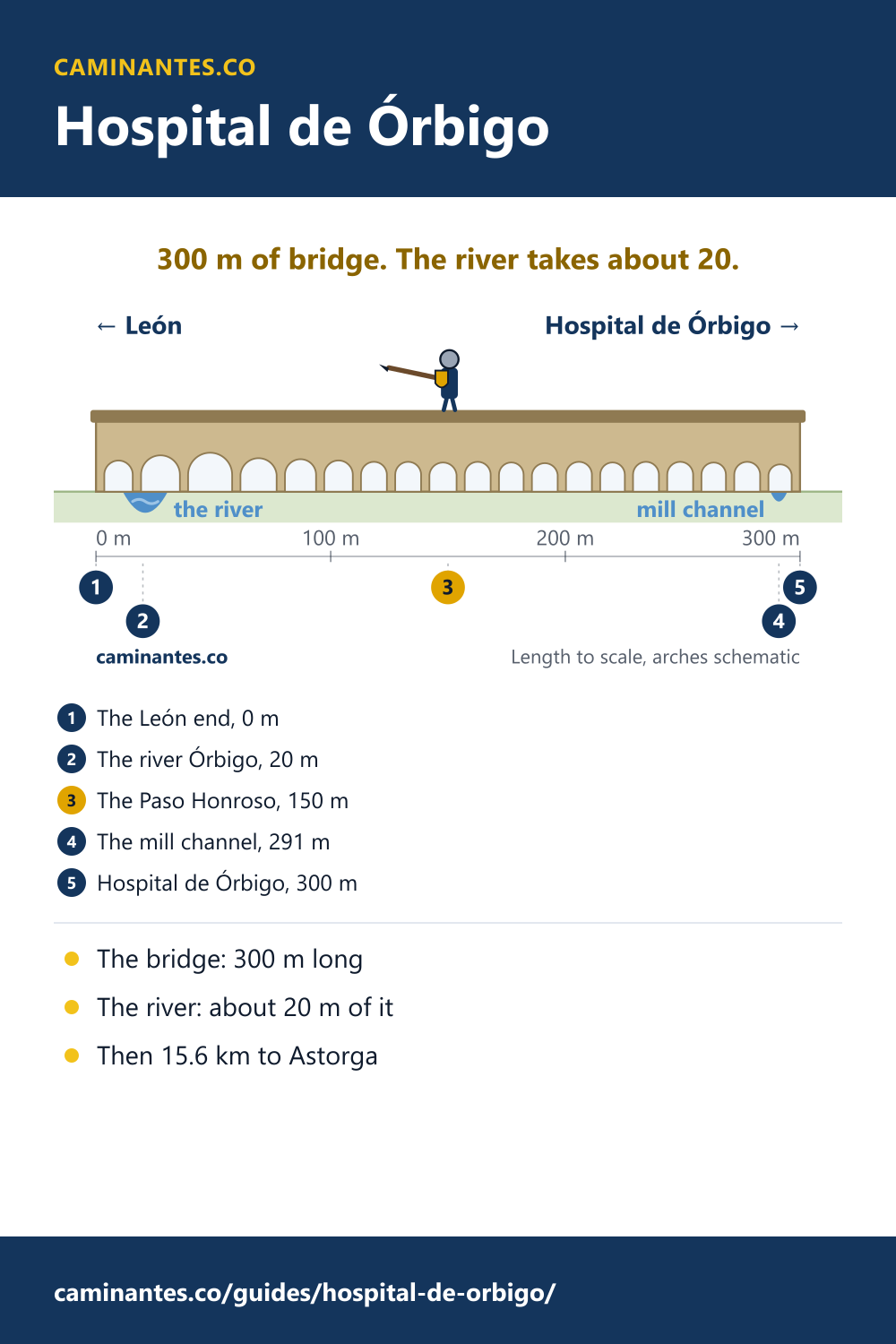
The bridge at Hospital de Órbigo is one of the longest medieval bridges on the Camino: on the map it measures 300 m. The river Órbigo passes under it about 20 m from the León end, and the other 280 m cross the flat floor of the valley. You reach it 32.0 km out of León, on day 2 of the walk from there, with 15.6 km left to Astorga.
The bridge
The Puente de Órbigo, also called the bridge of the Paso Honroso, was built in the 13th century, and it still carries the Camino Francés into Hospital de Órbigo. The counts of its arches differ, 19 in one source and 20 in another, and so do the lengths; on OpenStreetMap we measure 300 m. The town is named after the pilgrims’ hospital the Knights Hospitaller kept here. In the war against Napoleon the townspeople broke their own bridge to slow the French army; it has been mended since.
So much bridge for so little river
On the map the river’s line crosses the bridge about 20 m from the León end, and a mill channel crosses it 9 m before the Hospital end. Everything in between, 280 m of arches, stands over the flat floor of the valley. The bridge spans the whole valley floor, not just the water you see on a dry summer day.
The Paso Honroso: a month of jousts in 1434
In the summer of 1434 the León knight Suero de Quiñones, with the leave of King Juan II of Castile, held this bridge with his companions against every knight who wanted to cross. It lasted from 10 July to 9 August, with a day off on 25 July, the feast of Santiago. Every Thursday he had worn an iron collar as a token of his love for Doña Leonor de Tovar, and he vowed to be free of it once 300 lances were broken, three for each knight, and he had walked to Santiago.
One knight died, the Catalan Asbert de Claramunt, struck in the eye by a lance. The royal notary Pero Rodríguez de Lena wrote it all down. Then Suero and his companions walked to Santiago. The gold collar he left there is kept in the Apostle’s reliquary in the cathedral, and the blue ribbon that went with it hangs on an image of Santiago Menor in the relic chapel.
What pilgrims do when they reach the cathedral: the Cathedral of Santiago, step by step.
The jousts today
Since 1997 Hospital de Órbigo has held the Justas Medievales del Paso Honroso on the first weekend of June, a weekend of knights and jousting that ends with the great tournament on the Sunday afternoon. If you walk through that weekend, expect the town to be full, and book a bed ahead.
Know these words before your Camino. Spanish is preparation, the same as boots and stages. Try the free topic
Where it is on the walk
On our plan from León the bridge comes on day 2, Villadangos del Páramo to Astorga, 27.6 km. You reach it 11.8 km into the day and 32.0 km from León. Hospital de Órbigo, at its far end, leaves 15.6 km to Astorga and 272.3 km to Santiago, and it is a good place to break this long day in two.
The whole fortnight from León, day by day: León to Santiago. Starting in Astorga instead: the Camino from Astorga.
Two ways on to Astorga
Just past Hospital de Órbigo the Camino splits. Our measured line takes the direct way beside the N-120 road. The other way turns right through Villares de Órbigo and Santibáñez de Valdeiglesias, among fields and small villages; Gronze puts it about 1.2 km longer and calls it clearly the better choice. Both come down through San Justo de la Vega, 3.8 km before Astorga.
Every stage of the Francés, one by one: the stages guide.
The bridge’s length, and where the river and the mill channel cross it, are measured on OpenStreetMap (read on 13 October 2026); a river’s line on a map is its middle, not its banks, hence “about”. Distances along the Camino are on our track of the Camino Francés. The century, one count of arches and the two ways to Astorga are from Gronze and its stage notes; the other count from the Diario de León; the Paso Honroso from the Spanish Wikipedia; the hospital and the war against Napoleon from the English Wikipedia.
Common questions
How long is the bridge at Hospital de Órbigo?
300 m on OpenStreetMap. Other sources give about 300 m or 310 m, with 19 or 20 arches.
Why is the bridge so long?
It spans the whole flat floor of the Órbigo valley. On the map the river passes under it about 20 m from the León end; the rest stands over dry ground and a mill channel.
What is the Paso Honroso?
A month of jousts in 1434: the knight Suero de Quiñones and his companions held the bridge against every knight who wanted to cross, then walked to Santiago.
How far is Hospital de Órbigo from Astorga?
15.6 km on our track, by the direct way. The quieter way through Villares de Órbigo and Santibáñez de Valdeiglesias is about 1.2 km longer.
When are the medieval jousts in Hospital de Órbigo?
On the first weekend of June, every year since 1997, ending with the great tournament on the Sunday afternoon.
Keep reading
The Camino from Pamplona: 33 days to Santiago, the Pyrenees already behind you
Day one climbs to the metal pilgrims of the Alto del Perdón. 701.1 km in all, and leaving out the first 3 days saves 9% of the walking but 17% of the climbing.
Santiago Cathedral: what to do when you arrive, in 8 steps
Km 0, the free door in, the hug, the tomb and the Compostela, on a plan you can walk. And this autumn the Pilgrim’s Mass is moving to San Agustín.
The Cruz de Ferro is not the top of the Camino
Leave your stone at 1,494 m, then keep climbing: the Camino Francés tops out at 1,505 m, 5.5 km later. Walk it from Astorga to Molinaseca.
Take it with you
Caminantes is free, works offline, and plans your stages around your own legs rather than a guidebook's.