Caminantes
The Camino shell and the yellow arrow: what they mean and which way they point
By August Frederik Kramer · Last updated 23 October 2026
A village corner. The answer: Right. The yellow arrow points the way to Santiago, wherever it is painted: on a wall, a kerb, a tree or a lamp post.
A Galician bollard. The answer: Left, with the arrow. In Galicia the stone bollards carry the shell on a blue tile, an arrow and a plate with the distance to Santiago. When the shell and the arrow seem to disagree, follow the arrow.
A shell on a house. The answer: You can’t tell. A shell on its own says you are on the Camino, not where to turn. Which way its rays point depends on the region and on whoever set the tile, and the sources disagree. Walk on to the next arrow.
A fork in the woods. The answer: Straight on. An arrow pointing up means keep going ahead, even where a wider track turns off.
Two arrows. The answer: Left, after the yellow one. Arrows in other colours, or on boards that sell something, are not the Camino’s. When in doubt, follow the yellow paint.
The rule that never lets you down: the arrow shows the way; the shell shows you are on the Camino.
Download the poster (PNG)Free to print and share. Please keep caminantes.co on it.
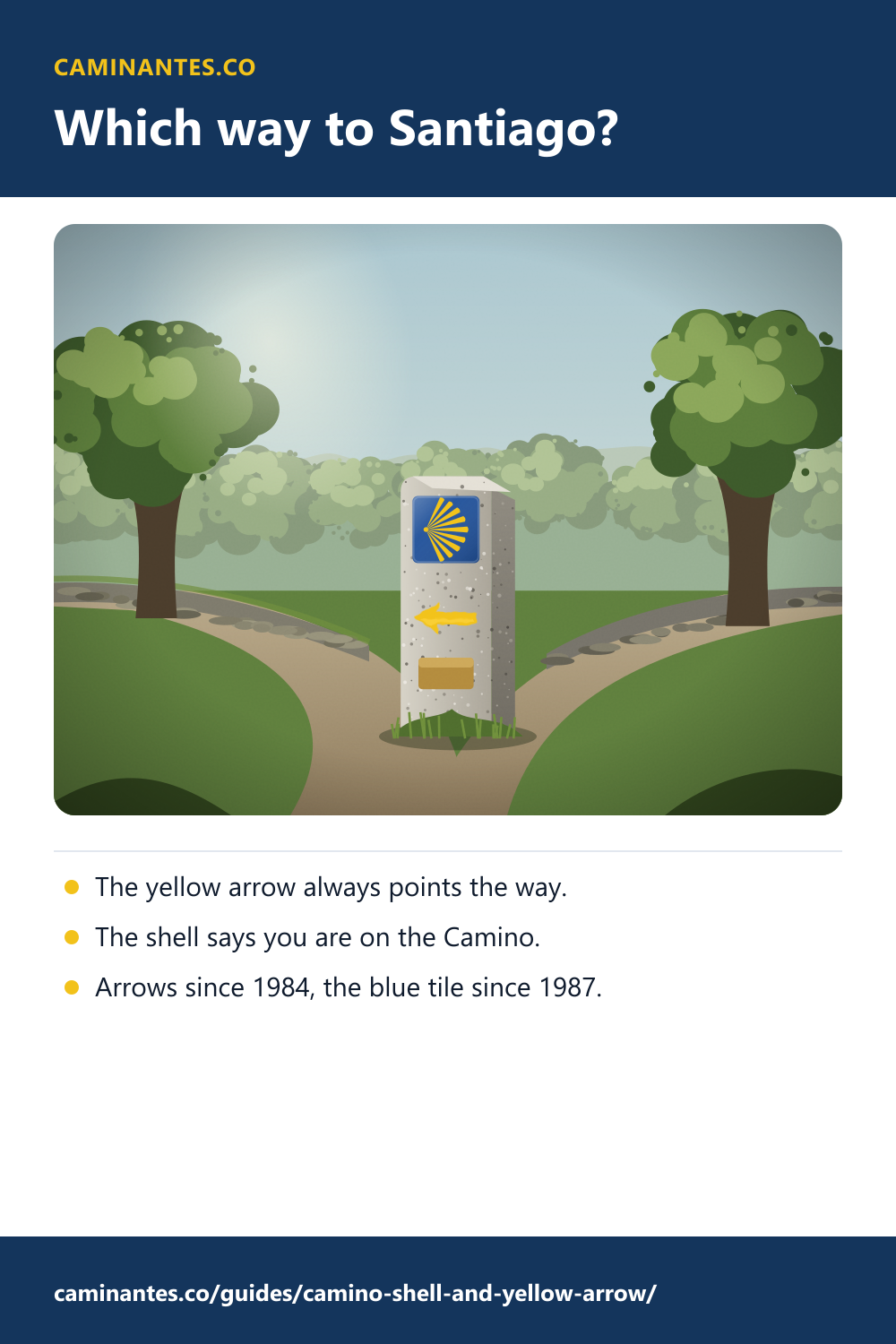
Two signs take you all the way to Santiago. The scallop shell has marked pilgrims since the Middle Ages and tells you that you are on the Camino. The yellow arrow dates from the 1980s and tells you where to turn. Only one of them works as a compass, and it is not the famous one.
Why a scallop shell?
The scallop, vieira in Galician and Spanish, is the shell of the Galician coast, and medieval pilgrims carried one home as proof that they had reached Santiago. The Codex Calixtinus, the 12th century book of the pilgrimage, already mentions it, and the oldest known image of it as the pilgrims’ badge, a carving at Santa Marta de Tera in Zamora, is from about 1125. Shells could only be sold in Santiago, and the street where the sellers worked, where the Camino Francés enters the city, is still called Os Concheiros. It was useful too: you could drink from it.
- about 1125the oldest known image of the pilgrims’ shell, at Santa Marta de Tera
- 12th centurythe Codex Calixtinus mentions the shell
- 1984Elías Valiña marks the Camino Francés with yellow arrows
- 1987the Council of Europe’s yellow shell on blue
The legend of the rider
A legend tells it differently. As the boat carrying the body of Saint James came in to the Galician shore, a wedding was taking place on the beach. The groom’s horse took fright and plunged into the sea with him, and horse and rider came out of the water alive, covered in scallop shells.
Who painted the yellow arrows?
Elías Valiña (1929 to 1989), the parish priest of O Cebreiro. In 1984, the Galician government says, he marked the whole Camino Francés himself, from Roncesvalles to Santiago, with yellow paint left over from painting signs on the N-VI road. The colour was chance, not a plan. Some accounts date his first arrows earlier, to 1980. Valiña also directed a pilgrim’s guide for Spain’s tourism office in 1982 and helped found most of the Spanish Camino associations, whose volunteers still repaint the arrows. The other routes took up his arrows, which is why you now follow them all over Spain and Portugal.
The blue tile with the yellow shell
In 1987 the Council of Europe made the pilgrim routes to Santiago its first European Cultural Route and gave them an official sign: a stylised yellow scallop shell on a blue ground. Its lines meet at one point, like the routes from all over Europe meeting in Santiago. That is the shell on the tiles and bollards you walk past today.
Which way does the shell point?
There is no single rule. Some guides say the wide end of the shell shows the way in Galicia and the narrow end everywhere else; others read it the other way round. A specialist guide says the placement varies by region and advises not to steer by the shell at all, only to take it as proof that you are still on the route. We found no official rule that settles it. The yellow arrow has no such problem: it always points towards Santiago.
Know these words before your Camino. Spanish is preparation, the same as boots and stages. Try the free topic
The Galician bollards
In Galicia the waymarks become granite bollards, mojones: the shell on a blue tile, a yellow arrow and a plate with the distance left to Santiago. On the bollard, read the arrow.
Wearing the shell
Medieval pilgrims brought a shell home at the end. Today many tie one to their rucksack on the first day. It marks you as a pilgrim, which is what it has always done.
The shell says you are a pilgrim; the credencial proves it, one stamp at a time.
The bollards count down the last 100 km.
Valiña’s church still stands at the top of the climb into Galicia: O Cebreiro.
The other thing you will meet at every junction is a greeting: what Buen Camino means.
And the medieval one: what Ultreia means.
The shell, the Codex, Os Concheiros, the arrows of 1984 and the N-VI paint: Xunta de Galicia. The shell as souvenir and the volunteer painters: Spanish Federation of Associations of Friends of the Way. The sign of 1987: Council of Europe. Santa Marta de Tera: Spanish Wikipedia, Camino de Santiago. Valiña’s dates and guide: Spanish Wikipedia, Elías Valiña. The legend: English Wikipedia. The bollards and the shell’s placement: Viaje Camino de Santiago.
Common questions
What does the scallop shell on the Camino mean?
It is the pilgrims’ badge. Medieval pilgrims brought a Galician scallop home as proof that they had reached Santiago, and the Codex Calixtinus mentions it in the 12th century. Today it marks the route and the people walking it.
Who painted the yellow arrows?
Elías Valiña, the parish priest of O Cebreiro. According to the Galician government he marked the whole Camino Francés in 1984, with paint left over from road signs.
Which way does the shell point?
There is no single rule: sources disagree, and it varies by region. Steer by the yellow arrow, which always points towards Santiago, and take the shell as proof that you are on the route.
What is on a Galician waymark?
A granite bollard with the shell on a blue tile, a yellow arrow and a plate with the distance left to Santiago.
Keep reading
What is the Camino de Santiago? Twelve centuries, measured
What the Camino is, why people walk it, and its whole history in ten pictures you scrub through, from a tomb in the woods to the next Holy Year. Then: history or legend?
O Pedrouzo: your last morning to Santiago, timed
Pick when you set off and how fast you walk, and watch the last 19.3 km from O Pedrouzo to the cathedral, timed: past the airport and over Monte do Gozo.
Nájera: the long day from Logroño, and the legend of the cave
Walk Logroño to Nájera in four pictures, with nearly all the climbing done by the Alto de San Antón, then follow the falcon into the cave under the red cliffs. 29.3 km.
Take it with you
Caminantes is free, works offline, and plans your stages around your own legs rather than a guidebook's.