Caminantes
What is the Camino de Santiago? Twelve centuries, measured
By August Frederik Kramer · Last updated 23 October 2026
9th centuryLegend
A tomb in the woods.
951History
The first pilgrim on record.
c. 1140History
The first guidebook.
1589History
The relics disappear.
1879History
Found again.
1984History
The yellow arrows.
1987History
Europe’s first Cultural Route.
1993History
World Heritage.
530,722 in 2025Tap a bar
Holy Year
2004 to 2026History
The boom, counted.
2027History
The next Holy Year.
Compostelas a year, 2004 to 2026. Gold: Holy Years. 2026 is the year so far.
Download the posterPNG, 1000 × 1500
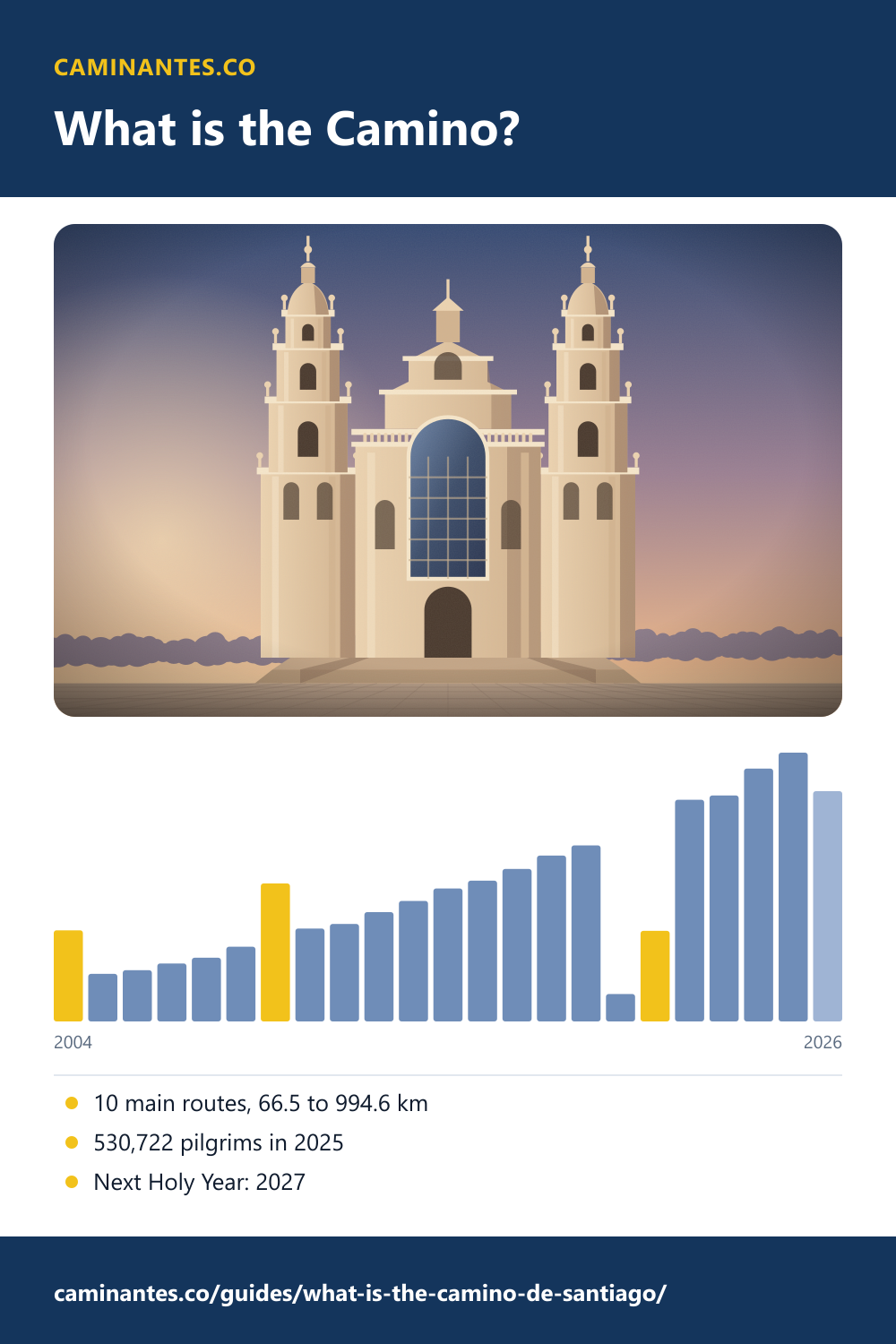
The Camino de Santiago, the Way of Saint James, is a pilgrimage on foot to the cathedral of Santiago de Compostela in Galicia, where tradition places the tomb of the apostle James. It is not one path but a family of routes. We measured the ten main ones: from 66.5 km to 994.6 km, and the Camino Francés, the one most people mean, is 768.6 km. In 2025, 530,722 people finished it and asked for their certificate.
What the Camino is
A pilgrimage, first of all: a walk to a holy place. The holy place is the cathedral of Santiago de Compostela, and the walk can start anywhere. Most people walk, some cycle, a few ride. You carry a pilgrim passport and collect stamps on the way, sleep in pilgrim hostels or anywhere else, and if you walk at least the last 100 km, the Pilgrim’s Office gives you the Compostela, a certificate in Latin.
There are many routes and ten main ones. We measured all ten on their GPS tracks: the shortest, the Camino Lebaniego, is 66.5 km; the longest, the Vía de la Plata, is 994.6 km. The Camino Francés is 768.6 km in 36 stages. How long each one is and which one to pick have their own pages.
Why people walk it
The Pilgrim’s Office asks everyone. In 2025, 43.9% said they walked for religious reasons, 31.9% for religious and other reasons, and 18.4% for no religious reason at all; the rest did not say. So faith is part of it for 75.8%, and for the others it is the walk itself. They came from 171 countries. How many walk, and from where, year by year.
Where it starts and where it ends
Every route ends in the same square, in front of the cathedral. Where you start is up to you: from your door, from the Pyrenees, or from 100 km out, the shortest walk that earns the Compostela. 45.6% of last year’s pilgrims came in on the Camino Francés. Where the Camino starts has every starting point, measured.
The history in brief
In the 9th century a tomb in Galicia was declared the apostle James’s, and a church was built over it. Pilgrims came from across Europe; by the 12th century the Codex Calixtinus was guiding them. From the 16th century the flow shrank, and in 1589 the relics were hidden and lost for 290 years. The revival came late: yellow arrows in 1984, Europe’s first Cultural Route in 1987, World Heritage in 1993. Since then the numbers have only climbed, apart from the pandemic.
- 9th century: A tomb in the woods. Tradition says a hermit called Pelayo saw lights over a wood in Galicia, and Bishop Theodemir of Iria Flavia declared the tomb found there to be the apostle James’s. King Alfonso II of Asturias had a church built over it. How the body got there is legend too: a boat from Jerusalem, landing at Padrón.Legend
- 951: The first pilgrim on record. Godescalc, bishop of Le Puy in France, crosses the Pyrenees to Santiago in 950 or 951. He is the first pilgrim from beyond the mountains anyone wrote down, 1,075 years ago.
- c. 1140: The first guidebook. The Codex Calixtinus is put together, most likely between 1138 and 1145. Its fifth book is a guide for pilgrims: the stages, the rivers safe to drink from, the shrines on the way. It is usually credited to a French cleric, Aymeric Picaud.
- 1589: The relics disappear. With Francis Drake’s fleet attacking A Coruña, the archbishop has the relics hidden, so well that nobody can find them again. The pilgrimage is already shrinking: the Reformation and Europe’s wars have cut the flow from the north.
- 1879: Found again. Digging behind the altar in January 1879 turns up bones, 290 years after they were hidden. In 1884 Pope Leo XIII declares them the apostle’s in the bull Deus Omnipotens. Science has never confirmed whose they are.
- 1984: The yellow arrows. Elías Valiña, the parish priest of O Cebreiro, paints yellow arrows along the Camino Francés, by most accounts with paint left over from road works. Lost pilgrims have followed them ever since.
- 1987: Europe’s first Cultural Route. On 23 October 1987, in the Santiago Declaration, the Council of Europe names the pilgrim routes to Santiago its first European Cultural Route. The blue tile with the yellow shell comes out of that.
- 1993: World Heritage. UNESCO lists the Camino Francés as World Heritage in 1993, the routes through France in 1998, and the northern routes in Spain, the Primitivo and the Norte among them, in 2015.
- 2004 to 2026: The boom, counted. The Pilgrim’s Office counts everyone who asks for the Compostela: 179,891 in 2004, 530,722 in 2025, 3.0 times as many. The gold bars are Holy Years. The one deep dip is 2020, the pandemic.
- 2027: The next Holy Year. 2027 is a Holy Year, because 25 July, Saint James’s day, falls on a Sunday. The Holy Door opens on the evening of 31 December 2026. After that, the next are 2032 and 2038.
History or legend?
A hermit saw lights over a wood, and the apostle’s tomb was found there.
Legend. It is the tradition, written down long after. Whose tomb it was has never been proven.
The yellow arrows were first painted by a parish priest, in the 1980s.
History. Elías Valiña of O Cebreiro started painting them in 1984.
The relics in the cathedral were lost for 290 years.
History. Hidden in 1589, found again in 1879.
The Holy Years
A year in which 25 July falls on a Sunday is a Holy Year, a Xacobeo, and the cathedral’s Holy Door stands open all year. The next is 2027, then 2032 and 2038. Holy Years are the gold bars in the chart: each one a jump. Holy Year 2027 has what changes for beds and crowds.
What the name means
What Camino de Santiago and Compostela mean, and the field of stars story, has its own page.
Sources: the measured routes and the pilgrim figures are ours and the Pilgrim’s Office’s. The history: Saint James and the tradition, Godescalc, the Codex Calixtinus, Elías Valiña, the Council of Europe, UNESCO. Legend is marked as legend.
Common questions
What is the Camino de Santiago?
A pilgrimage to the cathedral of Santiago de Compostela in Galicia, Spain, where tradition places the tomb of the apostle James. It is a family of routes, not one path; 530,722 people finished one in 2025.
How long is the Camino de Santiago?
It depends on the route. The Camino Francés, the most walked, is 768.6 km. Across the ten main routes it runs from 66.5 km to 994.6 km.
Why do people walk the Camino?
In 2025, 43.9% of pilgrims told the Pilgrim’s Office they walked for religious reasons, 31.9% for religious and other reasons, and 18.4% for no religious reason.
How old is the Camino de Santiago?
The tomb was declared the apostle’s in the 9th century, and the first pilgrim from beyond the Pyrenees on record walked in 950 or 951, 1,075 years ago.
Keep reading
O Pedrouzo: your last morning to Santiago, timed
Pick when you set off and how fast you walk, and watch the last 19.3 km from O Pedrouzo to the cathedral, timed: past the airport and over Monte do Gozo.
Nájera: the long day from Logroño, and the legend of the cave
Walk Logroño to Nájera in four pictures, with nearly all the climbing done by the Alto de San Antón, then follow the falcon into the cave under the red cliffs. 29.3 km.
Frómista: the four locks of the Canal de Castilla and San Martín
Walk the towpath along the Canal de Castilla, fill four locks and watch a barge climb, then reach one of Spain’s best-known Romanesque churches: day 17 from Saint-Jean.
Take it with you
Caminantes is free, works offline, and plans your stages around your own legs rather than a guidebook's.